Central Vietnam · Food
Mi Quang (Mì Quảng): What to Order and Where in Da Nang
Mi Quang explained: which version to order, how to eat it, 2026 prices, three MICHELIN-listed Da Nang shops and how it differs from cao lau and pho.
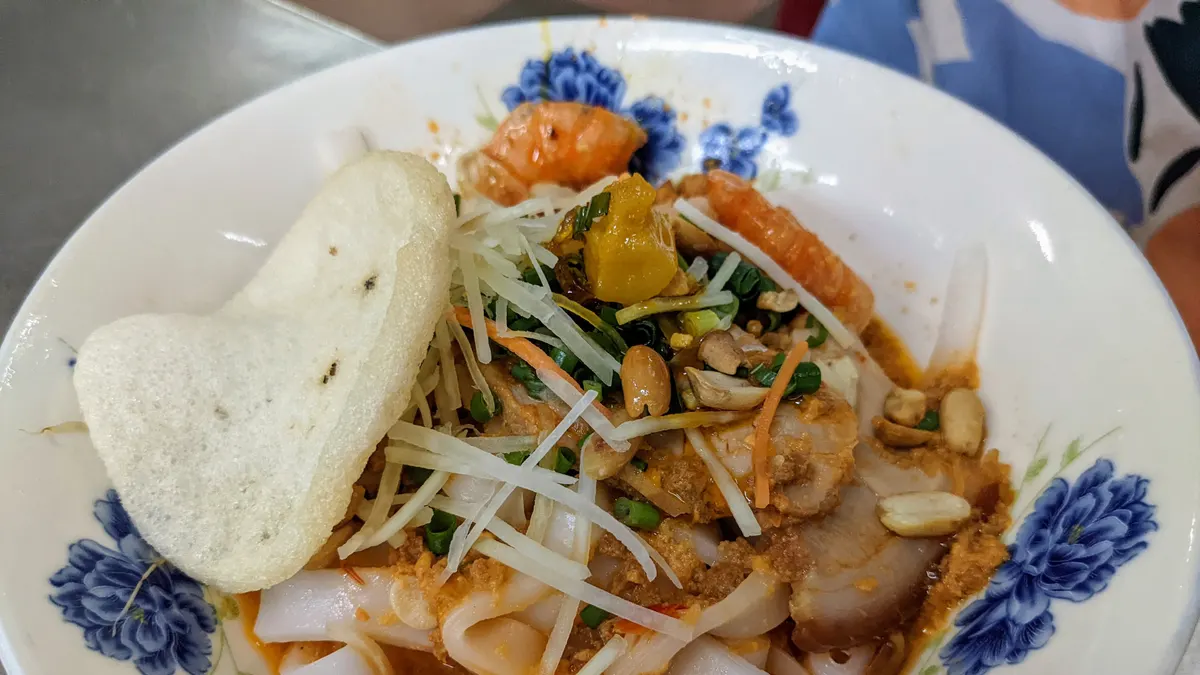
Order mi Quang expecting rice noodles dressed with a spoonful or two of rich broth rather than a soup: the classic topping is pork and shrimp with quail egg, and a “special” bowl lets you try several at once. A bowl cost about 40,000 dong at a Da Nang restaurant chain when VnExpress checked in June 2026, and as of November 2026 three mi Quang shops in Da Nang are in the MICHELIN Guide’s 2026 Vietnam selection, one of them a Bib Gourmand.
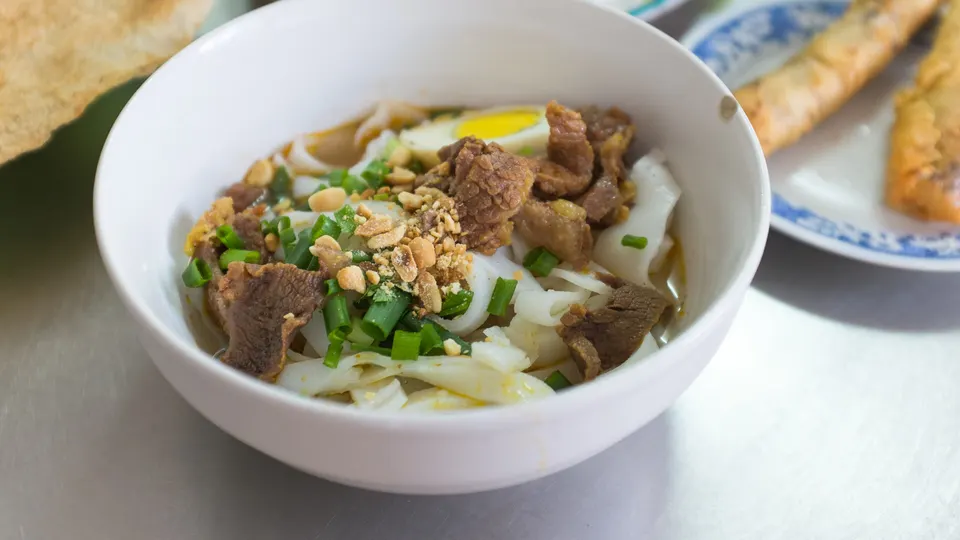
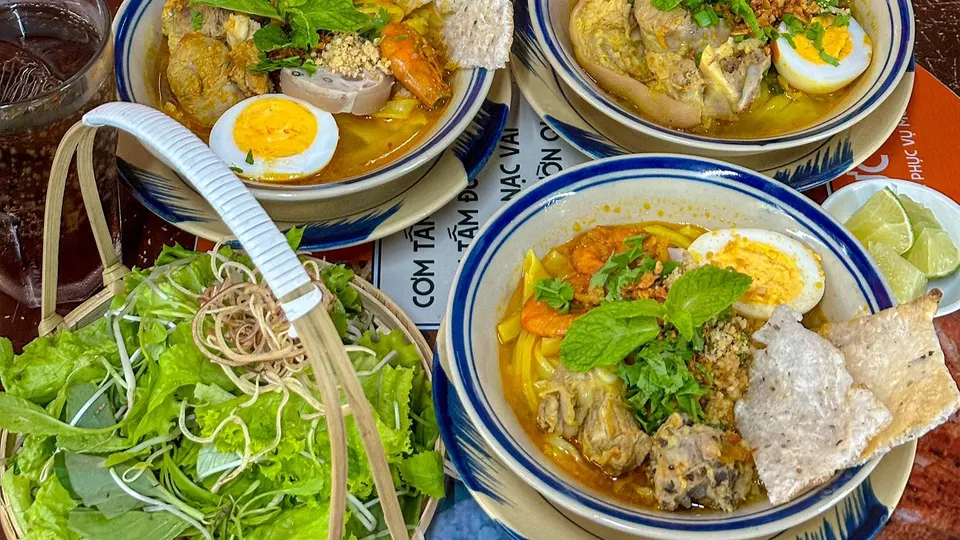
Mi Quang (Mì Quảng) (also written my Quang (mỳ Quảng), and often “mi quang” in English) is the noodle dish of Quang Nam (Quảng Nam) and Da Nang in Central Vietnam. Mi (Mì) means noodles and Quang (Quảng) is short for Quang Nam, the province the dish is named after, which has been part of Da Nang (Đà Nẵng) city since July 2025. A bowl holds wide, flat rice noodles, often tinted yellow with turmeric, a topping such as pork and shrimp, chicken or fish, fresh herbs, roasted peanuts and a toasted rice cracker, all moistened with just a little thick, concentrated broth. It is closer to a dressed noodle dish than to a soup, and that small amount of broth is the key to understanding it (MICHELIN Guide).
Da Nang was itself part of Quang Nam until 1997, which is why both places claim mi Quang as their own. You will find it in roadside shops in Da Nang, in Hoi An and in the towns and villages in between.
What goes into a bowl of mi Quang?
Every cook makes it a little differently, but most bowls are built from the same parts. Da Nang’s tourism authority describes the dish as a set of components put together at the last moment: noodles at the bottom, herbs, the toppings and their broth, then peanuts and the cracker on top (Da Nang tourism portal).
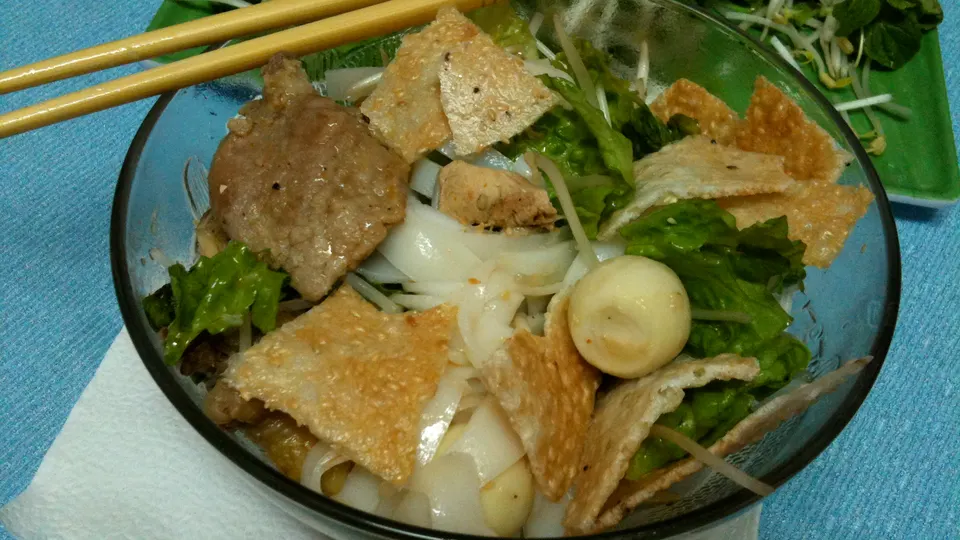
- The noodles. Wide, flat ribbons cut from steamed sheets of rice batter. Some cooks add turmeric, which turns them yellow; others leave them white.
- The nhan (broth and toppings). Meat, shrimp or fish fried with shallots and often turmeric, then simmered into a small amount of rich, thick broth. This is the part each cook is judged on.
- The herbs and greens. Banana blossom, lettuce, basil, Vietnamese mint, perilla, coriander, shredded water spinach and bean sprouts, in whatever mix the shop has. In Hoi An (Hội An), Tra Que (Trà Quế) herbs give the bowl its local scent; our guide to Vietnamese herbs explains what each one tastes like.
- The crunch. Roasted peanuts, and a grilled rice cracker sprinkled with black sesame, banh trang me (bánh tráng mè), which you break over the bowl.
- On the side. Lime, fresh green or red chilli, and often chilli sauce and fish sauce for seasoning to taste.
| Mi Quang at a glance | |
|---|---|
| Vietnamese name | Mi Quang or my Quang (“Quang noodles”) |
| Home area | Former Quang Nam province and Da Nang |
| Noodles | Wide, flat fresh rice noodles; yellow with turmeric or plain white |
| Broth | A small amount of thick, concentrated broth (nhan or nhun (nhưn)) cooked with the toppings |
| Classic toppings | Pork and shrimp with quail egg; chicken; snakehead fish; frog; jellyfish |
| Crunch | Roasted peanuts and a grilled sesame rice cracker (banh trang me) |
| On the side | Herbs, banana blossom, lettuce, lime, chilli |
| Heritage status | Folk knowledge of mi Quang on Vietnam’s national intangible heritage list since 2024 |
Why is there so little broth, and what is the “nhan”?
The first surprise for most visitors is that the bowl is not full of liquid. Instead of a soup, mi Quang comes with a ladle of thick, deeply flavoured broth that coats the noodles. Cooks in Quang Nam call this broth with its toppings nhan or nhun (local pronunciation varies, and English sources write it in different ways). A Nhan Dan (Nhân Dân) report from Phu Chiem (Phú Chiêm) village calls the nuoc nhan (nước nhân) the “soul” of the bowl and describes it as thick, made from shrimp, crab and pork (Nhan Dan).
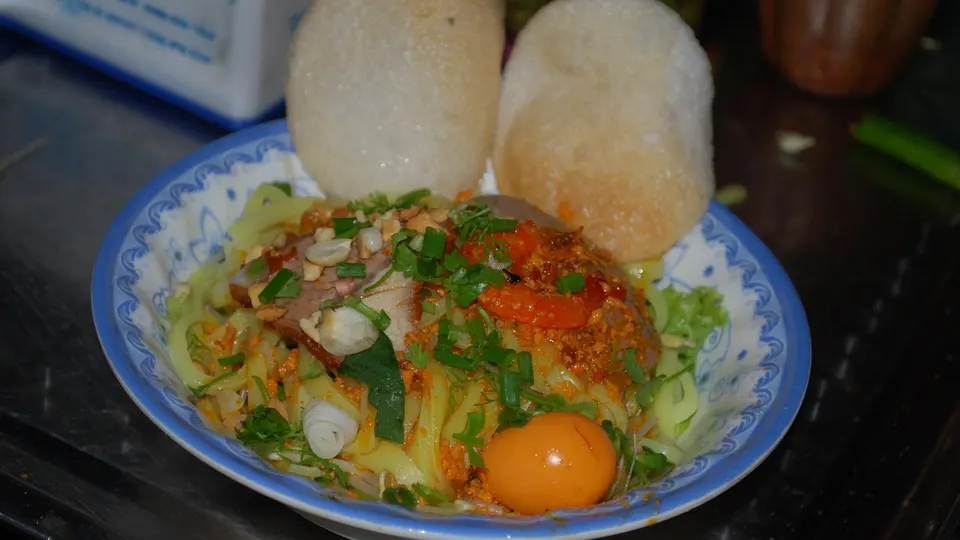
Why so little? Nobody wrote it down, but there are explanations. The chef Peter Cuong Franklin, interviewed by the MICHELIN Guide, links it to the region’s history of hardship: central Vietnam’s narrow coastal plains were poor and often hit by typhoons, and “when there’s only a little liquid, you can serve more people with less money.” Treat that as one chef’s reading rather than settled history. What it means for you is practical: the flavour is concentrated, so a small ladle is meant to season the whole bowl, as a VnExpress writer noted of the Phu Chiem style.
The colour of the nhan tells you something about the cook. In many Da Nang shops it is yellow from turmeric fried with the meat; MICHELIN inspectors describe turmeric-yellow broths at two of the city’s listed mi Quang shops. In Phu Chiem the broth is made with ground shrimp and field crab, which turns it brick-red and gives it a natural sweetness. Neither is “wrong”: they are two common styles.
How are the noodles made, and why does Phu Chiem matter?
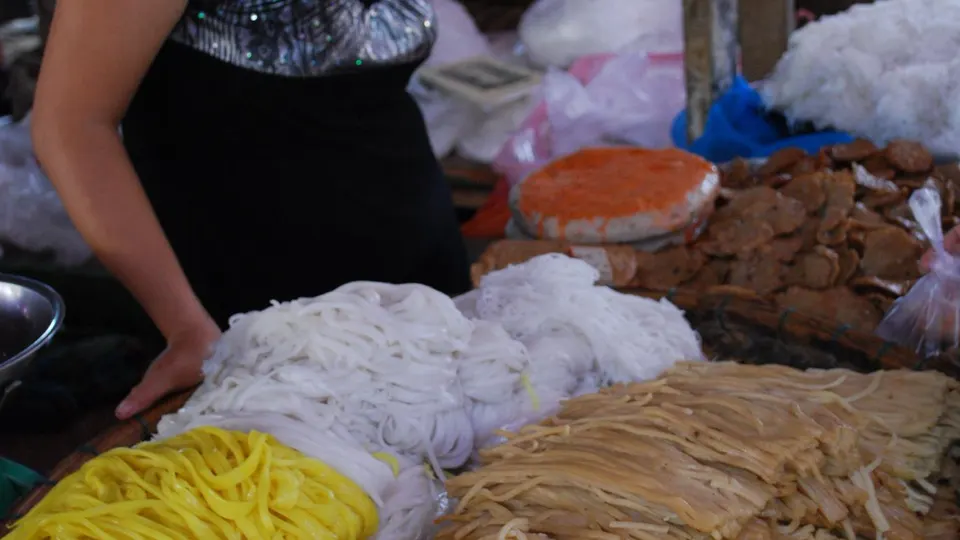
The noodle is made from rice, not wheat. According to Da Nang’s tourism authority, rice is washed, soaked and ground finely into a batter. The batter is ladled thinly onto a cloth stretched over a steamer, often with a coconut-shell ladle, covered and steamed for a few minutes. Each sheet is lifted off with a flat bamboo stick, brushed with peanut oil fried with shallots so the sheets do not stick, stacked and then cut into ribbons. Many workshops now cut by machine. Phu Chiem’s noodle makers were still cutting the sheets by hand when VnExpress wrote about them in 2013.
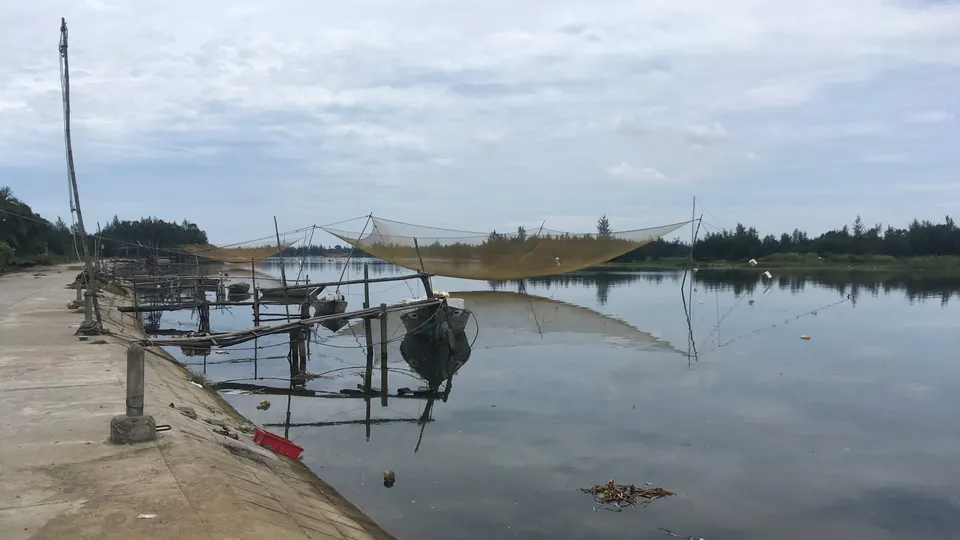
Phu Chiem, a village on the Thu Bon (Thu Bồn) River in the Dien Ban (Điện Bàn) area between Da Nang and Hoi An, is widely regarded as the birthplace of the noodle. The rice traditionally comes from fields along the Thu Bon. In 2018 Tuoi Tre (Tuổi Trẻ) found that eight or nine out of ten households in the village made noodles, and that about a hundred Phu Chiem stalls were selling mi Quang every day in Da Nang, Tam Ky (Tam Kỳ), Hoi An and nearby towns. Women once carried the noodles and broth on shoulder poles; later they travelled by motorbike and bus. The same report says the floods of 1996–1999, which washed away much farmland, pushed more villagers into the trade (Tuoi Tre).
VietNamNet notes that as the dish travelled to other regions its taste was adjusted to local habits. The traditional Phu Chiem bowl is shrimp and pork belly with quail eggs in the red shrimp-and-crab broth, served with raw vegetables and green chilli.
Which version should you order?
Mi Quang has never had one fixed recipe. Cooks traditionally used what was at hand, and the toppings still change with the place and the season. Vietnam’s national tourism authority lists pork, chicken, shrimp, fish and frog as the usual choices (VNAT), and Da Nang shops add jellyfish, beef, eel and fish cakes.

- Tom thit (shrimp and pork). The classic, usually with quail eggs.
- Ga (chicken). Often made with free-range chicken.
- Ca loc (snakehead fish). A freshwater fish offered by many Da Nang shops.
- Ech (frog). Favoured in the midlands and mountains.
- Sua (jellyfish). Springy rather than soft, and a speciality of some Da Nang shops.
- Dac biet (“special”). A bit of everything, useful for a first bowl.
- Tron kho (dry). Noodles tossed with pork, shrimp, peanut oil, peanuts, fish sauce and lime, with no broth poured over them. Tuoi Tre notes that dry mi Quang is part of the same tradition as the wet version.
Where you are changes what you get. Da Nang’s tourism authority notes that coastal areas favour shrimp and fish, while the midlands and mountains prefer crab, eel, stream fish and frog. Sources even disagree on which topping is oldest: a 2018 Tuoi Tre report says Phu Chiem bowls once held only shrimp and jellyfish, with chicken and pork added later, while the city’s tourism portal lists jellyfish among the later additions. The safe conclusion is that variety itself is the tradition.
Where does mi Quang come from?
The honest answer is that nobody knows exactly, and there are no written records of its origin. Several accounts circulate, and they are worth reading as views, not facts.
- A trading-port story. The MICHELIN Guide relates that Chinese merchants who settled near Hoi An in the 16th century brought egg noodles, which locals remade with rice flour. The word mi itself was borrowed from Chinese.
- A Cham layer. Peter Cuong Franklin suggests that noodles came with Chinese traders 400 to 500 years ago, but that some ingredients may be older. Quang Nam was part of the kingdom of Champa until 1471, and Champa had close ties with India, which may explain the turmeric. The brick temples of My Son are the most visible trace of that Cham past.
- A local account. Vietnam (Việt Nam) News quoted people in Quang Nam who say the dish has been eaten there since the 14th century, and a Phu Chiem family story that ties the village’s rice fields and noodles to Queen Huyen Tran (Queen Huyền Trân). This is family tradition, not documented history.
- A settlers’ dish. Da Nang’s tourism authority says simply that mi Quang has existed for centuries and travelled with the Vietnamese as they settled southwards. A culinary expert quoted by Vietnam News describes it as a labourers’ dish, made from whatever fresh plants, meat and fish the early settlers had.
What is certain is its status today. In August 2024 Vietnam’s Ministry of Culture, Sports and Tourism added the “folk knowledge of mi Quang” of Quang Nam province to the national list of intangible cultural heritage (SGGP). The certificate was presented in June 2025, alongside a mi Quang festival in Dien Ban where visitors ground rice on a stone mill and made noodles themselves. As of August 2026, Da Nang was preparing a “Mì Quảng Đà Nẵng” brand programme for 2026–2030, including a proposed quality standard and label modelled in part on Thailand’s Thai SELECT mark, VietnamPlus reported on 11 August 2026.
How do you eat mi Quang?
Mi Quang is eaten at any time of day. In the Quang Nam countryside many people have a bowl early in the morning before going to the fields or the market, and the MICHELIN Guide quotes a Da Nang cookbook author who eats it at breakfast, lunch or dinner. It is also a dish for family gatherings, death anniversaries and Tet (Tết).
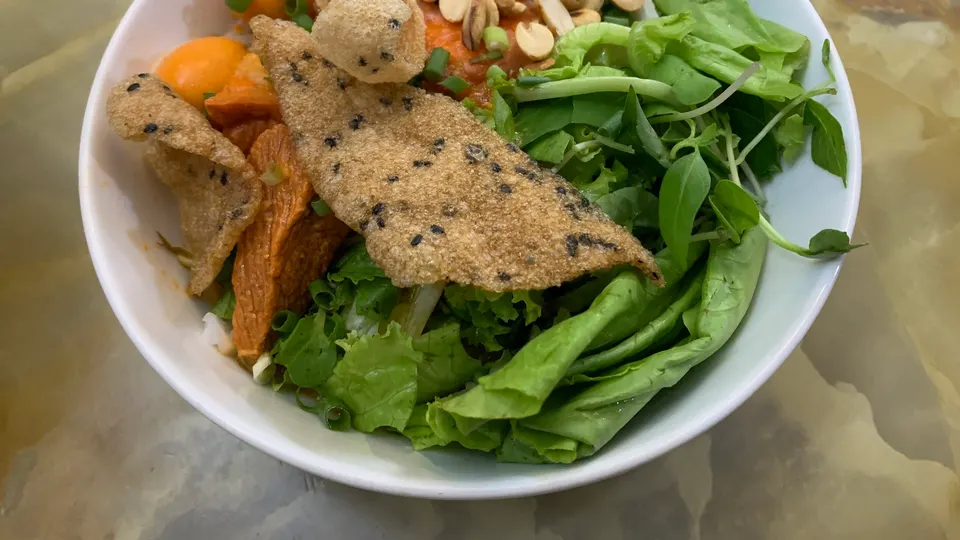
- Add the greens. If the herbs and banana blossom come on a separate plate, add some to the bowl; a Vietnam News recipe puts the raw vegetables in first and the noodles on top.
- Break the cracker. Crumble the banh trang me over the bowl. A VnExpress writer called this the connoisseur’s way; you can also keep a piece to bite between mouthfuls.
- Season it yourself. Squeeze in lime and add chilli, pepper and a little fish sauce to taste. In Phu Chiem, diners bite a fresh green or red chilli alongside.
- Mix well. Turn the noodles with chopsticks so the little broth coats everything.
- Eat it hot. “Mì Quảng ăn nóng mới ngon”: mi Quang is only good when it is hot (VnExpress).
The cracker matters more than it looks. For dry mi Quang, Tuoi Tre recommends crisp grilled crackers from Dai Loc (Đại Lộc) or Tuy Loan (Túy Loan), two places in the Da Nang area.
Mi Quang vs cao lau vs pho: what is the difference?
Visitors to Hoi An often meet mi Quang and cao lau (lầu) on the same menu, and both are yellowish noodles with pork, herbs and very little liquid. They are different dishes. Cao lau (Cao lầu) is Hoi An’s own: its thicker, chewier noodles are traditionally made with rice soaked in lye from tree ash from the Cu Lao Cham (Cù Lao Chàm) islands and water from the old Ba Le (Bá Lễ) well, it comes with char siu-style pork and crisp fried noodle pieces, and it gets only two or three spoonfuls of sauce. Da Nang’s tourism authority notes that mi Quang is found across the central provinces, while cao lau belongs to Hoi An (Da Nang tourism portal). Our guide to cao lau explains that dish in full.
| Mi Quang | Cao lau | Pho (Phở) | |
|---|---|---|---|
| Where it belongs | Former Quang Nam province and Da Nang, eaten across Central Vietnam | Hoi An | Northern Vietnam |
| Noodles | Wide, flat rice noodles, often yellow with turmeric, sometimes white | Thick, chewy noodles, traditionally made with ash-water from the Cu Lao Cham islands | Flat rice noodles in clear broth |
| Liquid | A small ladle of thick, concentrated broth (nhan) | Two or three spoonfuls of sauce | A full bowl of broth, traditionally from beef bones |
| Toppings | Pork and shrimp, chicken, fish, frog, jellyfish and more | Char siu-style pork, crisp fried noodle pieces, greens | Beef or chicken |
| Crunch | Peanuts and a sesame rice cracker | Crisp fried noodle pieces; a rice cracker may be served alongside | No cracker |
The difference with pho is simpler. Pho is a soup: the noodles sit in a full bowl of clear broth. Mi Quang uses much less broth, and a sweeter one: Vietnam News contrasts its flavour with “pho broth cooked with oxen bone”, and VnExpress noted as early as 2001 that it is far less plentiful than northern pho broth. For how pho itself changes between Hanoi and Saigon, see pho by region.
Where to try mi Quang
Da Nang is the easiest place to start. The MICHELIN Guide, which has covered the city since 2024, lists three mi Quang specialists in its 2026 selection, from a central shop serving the classic turmeric style to a Bib Gourmand shop known for jellyfish; the cards below give their addresses.
The 2026 selection was unveiled on 4 June 2026, Da Nang’s tourism portal reported, and as of November 2026 the MICHELIN listing pages still show Mi Quang 1A, Mi Quang Co Sau and the Bib Gourmand My Quang Sua Hong Van in it. All three carry MICHELIN’s lowest price symbol. For the other dishes and the streets around them, see where to eat in Da Nang. Outside the guide, prices stay low: VnExpress put a bowl at the Ba Mua restaurant chain’s Tran Binh Trong Street branch at about 40,000 dong in June 2026.
Hoi An is one of the towns that Phu Chiem sellers have long supplied, and bowls there often carry Tra Que herbs. If you want the village version, Phu Chiem lies in the Dien Ban area between Hoi An and Da Nang, now also part of Da Nang city. Da Nang’s tourism authority names the village itself as a place to taste Phu Chiem noodles, and VietNamNet describes women setting up their stalls there early in the morning.
For more on the region, start from our Central Vietnam hub or browse the food section. For a central-Vietnamese noodle bowl built on the opposite idea, plenty of spicy, lemongrass broth, try bun bo Hue.
Where to try mì Quảng in Đà Nẵng
MICHELIN Guide pick
Mì Quảng 1A
Đà Nẵng · Hải Châu ward (former Hải Châu district)
1A Hải Phòng Street
Listed in the MICHELIN Guide Vietnam 2026: a simple, central shop serving ribbon rice noodles in a yellow, turmeric-seasoned broth, a good first bowl of the classic style.
Order: The 'special' (đặc biệt), which combines the pork-and-shrimp and chicken versions, with the lettuce, coriander and banana blossom on the side.
Listed in: MICHELIN Guide Vietnam 2026 · checked November 2026
MICHELIN Guide pick
Mỳ Quảng Sứa Hồng Vân
Đà Nẵng · Hải Châu ward (former Hải Châu district)
59 Lê Hồng Phong Street
Bib Gourmand in the MICHELIN Guide Vietnam 2026: a busy, no-frills shop whose orange-red broth is made with shrimp. The place to try the jellyfish version.
Order: Mì Quảng with jellyfish (sứa), or with pork, shrimp, meatballs and quail egg.
Listed in: MICHELIN Guide Vietnam 2026 · checked November 2026
MICHELIN Guide pick
Mì Quảng Cô Sáu
Đà Nẵng · An Hải ward (former Sơn Trà district), on the east bank of the Hàn River
397 Trần Hưng Đạo Street
Listed in the MICHELIN Guide Vietnam 2026: a relaxed riverside room run by an owner from Quảng Nam, with a turmeric-yellow broth and a choice of toppings.
Order: Mì Quảng with chicken, fish or shrimp; also thịt heo bánh tráng (sliced pork belly rolled in rice paper with herbs).
A 2016 press list mentions a different 'Mì Quảng Cô Sáu' in Núi Thành, in the south of the former Quảng Nam province. This card means the MICHELIN-listed shop at 397 Trần Hưng Đạo in Đà Nẵng.
Listed in: MICHELIN Guide Vietnam 2026 · checked November 2026
Local favourite
Mì Quảng Bà Vị
Đà Nẵng · City centre (former Hải Châu district)
166 Lê Đình Dương Street
A long-running local shop that Da Nang Today, the city's newspaper, named in 2025 as one of the best for traditional mì Quảng, with a thick broth enriched with chicken, duck and quail eggs.
Order: Mì Quảng with a side plate of fried spring rolls and the plate of raw herbs.
Shops called 'Bà Vị' also exist in other cities. This card means the shop on Lê Đình Dương Street in Đà Nẵng; the house number comes from a 2016 listing, so check it on a map before you go.
Recommended by: Da Nang Today (Báo Đà Nẵng) (2025), Việt Nam News (2016) · checked November 2026
Addresses and details can change; check before you go. We do not accept payment for listings.
Frequently asked questions
How much does a bowl of mi Quang cost in Da Nang?
Mi Quang is cheap street food: VnExpress put a bowl at the Ba Mua chain in Da Nang at about 40,000 dong in June 2026. The MICHELIN Guide gives its three listed mi Quang shops in Da Nang its lowest price symbol.
Which mi Quang shop in Da Nang should I try first?
For the classic turmeric-yellow style, Mi Quang 1A on Hai Phong Street is a central, MICHELIN-listed choice. My Quang Sua Hong Van on Le Hong Phong Street, a Bib Gourmand in the 2026 MICHELIN Guide Vietnam, is the place for the jellyfish version, and Mi Quang Co Sau sits by the Han River on Tran Hung Dao Street.
Which mi Quang topping should I order on my first visit?
Start with tom thit (shrimp and pork with quail egg), the classic, or dac biet (special), which combines several toppings in one bowl. Try ga (chicken), ca loc (snakehead fish) or sua (jellyfish) on a second visit.
How do I eat mi Quang properly?
Add herbs and banana blossom, break the sesame rice cracker (banh trang me) over the bowl, season with lime, chilli and fish sauce, then mix with chopsticks so the small amount of broth coats the noodles. Eat it while it is hot.
Can I eat mi Quang for breakfast?
Yes. In the Quang Nam countryside many people eat mi Quang early in the morning, and in Da Nang it is eaten at breakfast, lunch and dinner.
Key sources
- What Is Mi Quang – the Noodle Dish that Defines Da Nang – and Where to Find the Best Bowl · MICHELIN Guide, 2 Apr 2025
- Folk Knowledge of Quang Noodles · Đà Nẵng City Tourism Promotion Center (danangfantasticity.com), 24 Oct 2025
- Cao Lau Hoi An – a traditional noodle specialty of Hoi An · Đà Nẵng City Tourism Promotion Center (danangfantasticity.com), 24 Sep 2025
- Rong ruổi gánh mì Phú Chiêm · Tuổi Trẻ, 26 Mar 2018
- Hương vị Quảng Nam · VnExpress, 1 Jun 2001
- Giữ vị mì xứ sở · Nhân Dân, 27 Aug 2024
- Mỳ Quảng trở thành di sản văn hóa phi vật thể quốc gia · Sài Gòn Giải Phóng (SGGP), 12 Aug 2024
- Mi Quang – Central Viet Nam's 'must-try' delicacy · Vietnam National Authority of Tourism (from Vietnam Pictorial), 9 Oct 2017
All 21 sources and further reading
- Food tour Đà Nẵng với 200.000 đồng · VnExpress, 16 June 2026
- MICHELIN Guide Vietnam 2026: Da Nang continues to strengthen its position on Vietnam's culinary map · Đà Nẵng City Tourism Promotion Center (danangfantasticity.com), 5 June 2026
- What is Da Nang's mi Quang? · MICHELIN Guide, 30 Jun 2024
- Quang noodles · Đà Nẵng City Tourism Promotion Center (danangfantasticity.com), 8 Dec 2019
- Về Điện Bàn dự festival, du khách được tự tay làm và ăn mỳ Quảng chính hiệu thỏa thích · Tuổi Trẻ, 7 Jun 2025
- Mì Quảng trộn khô · Tuổi Trẻ, 31 Jan 2026
- Nhớ vị mì Quảng Phú Chiêm · VnExpress, 8 Jan 2013
- Định hình vị thế 'đại sứ ẩm thực' cho Mì Quảng Đà Nẵng · VietnamPlus (VNA), 11 Aug 2026
- Story of the famous Quảng noodle · Việt Nam News, 13 Sep 2016
- A true taste of Mi Quang · VietNamNet, 24 Apr 2017
- Insight into cuisine of Quang land · Da Nang Today (Báo Đà Nẵng), 5 Apr 2025
- Mi Quang · Việt Nam News (Ông Táo's Kitchen), 20 Sep 2020
- Complete guide to MICHELIN-recognized restaurants in Da Nang 2026 · Đà Nẵng City Tourism Promotion Center (danangfantasticity.com)
Keep exploring
 Central Vietnam · Travel Da Nang (Đà Nẵng): What to Do, Where to Stay, How Long Da Nang travel guide: the best things to do, whether to stay in Da Nang or Hoi An, a 2–4 day plan with Hue, what to eat and when the rains usually come.
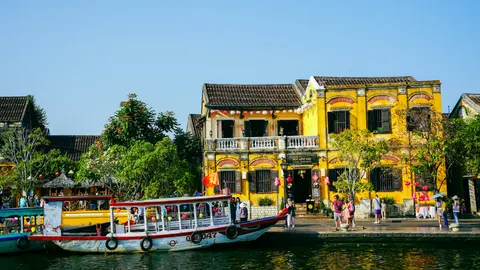 Central Vietnam · Travel Hoi An (Hội An): How Many Days, What to See, When to Go How many days Hoi An needs, what the 80,000 or 120,000 dong ticket covers, lantern nights, where to eat, beaches, flood months and getting there from Da Nang.
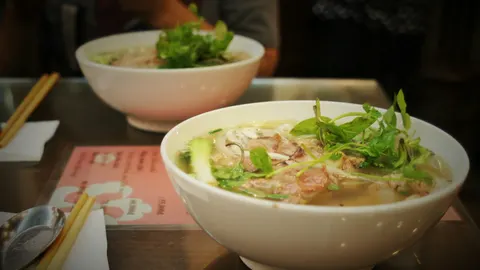 North · Central · South · Food Hanoi vs Saigon Pho (Phở): Differences and How to Order Hanoi vs Saigon pho: a clear, spare Northern broth or a sweeter Southern bowl with herbs and sauces, plus Central styles, 2026 prices and MICHELIN picks.
 Central Vietnam · Food Bun Bo Hue (Bún Bò Huế): Dac Biet, How to Order and Cook Bun bo Hue explained: what a dac biet bowl holds, how Hue cooks make the lemongrass and shrimp paste broth, what hot dieu mau does, and Hue vs Saigon bowls.