North Vietnam · Travel
Hang Mua (Hang Múa): Worth the Climb? Ticket and Best Time
Is Hang Mua worth the climb? As of November 2026: about 500 steps, 45 to 60 minutes up, a 150,000 dong ticket since April and the best time of day to go.

Yes, Hang Mua (Hang Múa) is worth it if you can manage a short, steep climb: roughly 486 to 500 stone steps take you to the best viewpoint in Ninh Binh, looking straight down on the rice fields, river and limestone towers of Tam Coc (Tam Cốc). As of November 2026 the ticket is 150,000 dong, the price in force since 1 April 2026, and most people need 45 minutes to an hour to get up. The climb is easiest and most rewarding early in the morning or in the late afternoon, ideally in the golden-rice weeks of late May and early June.
Hang Mua sits at the foot of Ngoa Long (Ngọa Long) mountain, whose name means “lying dragon”, in the core of the Trang An (Tràng An) UNESCO landscape. This page answers the practical questions: how hard the climb really is, what you find at the top, when to go by time of day and season, what the ticket costs since April 2026, how to get there and how to fit it around the Tam Coc boat. For the wider area, its history and the other sights, start with our Ninh Binh guide.
Hang Mua at a glance
| What it is | A viewpoint on Ngoa Long (Mua) mountain above Tam Coc, reached by stone steps |
| Where | Hoa Lu ward, Ninh Binh province; about 4 km from Tam Coc, about 10 km from Ninh Binh city, about 100 km from Hanoi |
| The climb | 486 steps in most sources, “about 500” in others; about 45–60 minutes up |
| Time needed | 2–3 hours for the climb, the summit and the lotus pond |
| Best time of day | Early morning or late afternoon; sunset is the busiest |
| Best season | Late May–early June for golden rice; June for lotus; avoid the June–August midday heat and wet days |
| Ticket | 150,000 dong from 1 April 2026 (children under 1 m free) |
| Pairs with | The Tam Coc boat trip (about 2 hours) and Bich Dong pagoda |
Is Hang Mua worth it?
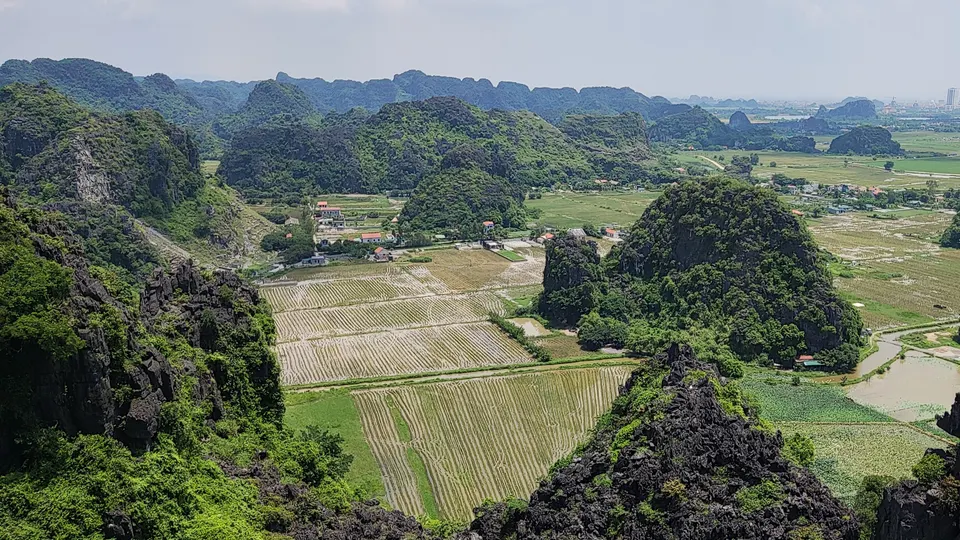
For most visitors, yes. Tam Coc’s boat trip shows you the karst from water level; Hang Mua is the only easy way to see the whole picture from above: the Ngo Dong (Ngô Đồng) river winding between the towers, the boats on it, the patchwork of paddies and, on a clear day, the Hoa Lu (Hoa Lư) area beyond. Vietnam’s national tourism authority places Hang Mua in the core zone of the Trang An Landscape Complex, about 10 km from Ninh Binh city (Vietnam National Authority of Tourism).
The name means “dancing cave”. The legend, repeated by the tourism authority and VTC News, is that King Tran Thai Tong (Trần Thái Tông) of the 13th-century Tran dynasty came back to Hoa Lu, built a retreat nearby and had court dancers perform here, and that the music echoed through the cave. Treat it as a local legend rather than documented history; today almost everyone comes for the view.
Who might skip it: travellers with knee, heart or balance problems, families with very small children who would need carrying, and anyone visiting on a rainy or very foggy day, when the steps are slippery and the view disappears. If Tam Coc’s boat is your only stop and you are short of time, the climb is the first thing to drop; if you have a free late afternoon, it is the first thing to add.
How many steps, and how hard is the climb?
The step count depends on who you ask. The national tourism authority, the Vietnam News Agency, Bao Dau tu (Báo Đầu tư) and VTC News all give 486 stone steps, while Znews, VietNamNet and Vietnam Airlines’ guide say “about” or “nearly” 500 (VTC News). Sources may simply count differently; plan for about 500.
How hard is it? Short but steep. Vietnam Airlines’ guide calls it a moderate climb of about 45–60 minutes, and Hanoi Times suggests allowing an hour for the staircase, which gets more uneven towards the top. The steps are carved stone, edged with dragon and phoenix motifs that VietNamNet and the tourism authority describe as Tran-dynasty style, and the Vietnam News Agency notes that the peak is often called Vietnam’s “Great Wall”.
What makes it harder than the numbers suggest:
- Steepness and uneven treads, especially on the last stretch to the summit rocks.
- No shade on most of the way up, so heat and humidity matter more than distance.
- Crowds on the narrow upper steps at sunset and in the rice season, when you may wait to pass.
- Wet stone after rain or in heavy fog.
With average fitness, take it slowly, stop at the landings and it is very manageable. Znews puts a full visit, with photos at the top and the lotus pond, at two to three hours.
What is at the top: the Lying Dragon and Quan Am
Partway up the path splits. Vietnam Airlines’ guide describes one branch leading to a statue of Quan Am (Quan Âm), the Bodhisattva of compassion, and the other to the dragon on the summit of Ngoa Long mountain. VTC News and Bao Dau tu both describe a Quan Am statue and a “rong chau (rồng chầu)”, a guardian dragon, on the peak (Bao Dau tu).
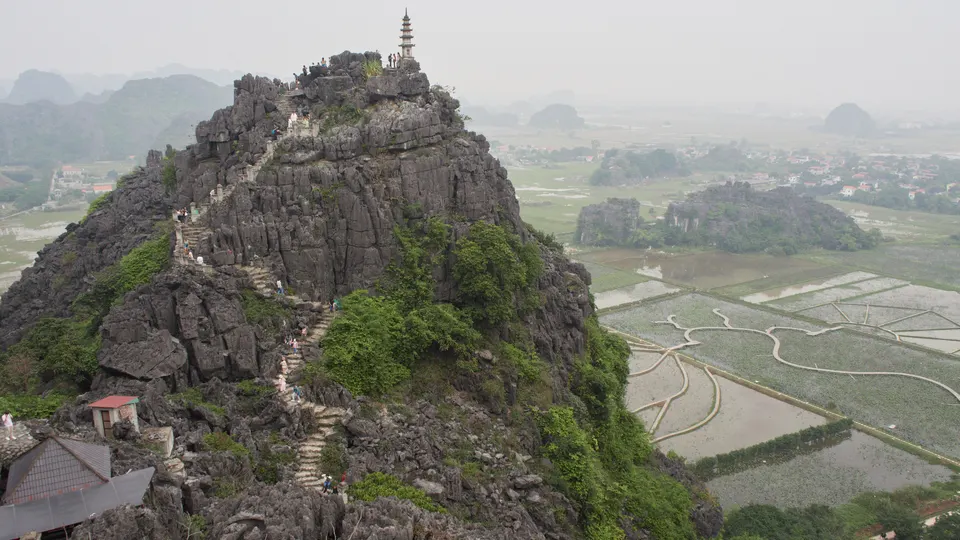
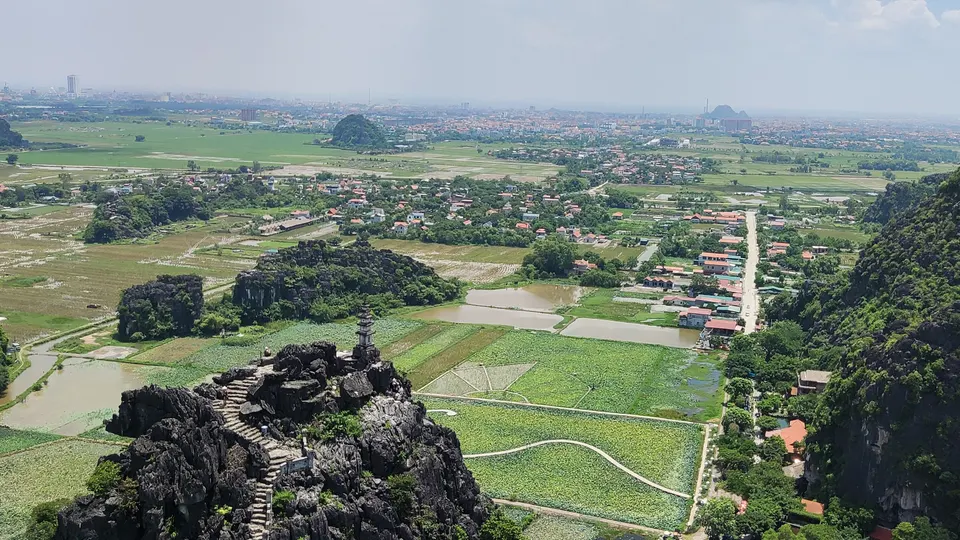
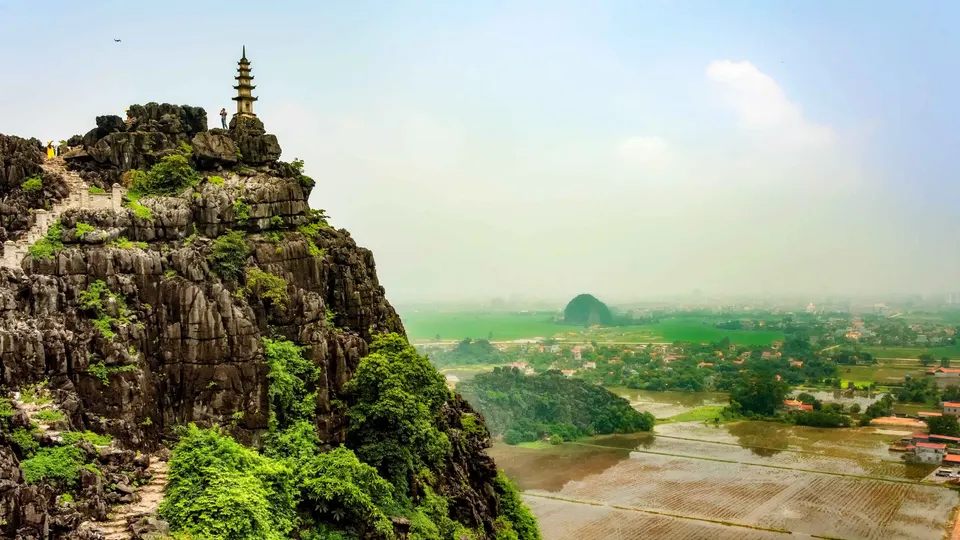
The national tourism authority adds the detail that ties it together: the Quan Am statue looks out over the old capital at Hoa Lu, the dragon statue is behind it, and a small tower in the style of a Buddhist stupa stands on the highest point of the mountain. That tower is the one you see in most photos of Hang Mua.
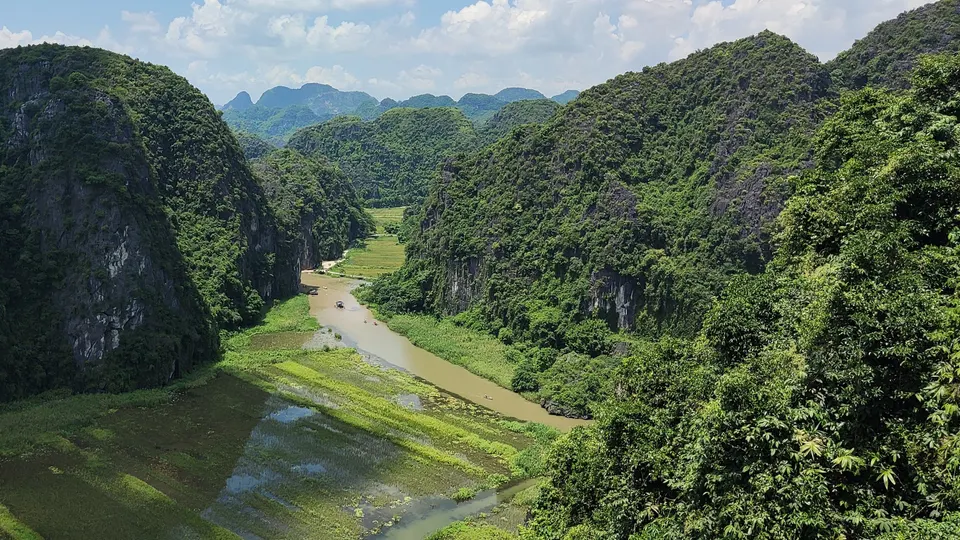
The views. One side looks over Tam Coc: the Ngo Dong river, the boats and the paddies on its banks. VnExpress International wrote that from the peak “the Tam Coc landscape spreads out in all its golden, green and silver splendor”, with Hoa Lu also visible. The other side looks across the karst towards Hoa Lu and the plain. Space on the rocks around the dragon is limited, and at sunset people queue for photos there.
What is the best time of day to climb?
Early morning or late afternoon. Hanoi Times recommends the morning or late afternoon because the sun is milder and you can catch sunrise or sunset (Hanoi Times), and Vietnam Airlines’ Vietnamese-language guide singles out sunset as the most beautiful time.

| Time | Light and heat | Crowds | Good for |
|---|---|---|---|
| Early morning | Soft light, coolest stone; mist possible in winter and spring | Fewest people | Photos without queues, hot months |
| Midday | Harsh overhead light, hottest | Moderate | Not recommended in summer |
| Late afternoon to sunset | Warm light over Tam Coc | Busiest, queues at the dragon | The classic photo; come down with a torch |
If you climb for sunset, start up about an hour before it and bring a torch or phone light: Vietnam Airlines’ guide warns that it gets dark quickly after sunset, and you will be coming down uneven steps. Opening hours are given as roughly 6 or 7 am to 6 or 7 pm in different undated sources, so a sunrise climb depends on the gate; ask your hotel the evening before.
When is the best season: rice and lotus
The time of year changes the view more than anything else. Late May to early June is the golden-rice season. VnExpress International explains that Tam Coc has only one rice crop a year along the river, because the water rises in the monsoon, and that May and June are the busiest harvest months (VnExpress International).

The exact weeks move with the weather. VnExpress reported in 2022 that the harvest usually starts in mid-May but the rice only turned gold in June that year, and that the harvest lasts about two weeks; in 2023 it reported the crop at its peak in the first days of June, with the province’s golden-season tourism week ending on 4 June “when the rice season ends”. In 2026 the provincial tourism week opened on 23 May, timed for the moment the Tam Coc fields turn gold, according to Bao Van Hoa (Báo Văn Hóa).
| Season | What you see from the top | Notes |
|---|---|---|
| January–March | Often flooded paddies and mist, as in the February photo above | Mild and cool; Vietnam Airlines calls spring the most pleasant weather |
| April–early May | Rice turning from green to yellow | Hanoi Times recommends April–May |
| Late May–early June | Golden rice and harvest | Peak beauty and peak crowds, especially weekends |
| June–July | Lotus in bloom at the foot of the mountain | Znews says the lotus pond is best in June; hot |
| July–August | Lush green, frequent rain | Heat and slippery steps; Vietnam Airlines advises avoiding June–August heat |
| September–November | Fields vary from plot to plot | Cooler than summer |
Golden fields are not the only reason to come. The karst view works all year, and the cooler months are much kinder for the climb itself; our Vietnam weather by month guide shows what to expect in the North in each month.
What does the ticket cost, and what does it include?
From 1 April 2026 the ticket costs 150,000 dong per person, up from 100,000 dong, and children taller than 1 m pay the full price while those under 1 m go free, Znews reported on 30 March 2026, citing the operator, Lac Hong (Lạc Hồng) tourism company (Znews). Many English-language guides still quote the old 100,000 dong, and as of November 2026 Ninh Binh’s tourism portal still shows only its 2025 price list, with 100,000 dong for Hang Mua; the Znews figure is the newer one.

According to Znews the ticket covers the points of interest inside the site, including a lotus pond of more than a hectare at the foot of the mountain, at its best in June. Hang Mua is run by a company rather than the state, so prices can change again: check at the gate.
How do you get to Hang Mua from Tam Coc, Ninh Binh city or Hanoi?
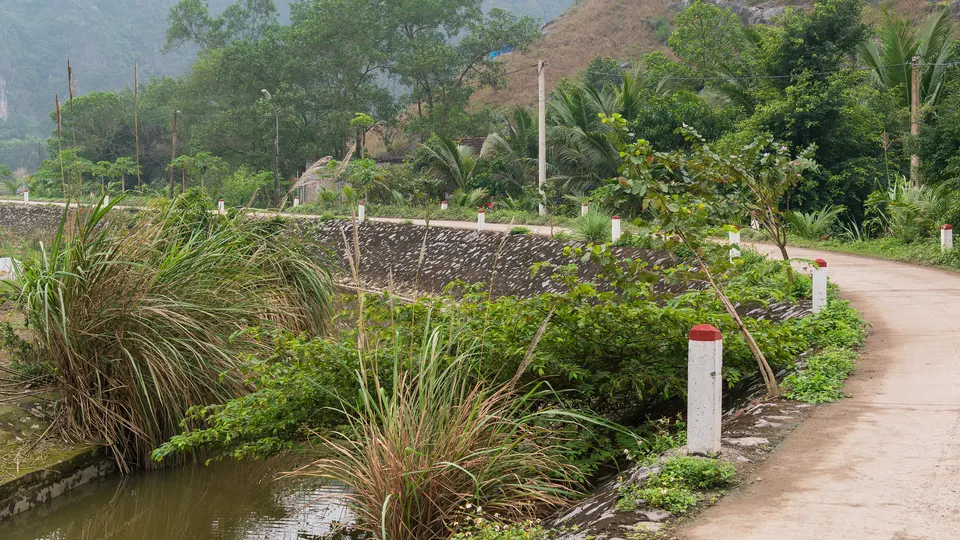
From Tam Coc. VnExpress International puts Hang Mua about 4 km from Tam Coc, an easy ride by bicycle or motorbike; Vietnam Airlines’ guide calls it a 10-minute drive.
From Ninh Binh city. The national tourism authority gives about 10 km; Vietnam Airlines’ guide says about 20 minutes by motorbike or 15–20 minutes by taxi. Ninh Binh railway station is in the city centre, so from the train you need a taxi, a hired motorbike or a car for the last leg.
From Hanoi. Hang Mua is about 100 km from Hanoi. Take the train, a limousine van or a bus to Ninh Binh or Tam Coc, then a taxi or bike; our guide to getting from Hanoi to Ninh Binh compares the options with dated times and fares. Some day tours from Hanoi include Hang Mua with a boat trip; check that the itinerary leaves time for the climb in the afternoon rather than at midday. Our day trips from Hanoi guide explains why one boat trip plus one land sight is the realistic limit for a day.
On the map. Since 1 July 2025 Ninh Binh province also includes the former Ha Nam (Hà Nam) and Nam Dinh (Nam Định) provinces, which were merged into it under Resolution 202/2025/QH15 (LuatVietnam). VTC News placed Hang Mua in Hoa Lu ward in October 2026; older guides give the former Ninh Xuan commune in Hoa Lu district. The site has not moved.
Is Hang Mua safe? Heat, slippery steps and crowds
It is a well-built staircase, not a hike, but a few precautions make a real difference. The main risks are heat, wet stone and crowding on the narrow summit rocks, and all three are worst at the times most people choose to come.
- Heat. Vietnam Airlines’ Ninh Binh guide advises avoiding June to August because of the heat, and the staircase has almost no shade. In summer climb early or late, carry more water than you think you need and wear a hat.
- Slippery steps. The same airline’s Hang Mua guide warns of slippery paths in the July–August rains. Skip the climb in heavy rain or thick fog, and wear shoes with grip, not flip-flops.
- Uneven rock at the top. Hanoi Times notes the limestone steps are uneven, especially near the summit. Keep back from the edges around the dragon and the stupa, and do not climb onto the rocks for photos.
- Coming down in the dark. After sunset the steps are hard to see; bring a light and leave the summit as soon as the sun has set.
- Crowds. On rice-season weekends and holidays the upper steps get congested. VnExpress described the Tam Coc river packed with boats at peak times in 2023; expect the same pressure on the viewpoint. Go on a weekday or early in the morning if you can.
Combining Hang Mua with the Tam Coc boat: a half-day plan
Hang Mua and the Tam Coc boat trip are the natural pair: the boat shows you the karst from the river, the climb shows you the same river from above, and the two are only a few kilometres apart. The Tam Coc round trip takes about two hours; on the province’s 2025 price list the Tam Coc–Bich Dong ticket was 250,000 dong for adults (Ninh Binh Tourism Centre). Our Tam Coc vs Trang An guide helps you decide which boat to take and has newer price reports.
Which plan suits you depends mainly on where you sleep:
| Plan | Time needed | Tickets (as of November 2026) | Effort | Best for |
|---|---|---|---|---|
| Hang Mua only | 2–3 hours | 150,000 dong | Steep climb, about 45–60 minutes up | Travellers already based in Tam Coc with a free morning or late afternoon |
| Hang Mua + Tam Coc boat, staying in Tam Coc | Half a day | 150,000 dong + Tam Coc–Bich Dong ticket (250,000 dong for adults on the province’s 2025 list) | Climb plus a 2-hour boat ride, with a rest in between | Most visitors: climb early, boat mid-morning |
| Day trip from Hanoi | Full day, about 100 km each way | The same tickets, plus transport or a tour | Long day; the climb comes in the afternoon | Travellers short of nights who still want the view from the top |
If you stay in Tam Coc (best):
- Early morning: climb Hang Mua at opening, before the heat and the tour groups.
- Mid-morning: the Tam Coc boat, about two hours.
- Midday: lunch and a rest out of the sun.
- Afternoon: Bich Dong (Bích Động) pagoda by bike, or a second climb at Hang Mua for sunset if the first was misty.
On a day trip from Hanoi:
- Morning: travel down, then the Tam Coc boat late morning.
- Lunch near the wharf.
- Mid to late afternoon: cycle or ride to Hang Mua, climb for the late light, and leave the summit around sunset.
- Evening: return to Hanoi by van or car; the transport guide above explains why the road is easier than the train for the way back.
Before you go, check:
- The weather: skip the climb in rain or thick fog and swap in Bich Dong or Hoa Lu.
- Your shoes, water, hat and a phone torch for the descent.
- The ticket at the gate (150,000 dong since April 2026), and carry cash.
- That a tour gives you the late afternoon, not the midday slot, at Hang Mua.
- Your timing in the rice season: weekdays and early mornings beat weekends.
Hang Mua is part of a bigger northern trip: start from our North Vietnam hub for routes beyond Ninh Binh, or see how Ninh Binh fits into our one-week Vietnam itinerary.
Frequently asked questions
How many steps are there at Hang Mua, and how long does it take to climb?
Most Vietnamese sources, including the national tourism authority and VTC News (October 2026), give 486 stone steps; others round it to about 500. Most people need 45 minutes to an hour to reach the top of Hang Mua, and two to three hours for the whole visit.
Is the Hang Mua climb too hard for older travellers or children?
The Hang Mua staircase is short but steep, shadeless and uneven near the top, so anyone of average fitness can manage it slowly in cool weather. It is not a good idea for people with knee, heart or balance problems, or with small children who would need carrying.
How much is the Hang Mua ticket in 2026?
As of November 2026 it is 150,000 dong per person, the price set from 1 April 2026 according to Znews (30 March 2026); children under 1 m are free. Ninh Binh's tourism portal still shows its 2025 list with the old 100,000 dong, so expect to see both figures online.
Which is better at Hang Mua, sunrise or sunset?
Sunset gives the warm light over Tam Coc that most photos show, but it is the busiest time and you come down in the dark. Early morning is cooler and quieter, though it depends on the gate opening time, which sources give as 6 or 7 am.
Do I need a tour to visit Hang Mua from Hanoi?
No. You can take a train, limousine van or bus from Hanoi to Ninh Binh or Tam Coc and then a taxi or bike for the last few kilometres to Hang Mua. A tour is easier on a day trip, but check that it gives you the late afternoon at Hang Mua, not the midday heat.
Key sources
- Hang Múa Ninh Bình tăng giá vé từ 1/4 · Znews, 30 March 2026
- Tên gọi Hang Múa có ý nghĩa gì? · VTC News, 16 October 2026
- Hang Mua (Mua Cave) · Vietnam National Authority of Tourism
- Nghỉ lễ dài ngày dịp 30/4-1/5, không thể bỏ lỡ Hang Múa · Báo Đầu tư, 21 April 2024
- Tam Coc shimmers in silver and gold · VnExpress International, 27 May 2019
- Ticket price list for tourist destinations in Ninh Binh 2025 · Ninh Binh Tourism Information and Promotion Centre, updated 4 March 2025
- One day with Vietnam's Great Wall · Hanoi Times
- Resolution 202/2025/QH15 on the reorganization of provincial-level administrative divisions · LuatVietnam (text of the National Assembly resolution)
All 15 sources and further reading
- Mua Caves: the best place to see beautiful Ninh Binh · Vietnam News Agency (Vietnam Pictorial), 5 November 2018
- Tam Cốc mùa lúa chín · VnExpress, 7 June 2022
- Mùa vàng ở Tam Cốc · VnExpress, 2 June 2023
- Khai mạc Tuần Du lịch Ninh Bình 2026 · Báo Văn Hóa, 23 May 2026
- Hang Mua – panorama for kings in Trang An · VietNamNet, 5 April 2018
- Mua Caves, Ninh Binh (travel guide) · Vietnam Airlines, checked 14 November 2026
- Du lịch Ninh Bình (travel guide) · Vietnam Airlines, checked 14 November 2026
Keep exploring
 North Vietnam · Travel Ninh Binh (Ninh Bình): How Many Days, Boats and Tickets Ninh Binh: how many days you need, Trang An or Tam Coc boats, 2026 ticket prices, when the rice turns gold, the Hoa Lu capital, what to eat and a 2-day plan.
 North Vietnam · Travel Tam Coc vs Trang An (Tràng An): Which Ninh Binh Boat Trip? Tam Coc or Trang An? Compare Ninh Binh's boat trips by route, caves, crowds, season and time, plus Thung Nham, Van Long and half-day or full-day plans.
 North Vietnam · Travel Hanoi to Ninh Binh (Ninh Bình): Train, Bus or Tour? Hanoi to Ninh Binh in 2026: train, limousine van, bus, Grab or day tour compared, with dated times and fares, the station transfer and a day-trip plan.
 North Vietnam · Travel Which Day Trip from Hanoi? Ninh Binh vs Ha Long vs Bat Trang Which day trip from Hanoi? Ninh Binh, Ha Long Bay, Bat Trang, Duong Lam and the Perfume Pagoda compared by road time, effort and season, as of November 2026.