South Vietnam · Travel
Tay Ninh (Tây Ninh) Day Trip from Saigon: Holy See, Ba Den
Is a Tay Ninh day trip from Saigon worth it? Noon prayer at the Cao Dai Holy See, Ba Den cable car prices for 2026, getting there, a one-day plan, mistakes.
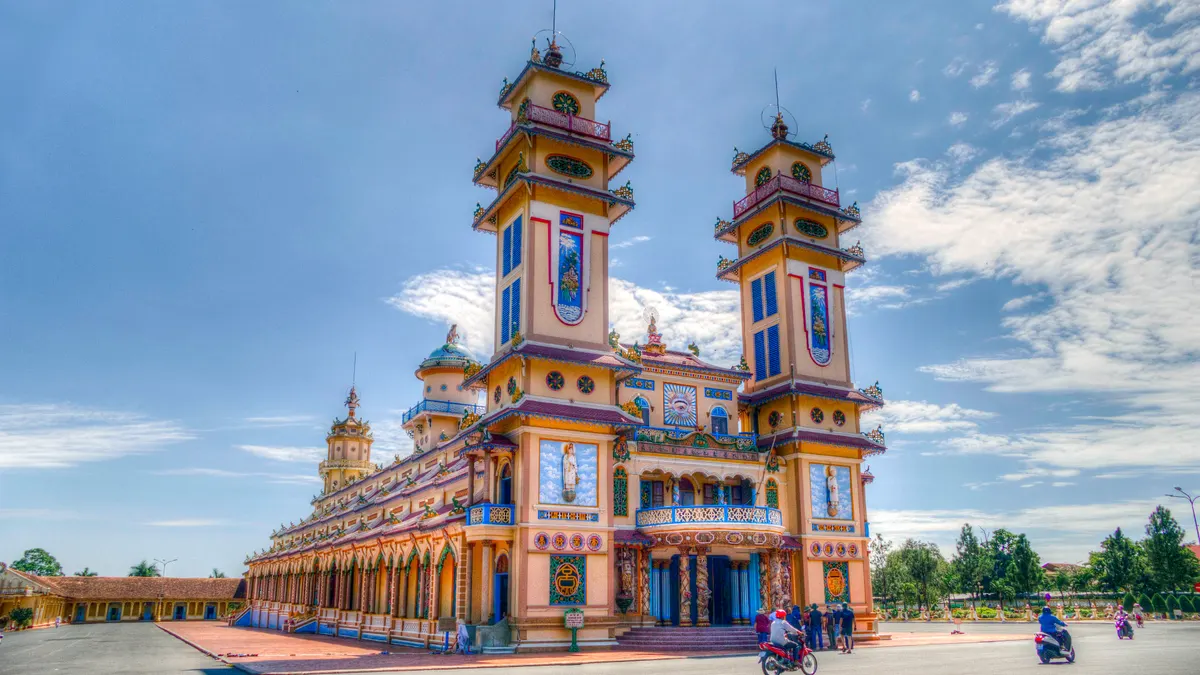
Yes: Tay Ninh (Tây Ninh) works as a long day trip from Ho Chi Minh City, about 100 km and 2 to 3 hours by road each way, as long as you plan the day around the noon prayer at the Cao Dai Holy See. As of November 2026 the drive is still on the old national roads: the Ho Chi Minh City–Moc Bai expressway is under construction and due to be finished in 2028. If you add Ba Den (Bà Đen) Mountain, budget about 250,000–450,000 VND per adult for the round-trip cable car (operator’s price list, 17 February 2026).
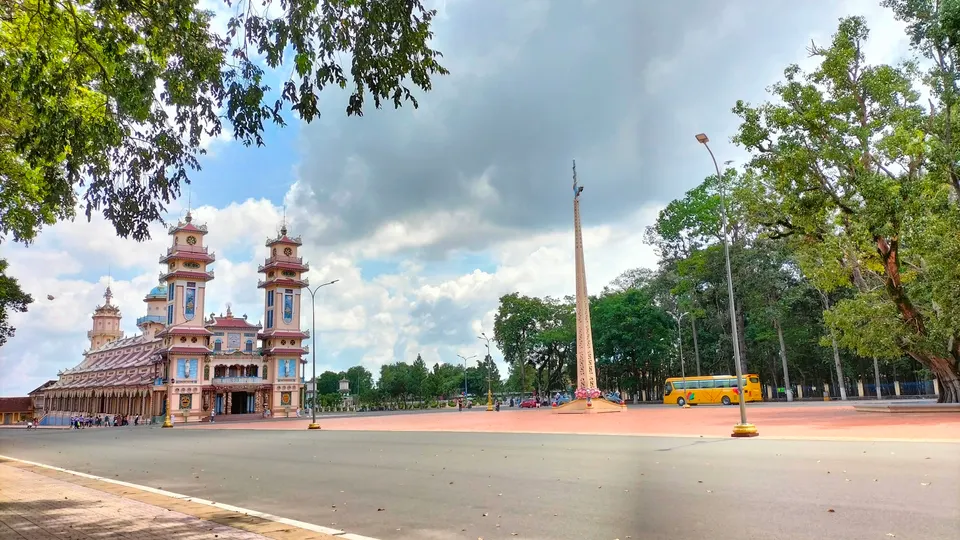
Tay Ninh, the province on the Cambodian border north-west of Ho Chi Minh City, is where Caodaism (dao Cao Dai) was founded in 1926 and where its Holy See still stands: a long, twin-towered temple, now in Long Hoa ward. At its great festivals hundreds of thousands of followers and visitors fill the grounds (Tien Phong); on ordinary days a steady stream of tourists arrives for the noon prayer.
This guide suits travellers who want more than a photo stop: people curious about religion and architecture, day-trippers from Saigon who want to watch a ceremony without intruding, and anyone weighing whether to add Ba Den Mountain, the pilgrimage peak that rises out of the plain nearby. It is not a beach or nightlife destination. For the rest of the region, see our guide to Southern Vietnam.
Tay Ninh at a glance
| Region | Southern Vietnam, on the Cambodian border |
| Admin (since July 2025) | Tay Ninh province, merged with the former Long An province; provincial seat in Tan An (Tân An). The Holy See is in Long Hoa ward (formerly Hoa Thanh (Hòa Thành) town), Ba Den Mountain mostly in Binh Minh (Bình Minh) ward |
| Known for | The Cao Dai Holy See (Toa Thanh Tay Ninh); Ba Den Mountain, 986 m; banh canh Trang Bang (Trảng Bàng) noodle soup and dew-softened rice paper; Dau Tieng (Dầu Tiếng) Lake |
| Distance from Ho Chi Minh City | About 100 km; roughly 2 to 3 hours by road, depending on traffic |
| How long | A long day trip for the Holy See (often combined with Cu Chi); one night if you add Ba Den |
| Best time | Dry season, roughly December to April; festivals bring big crowds at Tet (Tết), on the 8th–9th of the first lunar month and on the 15th of the eighth lunar month |
| Prayers at the Holy See | Four a day; noon is the main one, so arrive by about 11:45. Other times differ by source (see below) |
| Ba Den cable car | Round trip about 250,000 VND (base to temples) or 450,000 VND (to the summit) per adult, children under 1 m free (operator price list, 17 Feb 2026); combos with buffet cost more |
| Local dishes | Banh canh Trang Bang, banh trang phoi suong (bánh tráng phơi sương), muoi tom (shrimp-chilli salt) |
What is Caodaism, and why is its Holy See in Tay Ninh?
Caodaism is a Vietnamese religion, founded in Tay Ninh in late 1926. According to EBSCO’s research overview, its founder, Ngo Van Chieu (Ngô Văn Chiêu), a civil servant in the French colonial administration, said he had received messages from the Supreme Being during seances (séances) in 1919 and 1921. The faith draws on Buddhism (karma and rebirth), Confucianism (ethics), Taoism (yin and yang, spiritualism) and Christianity, and its central teaching is that “all religions have one same principle, and one same origin” (EBSCO).
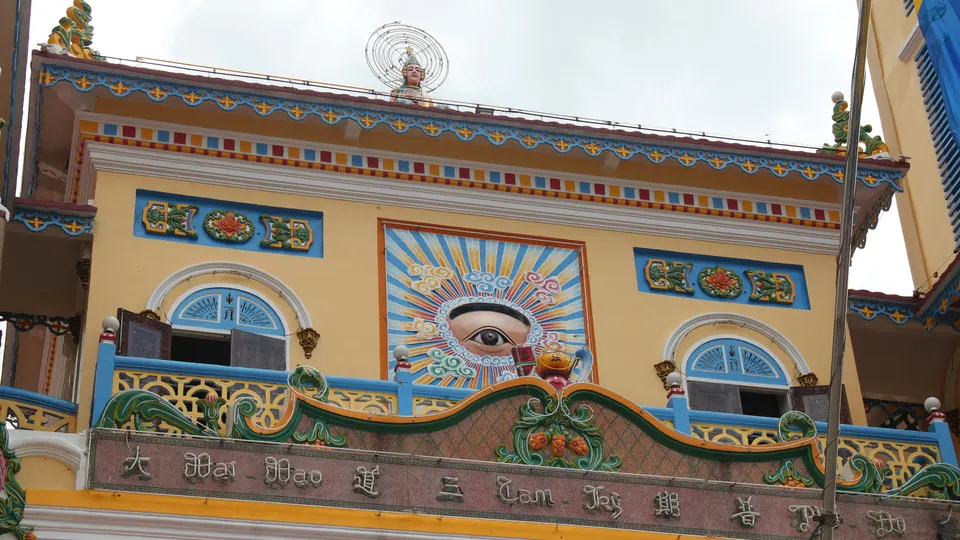
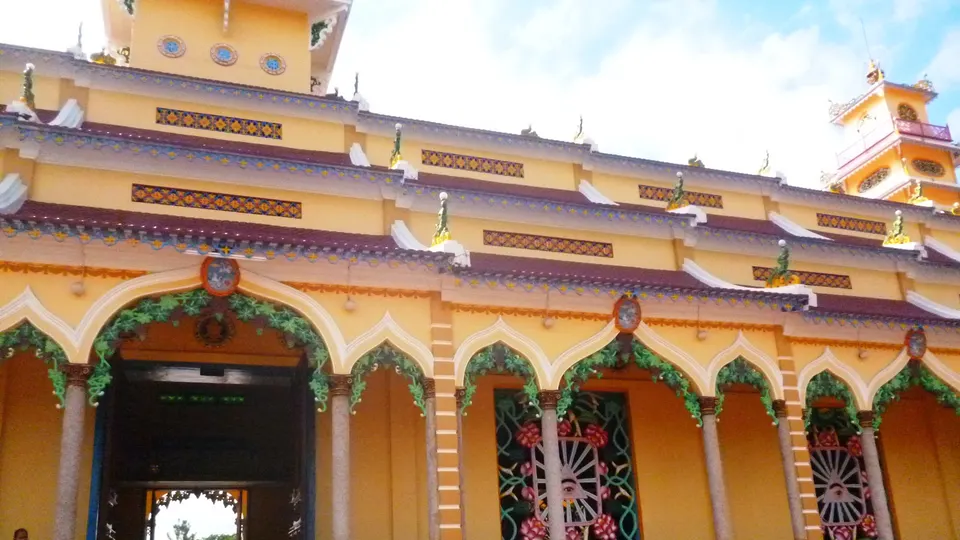
Its symbol is the Divine Eye (Thien nhan (Thiên nhãn)), an eye inside a triangle that stands for the Supreme Being; you will see it above doors, on windows and on the great globe inside. The church is organised much like the Roman Catholic Church, with a pope, cardinals and archbishops, and both men and women can be priests. The figures it honours range from the Buddha, Confucius and Jesus to Victor Hugo and Sun Yat-sen, whom the murals at the Holy See show as disciples. Its motto, Tam giáo quy nguyên, Ngũ chi phục nhứt, roughly means that the three teachings return to a single source.
Tay Ninh is the religion’s centre because it was founded there, and the Holy See is the largest seat of the faith, VnExpress notes. The followers themselves are spread more widely. Tien Phong (Tiền Phong) put their number at about 2.4 million in 35 provinces and cities in 2026; EBSCO gives an estimate of 2 to 6 million and says the exact figure is debated, with most followers living in the Mekong Delta.
The religion has also had a political history. EBSCO’s overview records that the movement raised an armed militia with Japanese support during the Second World War, that its army may have reached 25,000 men in the 1950s, and that its leader Pham Cong Tac (Phạm Công Tắc) went into exile after the army was disbanded. After 1975 the movement was repressed, EBSCO says; the Holy See and its lands were returned in 1985. Today the Holy See is again a working religious centre, and you are a guest at someone else’s service.
What to look for at the Holy See
The main temple took two decades or more to build, and sources do not agree on the dates. The newspaper Bao The gioi & Vietnam gives 1927 to 1947 and says the work was directed by the Ho Phap (Hộ Pháp), Pham Cong Tac, without any drawn plans (Bao The gioi & Vietnam). Vietnam Airlines’ guide dates the foundation work to 1931 and the groundbreaking to 1933, has the main structure finished on 24 January 1947 and the official inauguration on 1 February 1955, and notes restoration work in 2023.
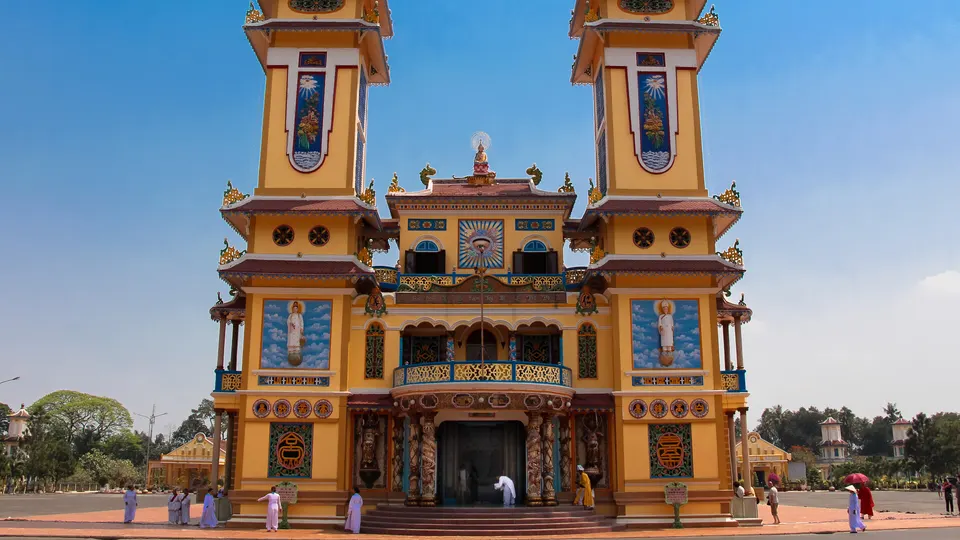
The building mixes traditions on purpose, so it rewards a slow look:
- The outline. Seen from the side, the temple is read as a reclining mythical horse (long ma (long mã)), with the drum tower and bell tower at the front as its two horns. The temple is about 140 m long and 40 m wide, according to the Vietnam National Authority of Tourism.
- The roof and towers. The dome on the roof is modelled on a mosque, and the Bat Quai Dai (Bát Quái Đài) at the far end has three storeys and eight sides, after the Taoist eight trigrams (bat quai (bát quái)).
- Inside the nave. Two rows of columns wrapped in coloured dragons lead to the altar; the ceiling is divided into nine parts and painted as a starry sky. At the end stands a large blue globe bearing the Divine Eye, decorated, Heritage magazine says, with 3,027 stars.
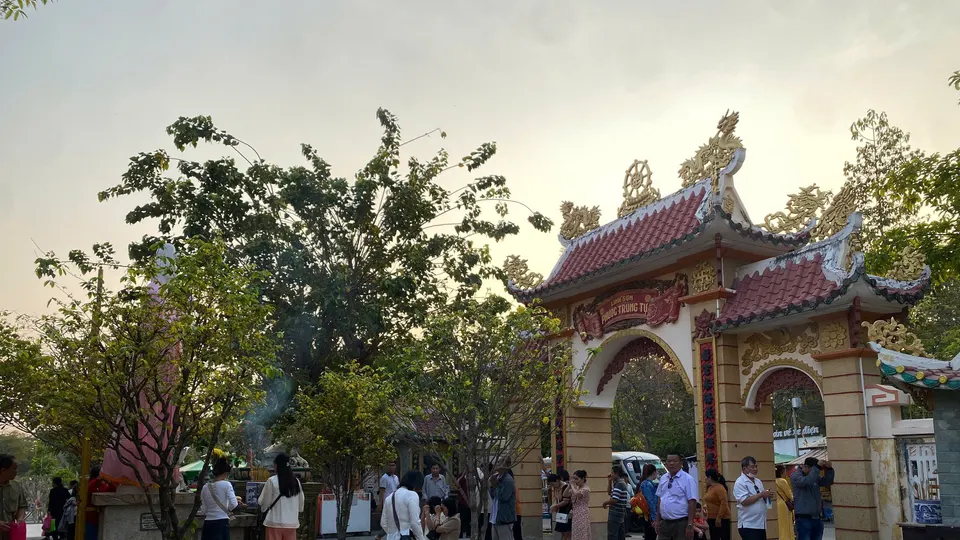
- The grounds. The temple sits in a walled park of more than 1 km², with twelve gates. Tuoi Tre (Tuổi Trẻ) News notes a protected area for monkeys just outside.
The mix is part of the point. Bao The gioi & Vietnam describes the style as a blend of Vietnamese temple, Taoist and Islamic forms, fitting for a faith that sets out to bring different teachings together.
How to watch the noon ceremony respectfully
Prayers are held four times a day, and noon is the biggest session and the one visitors should aim for, VnExpress International advised in 2018; Vietnamese press describes the same habit of visitors choosing the 12 o’clock rite. The other times are given differently: Outlook Traveller (2023) lists 6 am, noon, 6 pm and midnight, while Vietnam Airlines’ undated guide lists 6 am, noon and 6 pm plus an additional service at 9 am. Treat noon as the fixed point and ask on the day about the rest. VietNamNet reported in 2020 that the Holy See received 100 to 200 foreign visitors a day. During the ceremony, worshippers in white, red, blue or yellow robes kneel in rows before the altar, accompanied by gongs, string instruments and chanting. Visitors may be led up a narrow stairwell to a balcony overlooking the hall (Vietnam National Authority of Tourism).
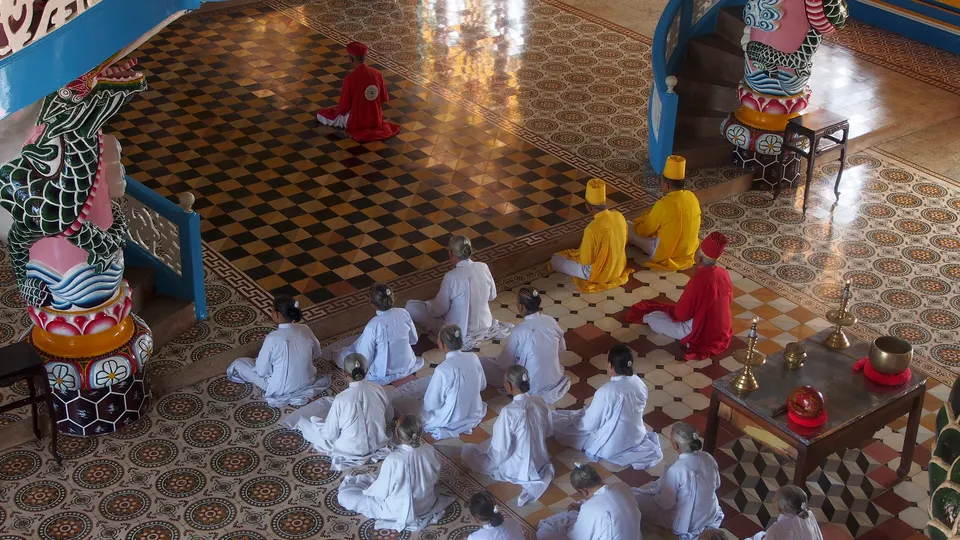
What the published guidance asks of visitors:
- Arrive early. Tours aim to be at the temple before about 11:45, so you have time to find the entrance and the stairs before the noon prayer starts.
- Dress modestly, especially if you will enter the main hall, and take your shoes off before you go in; sandals are not worn in the main hall.
- Use the side doors. Vietnam Airlines’ guide says visitors should not enter through the main door, only the two side doors. Men enter on the right and women on the left.
- Watch from where you are shown. Tuoi Tre News describes viewing platforms that open during prayer time; stay there, stay quiet and do not walk among the worshippers.
- Ask before photographing or filming, and before lighting incense: the attendants decide. VnExpress International noted in 2018 that photos are allowed of anything except the deities, and that visitors may not touch the great globe. Do not touch, write on or lean against the walls and decorations.
Common vs exception: most visitors come only for the noon prayer, so that is when the gallery is fullest. If you are staying overnight, the 6 am or 6 pm prayers give you a chance to see the same rite on a different schedule.
Is Ba Den Mountain worth the trip?
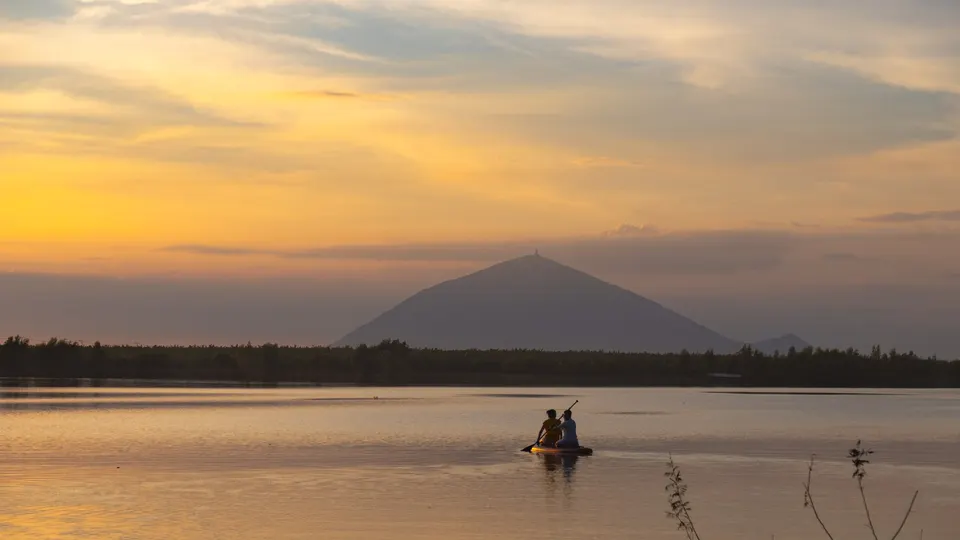
Ba Den Mountain (Nui Ba Den (Núi Bà Đen), often called the Black Virgin Mountain) is a dormant volcano that rises to 986 m, the highest peak in southern Vietnam, mostly in Binh Minh ward. With the smaller Nui Heo (Núi Heo) and Nui Phung (Núi Phụng) it forms a massif of about 24 km² (VnExpress). It is first of all a pilgrimage mountain: Saigon Giai Phong (Sài Gòn Giải Phóng) cites 19th-century records that already describe it as a sacred guardian of Gia Dinh (Gia Định), the old name for the Saigon area.
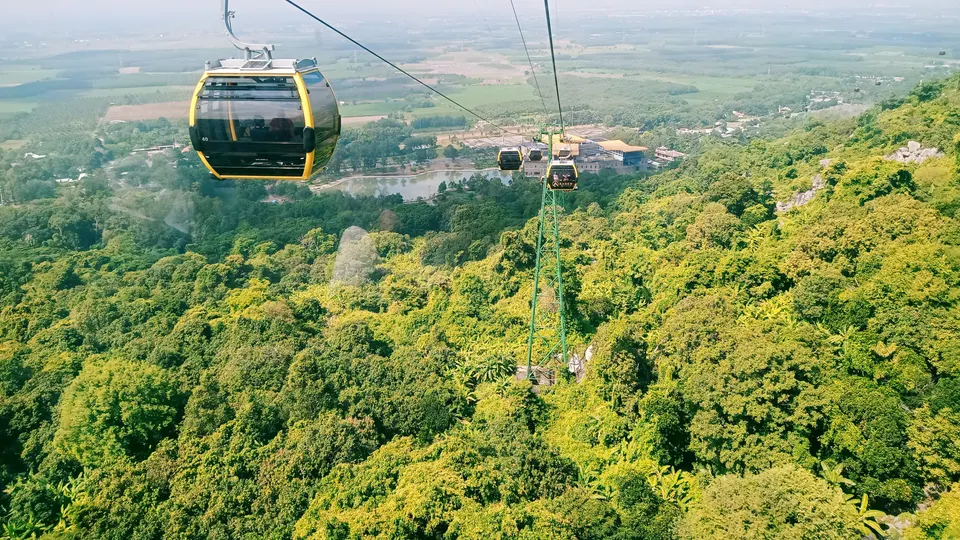
The heart of the pilgrimage is on the middle slope, at about 250 m. Chua Ba (Linh Son Tien Thach Tu), dated to the 18th century and about 300 years old according to press reports, is the oldest temple on the mountain; next to it, the Dien Ba (Điện Bà) shrine is built into a rock cave and honours Linh Son Thanh Mau (Linh Sơn Thánh Mẫu), the Holy Mother of the mountain, known to pilgrims simply as Ba Den.
Getting up. VnExpress lists three cable-car lines: the Van Son (Vân Sơn) line from the base to the summit (about 8 minutes), the Chua Hang (Chùa Hang) line from the base to the temple complex (about 5 minutes) and the Tam An (Tâm An) line from Chua Ba to the summit (about 5 minutes). Climbing on foot takes roughly two hours (VietNamNet) to three or four (VnExpress); for the harder routes, VnExpress advises registering with the forest rangers and hiring a guide. Mind your bags at the temples: Tuoi Tre News warns that the monkeys snatch them, especially if there is food inside.
Tickets and timing (prices dated, check before you go). VnExpress gave a range of 150,000 to 800,000 VND for cable-car tickets and combos in December 2025. The operator’s own list, dated 17 February 2026, gives approximate round-trip prices per line of 250,000 VND for adults and 150,000 VND for children on the Chua Hang line, and 450,000 and 350,000 VND on the Van Son and Tam An lines; children under 1 m ride free, and combos with the summit buffet run to about 650,000–800,000 VND per adult. It sells tickets online, in its app and at the station, and says prices and operating hours change with weekends, holidays and seasons, so check on the day rather than relying on a fixed timetable. Hikers should register with the forest rangers and, VnExpress advises, plan to start down before 3 pm.
Tradition vs today. The summit is now a resort as much as a sanctuary. It has a 72 m Buddhist statue, the Tuong Phat Ba Tay Bo Da Son (Tượng Phật Bà Tây Bổ Đà Sơn), cast from more than 170 tonnes of copper (VnExpress), food stalls and a buffet restaurant, and a calendar of events that runs from Buddhist festivals to New Year fireworks. Whether that suits you depends on what you came for: the old temples on the middle slope are where the pilgrimage itself still happens. The whole area is a national tourist area of nearly 3,000 ha, Bao Van Hoa (Báo Văn Hóa) reports.
When are Tay Ninh’s big festivals?
Tay Ninh follows the lunar calendar, and its festival days are some of the busiest in the south. The Holy Mother’s own festival at Ba Den, the Le via Ba Linh Son Thanh Mau (the festival of the Holy Mother), held on the 5th–6th day of the fifth lunar month, was listed as national intangible cultural heritage by a Ministry of Culture, Sports and Tourism decision of 4 September 2018 (Bao Van Hoa).
| When (lunar calendar) | Where | What happens |
|---|---|---|
| From the evening of the 4th day of Tet, through the first month | Ba Den Mountain | The spring festival (Hoi Xuan Nui Ba Den); on the 15th, thousands camp at the foot of the mountain (Saigon Giai Phong) |
| 8th–9th day of the first month | Holy See | Le via Duc Chi Ton (Lễ vía Đức Chí Tôn), the feast of the Supreme Being, one of Caodaism’s two great annual festivals |
| 5th–6th day of the fifth month | Ba Den Mountain | Le via Ba (Lễ vía Bà), the Holy Mother’s festival; national intangible heritage since 2018 |
| 15th day of the eighth month (Mid-Autumn full moon) | Holy See | Hoi Yen Dieu Tri Cung (Hội Yến Diêu Trì Cung), for the Holy Mother of the Cao Dai pantheon; in 2026 its 101st edition drew hundreds of thousands (Tien Phong) |
At the Hoi Yen Dieu Tri Cung, Tien Phong reported, a procession carries the Holy Mother past the temple and two incense dragons about 40 m long, each worked by around 50 people, breathe fire, alongside lion, tortoise and phoenix dances, one of them a phoenix on roller skates. So what: these are the most spectacular days to come, and the hardest. Roads, parking and cable cars are at their busiest, many people camp overnight on the grounds, and a quiet look at the architecture is impossible. If you want calm, avoid them.
What to eat in Tay Ninh
Much of Tay Ninh’s food fame comes from Trang Bang, the former town on the road from Saigon. Its speciality soup, bánh canh Trảng Bàng, is made, Vietnam News stresses, with rice noodles rather than tapioca: rice soaked overnight, ground, steamed, kneaded and pressed into thick round strands. The broth is simmered for hours from pork bones, carrots, straw mushrooms and dried shrimp; the bowl comes with lean pork or pork trotters, and with a plate of more than twenty kinds of greens and wild herbs and a sweet-and-sour fish sauce on the side. Our guides to banh canh by region and to banh trang rice paper compare the town’s two specialities with their cousins elsewhere.
Trang Bang’s location explains the dish’s reputation. One family’s account, told to VnExpress, traces it to the colonial era, when French convoys between Saigon and Tay Ninh stopped at Trang Bang and local cooks carried broth, pork and herbs to the drivers at night.
- Banh trang phoi suong. A thick rice paper that is grilled and then left out overnight or at dawn to absorb the dew, which makes it soft enough to eat without soaking. It is rolled with boiled pork hock, wild and river herbs and dipped in mam nem (mắm nêm), fermented fish sauce. Bao Van Hoa dates its listing as national intangible heritage to 2015; VietnamPlus gives 2016.
- Muoi tom (shrimp-chilli salt). Sea salt, dried chilli and shrimp, dried under Tay Ninh’s strong sun and made mainly in Trang Bang and Hoa Thanh, near National Route 22. It is best as a dip for guava or mango, and its craft became national intangible heritage on 14 February 2023 (Saigon Giai Phong).
- Also look for Tay Ninh veal and the custard apples grown around Ba Den, which VietNamNet lists among the province’s specialities.
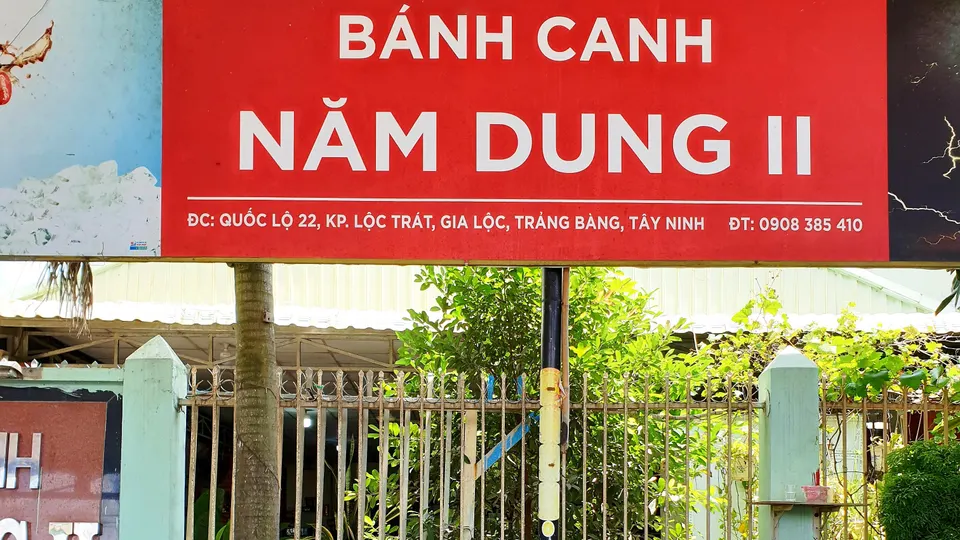
As of November 2026 we list one shop, Nam Dung (Năm Dung) in Trang Bang, which Viet Nam News named in August 2026 as one of the province’s most famous banh canh restaurants and whose street address a Vietnamese magazine confirmed; other well-known names could not be matched to an address in two independent press or official sources. For more on southern dishes, see our food hub.
A realistic one-day plan from Saigon
One long day. The fixed point is the noon prayer, so the day is planned backwards from it. Day tours that combine Tay Ninh with the Cu Chi Tunnels typically leave Saigon at 7:00, visit Cu Chi first and aim to reach the Holy See before 11:45, then stop for lunch and drive back (Travel Vietnam’s itinerary is a typical example). Some 12-hour tours add Ba Den as well, but three stops and four to six hours on the road leave little time at any of them.
| Time | Classic: Cu Chi + Holy See | Alternative: Holy See + Ba Den |
|---|---|---|
| 7:00 | Leave Ho Chi Minh City | Leave Ho Chi Minh City, straight to Tay Ninh (2–3 hours) |
| Mid-morning | Cu Chi Tunnels, on the way | Arrive at the Holy See early and walk the grounds |
| By 11:45 | Holy See: shoes off, side door, up to the gallery | Same |
| Noon | Noon prayer from the gallery | Same |
| Early afternoon | Lunch, for example banh canh in Trang Bang on the road back | Lunch, then the cable car to the temples or the summit |
| Late afternoon | Drive back to Saigon | Drive back; hikers should start down before 3 pm |
Lunch on the road is a natural moment for banh canh in Trang Bang. If you are building a longer stay, our three days in Saigon plan shows where a Tay Ninh day fits.
Two days. Day one: the Holy See for the noon prayer, then time to walk the grounds after the crowds leave. Day two: Ba Den in the morning, with the old temples on the middle slope before the summit. If you have the afternoon, Dau Tieng Lake, on the upper Saigon River, is the largest man-made lake in Vietnam (Heritage), about 270 km² according to VnExpress, and is visible from Ba Den. Tuoi Tre News describes small lakeside restaurants with hammocks for an after-lunch rest, and Heritage notes that the rubber forest nearby turns golden from late November to early March. To compare Tay Ninh with Cu Chi, the Mekong and Vung Tau, or to combine it with Cu Chi in one day, see our guide to day trips from Saigon.
Getting there from Ho Chi Minh City, and the 2025 merger
Tay Ninh has no airport; arrive at Tan Son Nhat (Tân Sơn Nhất) in Ho Chi Minh City and continue by road. Tay Ninh is about 100 km away, roughly 2 to 2.5 hours according to Vietnam Airlines’ guide, or 2.5 to 3 hours according to VnExpress, depending on traffic. You can go by day tour, private car, motorbike, limousine van or bus; a tour takes care of arriving in time for the noon prayer.
| Option | What the sources say (with date) | Best for |
|---|---|---|
| Day tour | Leaves around 7:00, timed for the noon prayer; full-day listings run to about 12 hours | First-timers who want the timing handled |
| Private car or motorbike | About 100 km on National Route 22 (22A, then 22B at Trang Bang), 2.5–3 hours (VnExpress, Dec 2025) | Flexibility, or adding Ba Den |
| Limousine van | Operators run from Ho Chi Minh City for about 150,000–250,000 VND (VnExpress, Dec 2025) | Independent travellers on a budget |
| Bus | Several routes run via Moc Bai or Cu Chi towards Ba Den; VnExpress gave fares of 100,000–200,000 VND (Dec 2025) | The cheapest option, but the slowest and hardest to time for noon |
Is a faster road coming? A 51 km Ho Chi Minh City–Moc Bai expressway, from Ring Road 3 to National Route 22 near the Cambodian border, began construction in packages in 2026. By early October 2026, about three months after the groundbreaking, piers were going up, land clearance on the Tay Ninh side was 99.5% complete and the project was still due to be finished in 2028, CafeF reported (5 October 2026). In April 2026 the city had expected the expressway itself to open in late 2027; plan on the existing roads until it does.
Names on the map. Under Resolution 202/2025/QH15 the former Long An and Tay Ninh provinces merged into a new Tay Ninh province from 1 July 2025, covering 8,536.44 km² and home to 3.25 million people, and its seat is in Tan An, the former capital of Long An (Tuoi Tre). Local names changed too: the Holy See, long described as being in Hoa Thanh, is now in Long Hoa ward, and Ba Den mostly in Binh Minh ward. Tien Phong still gave the Holy See’s address as Long Hoa ward, Tay Ninh, in September 2026. Older guides, tour notes and signs still use the former names.
Season. The dry season, roughly December to April, has the clearest weather; the rainy season, May to November, is greener and less crowded, VnExpress notes. Whatever the season, the Holy See is hot at midday, so bring water and a hat for the walk across the grounds. For more trip ideas across the country, see our travel hub.
Common mistakes on a Tay Ninh day trip
Most of what goes wrong on this trip is about timing and etiquette at a working temple. These are the mistakes the sources above warn about.
- Arriving after the prayer has started. Tours aim to be at the Holy See before 11:45; arrive later and you may miss the start of the rite.
- Walking in through the main door. Visitors use the two side doors, men on the right and women on the left, and take their shoes off before the main hall.
- Photographing the deities or filming without asking. Ask an attendant first, keep to the gallery and do not touch the great globe or the walls.
- Dressing for the beach. Cover shoulders and knees; sandals are not worn in the main hall.
- Trying to do everything in one day. Cu Chi, the Holy See and Ba Den together means more time on the road than at any stop; choose two.
- Starting a Ba Den hike late or alone. Register with the forest rangers, take a guide on the harder routes and start down before 3 pm.
- Carrying food in an open bag near the temples. Tuoi Tre News warns that the temple monkeys snatch bags, especially ones with food inside.
- Coming on a festival day for a quiet visit. At Tet, the Holy See’s great feasts and the Holy Mother’s festival, roads, parking and cable cars are packed; check the lunar dates first.
- Using old names and old prices. The Holy See is now in Long Hoa ward (no longer Hoa Thanh town), and ticket prices change: use the dates given here as a guide, not a quote.
Where to eat banh canh in Trang Bang
Local favourite
Bánh canh Trảng Bàng Năm Dung
Trảng Bàng, Tây Ninh · Trảng Bàng ward (former Trảng Bàng town)
90 Nguyễn Văn Rốp Street
Việt Nam News (August 2026) calls Năm Dung one of the most famous banh canh restaurants in Tay Ninh and quotes its cook on how the rice noodles are made; it sits in Trang Bang, on the road from Saigon, so it suits a lunch stop on the way back.
Order: Banh canh Trang Bang: thick rice noodles in pork-bone broth with pork or pork trotters, a plate of fresh herbs and greens, and the sweet-and-sour fish sauce.
The house number (90) comes from a 2020 magazine article; a user-review site lists 91, so look for the Năm Dung sign on Nguyễn Văn Rốp Street. The same family is linked to the Út Huệ shops (VnExpress, 2012), and other shops in town use similar names.
Recommended by: Việt Nam News (2026), Thương hiệu và Công luận (2020), VnExpress (2012) · checked November 2026
Addresses and details can change; check before you go. We do not accept payment for listings.
Frequently asked questions
Can tourists watch a Cao Dai ceremony at the Tay Ninh Holy See?
Yes. Visitors are led up to an upper gallery or balcony during prayers. Dress modestly, take your shoes off before the main hall, stay quiet and ask an attendant before photographing or filming.
Can I do Tay Ninh and the Cu Chi Tunnels in one day from Saigon?
Yes, and many day tours from Ho Chi Minh City do exactly that: Cu Chi in the morning, the Holy See before the noon prayer, then back in the afternoon. Some 12-hour tours squeeze in Ba Den Mountain as well, but adding Ba Den works better as a swap for Cu Chi or with an overnight stay.
Is Tay Ninh still a province after the 2025 merger?
Yes. Under Resolution 202/2025/QH15, Long An and Tay Ninh merged into a larger Tay Ninh province from 1 July 2025, with its seat in Tan An. The Holy See is now in Long Hoa ward, formerly part of Hoa Thanh town.
What time is the Cao Dai ceremony at the Tay Ninh Holy See?
Prayers are held four times a day, and noon is the main service that visitors attend. Published schedules differ on the other times (6 am, 6 pm and midnight, or 6 am, 9 am and 6 pm), so aim for noon and arrive by about 11:45.
How much does the Ba Den Mountain cable car cost in 2026?
As of November 2026, the latest price list from the Ba Den cable car operator (17 February 2026) gives round trips of about 250,000 VND per adult on the Chua Hang line to the temples and 450,000 VND on the Van Son line to the summit, with children under 1 m free. Prices change at weekends, holidays and festivals, so check on the day; climbing instead takes roughly two to four hours.
Key sources
- Biển người đổ về Tòa thánh Tây Ninh xem rồng nhang phun lửa · Tiền Phong, 26 September 2026
- Cao Dai (religious movement) · EBSCO Research Starters
- Kiệt tác kiến trúc tôn giáo nức tiếng ở Tây Ninh · Báo Thế giới & Việt Nam, 18 November 2023
- Seeking tranquility in Cao Dai Temple · Vietnam National Authority of Tourism (vietnamtourism.vn), 2009
- Cẩm nang du lịch núi Bà Đen · VnExpress, 26 December 2025
- Công bố Di sản văn hóa phi vật thể quốc gia “Lễ vía bà Linh Sơn Thánh Mẫu - núi Bà Đen” · Báo Văn Hóa, 14 August 2019
- “Vị ngọt” muối tôm ớt Tây Ninh · Sài Gòn Giải Phóng, 5 April 2023
- Tỉnh Tây Ninh mới sẽ hoạt động từ 1-7-2025 · Tuổi Trẻ, 13 June 2025
All 30 sources and further reading
- Tay Ninh Holy See travel guide · Vietnam Airlines
- 5 cái nhất ở Tây Ninh · VnExpress, 11 March 2021
- Núi Bà Đen chính thức khai mạc Hội xuân, hàng trăm người tìm đến núi thiêng · Sài Gòn Giải Phóng, 3 February 2025
- Tay Ninh's historical and cultural riches waiting to be explored · VietNamNet Global, 16 August 2020
- Tay Ninh: a gem hidden from Vietnam's tourist trail · Tuổi Trẻ News, 22 October 2021
- Tay Ninh – beyond Ba Den Mountain · Heritage (Vietnam Airlines magazine), 28 June 2022
- Rice noodle soup, the most popular dish in Tây Ninh Province · Việt Nam News, 2026
- Bánh canh Trảng Bàng Ba Xi · VnExpress, 13 January 2012
- Bánh tráng phơi sương Trảng Bàng - ẩm thực nổi tiếng đất Tây Ninh · VietnamPlus, 24 October 2023
- Bảo tồn, tôn vinh Nghề làm bánh tráng phơi sương Trảng Bàng · Báo Văn Hóa, 21 December 2018
- Cu Chi – Tay Ninh day trip (example itinerary) · Travel Vietnam
- Vietnam's unique religion and the center of its universe · VnExpress International, 6 November 2018
- All About Vietnam's Cao Dai Holy See · Outlook Traveller, May 2023
- Tòa thánh Tây Ninh - điểm du lịch văn hóa và tôn giáo · Luật sư Việt Nam (lsvn.vn), 5 January 2021
- Giá vé cáp treo núi Bà Đen 2026: giá vé và cách mua mới nhất · Sun Paradise Land (operator of Sun World Ba Den Mountain), 17 February 2026
- Cao Dai Temple and Ba Den Mountain full-day tour (example listing) · Musement
- Cao tốc TPHCM - Mộc Bài sắp khởi công loạt gói thầu · Tuổi Trẻ (Saigon Times), 27 February 2026
- TP.HCM tăng vốn dự án cao tốc đi Mộc Bài lên gần 23.000 tỷ, tiến độ lùi đến 2028 · Báo Pháp Luật Việt Nam (Doanh nhân), 19 April 2026
- Resolution 202/2025/QH15 on the reorganization of provincial-level administrative divisions · LuatVietnam (text of the National Assembly resolution)
- Cao tốc TPHCM - Mộc Bài rầm rộ thi công dàn lớp hình hài · CafeF (from Đại Đoàn Kết), 5 October 2026
- Xách ba lô lên và ăn cả Tây Ninh thôi · Thương hiệu và Công luận, 3 November 2020
- Rice noodle soup, the most popular dish in Tây Ninh Province (O Vietnam edition) · Việt Nam News, 25 August 2026
Keep exploring
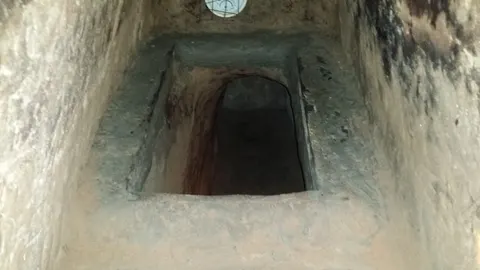 South Vietnam · Travel Cu Chi Tunnels (Củ Chi): Ben Duoc or Ben Dinh, and Tickets Ben Duoc or Ben Dinh? What the Cu Chi tunnels were, from 1946 to 1975, their relic and UNESCO status, and how to visit from Ho Chi Minh City by road or river.
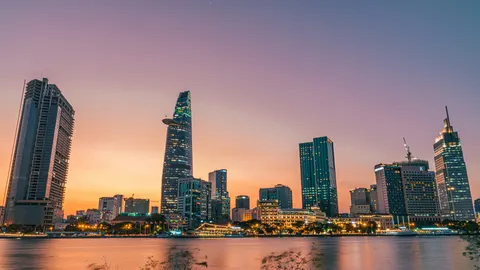 South Vietnam · Travel Ho Chi Minh City (Saigon): How Many Days and What to See Ho Chi Minh City (Saigon) explained: the 2025 merger and new wards, how many days to stay, Metro Line 1, Long Thanh airport, palace and museum tickets.
 South Vietnam · Travel Mekong Delta: Which Area to Visit and Where to Base Which part of the Mekong Delta to visit and where to base: Can Tho, Ben Tre or Chau Doc, Cai Rang market hours, seasons, where to eat, new province names.