North Vietnam · Food
Cha Ca La Vong (Chả Cá Lã Vọng): Where and How to Eat It
Where to eat cha ca La Vong in Hanoi, including the 2026 MICHELIN picks, how to eat the turmeric fish with dill at the table, and how it differs from fish cake.
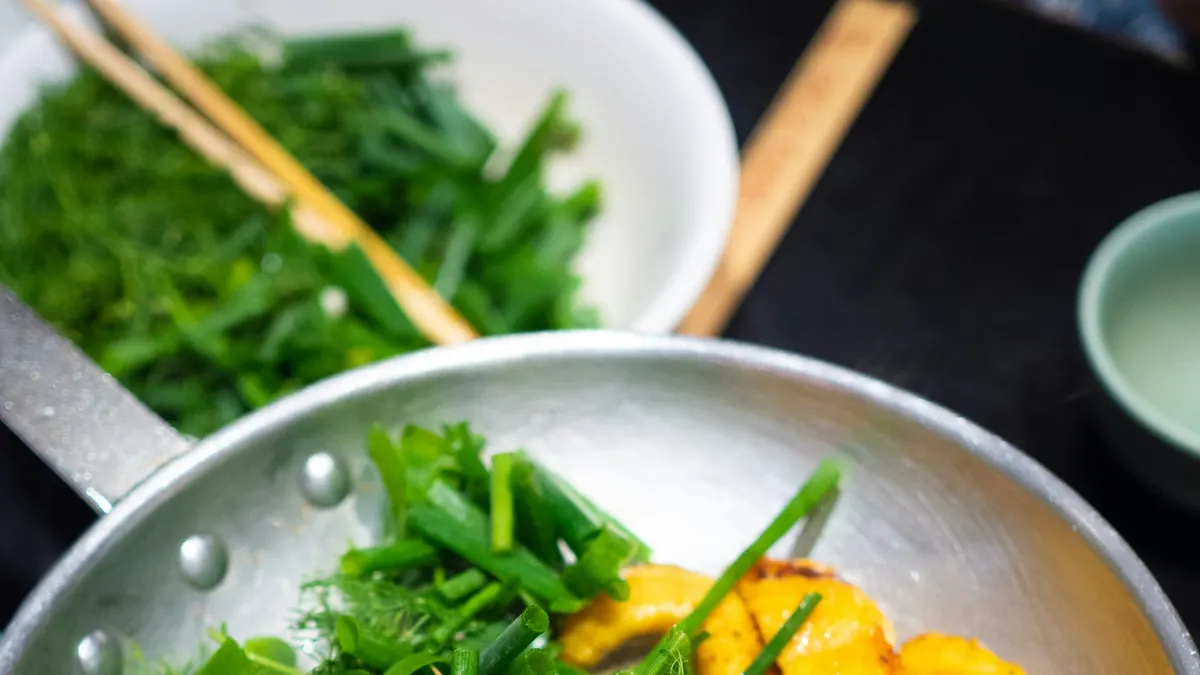
To eat cha ca La Vong, sit down at a Hanoi cha ca restaurant: the turmeric fish arrives in a sizzling pan, you stir in dill and spring onion yourself, and you eat it with rice noodles, peanuts, herbs and a shrimp-paste dip. As of November 2026, the MICHELIN Guide Vietnam 2026 lists two Hanoi specialists, Cha Ca Thang Long at 6B Duong Thanh Street (a Bib Gourmand) and Cha Ca Anh Vu on Giang Vo Street, while the Doan family that created the dish still serves it at 14 Cha Ca Street.
Cha ca La Vong (Chả cá Lã Vọng) is Hanoi’s turmeric fish. Pieces of river fish are marinated with turmeric, galangal and fermented rice, grilled over charcoal, and then brought to your table to finish sizzling in a pan of hot fat with handfuls of dill and spring onion. You eat it in a bowl with rice vermicelli, roasted peanuts, fresh herbs and a sharp dip of mam tom (mắm tôm) (fermented shrimp sauce). Cha (Chả) here means grilled or fried pieces, and ca (cá) means fish.
It is also one of the few dishes in Vietnam that has given its name to a street. The Doan (Đoàn) family, who created it in the Old Quarter, still run the shop that made it famous, and in December 2025 the Ministry of Culture, Sports and Tourism added the knowledge of preparing and enjoying cha ca La Vong to Vietnam’s national list of intangible cultural heritage (DTiNews). It joined six other Hanoi food traditions already on that list, including pho (phở).
What goes into cha ca La Vong?
The dish is simple in outline and fussy in detail.
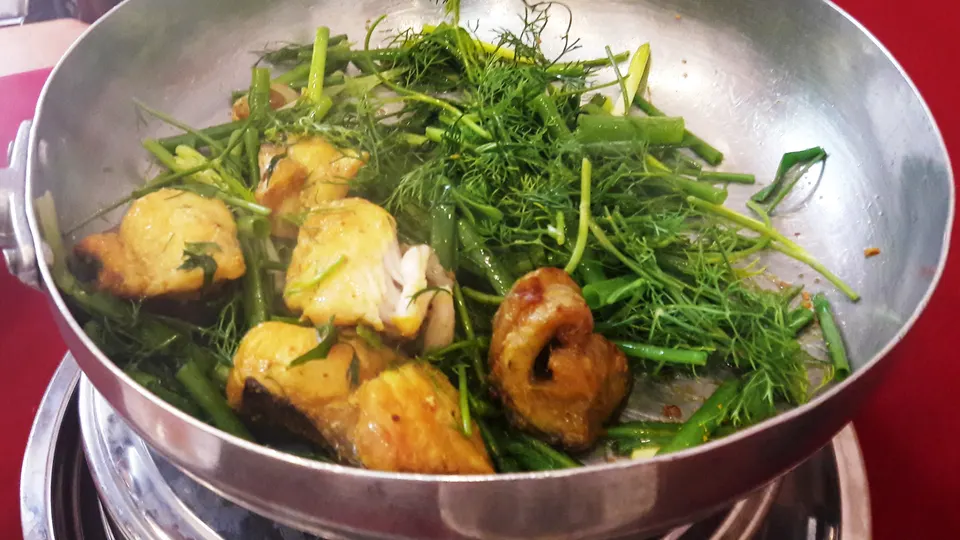
- The fish. The traditional choice is ca lang (cá lăng), a river catfish with firm, sweet flesh and few bones. Vietnamese writers also mention a rare version made with caca Anh Vu (cá Anh Vũ), a prized river fish from the Viet Tri (Việt Trì) area. Fillets are cut from both sides of the fish and sliced into flat pieces.
- The marinade. The fish rests for at least two hours in galangal, turmeric, me (mẻ) (a sour fermented rice), pepper and fish sauce. Turmeric gives the colour, galangal a sharp warmth, and me a gentle sourness that keeps the rich fish from tasting heavy. The exact proportions are the family’s secret (Tap chi Cong Thuong).
- The grill. The pieces are clamped in a hinged grill brushed with fat and cooked over charcoal until golden on both sides. This happens in the kitchen, before the fish reaches you.
- The finish. At the table the grilled fish goes into a small pan of sizzling fat over a burner, with dill (thi la (thì là)) and spring onion, added by the handful rather than as a garnish.
How do you eat cha ca at the table?
Cha ca (Chả cá) is a dish you finish yourself, and it has a rhythm.
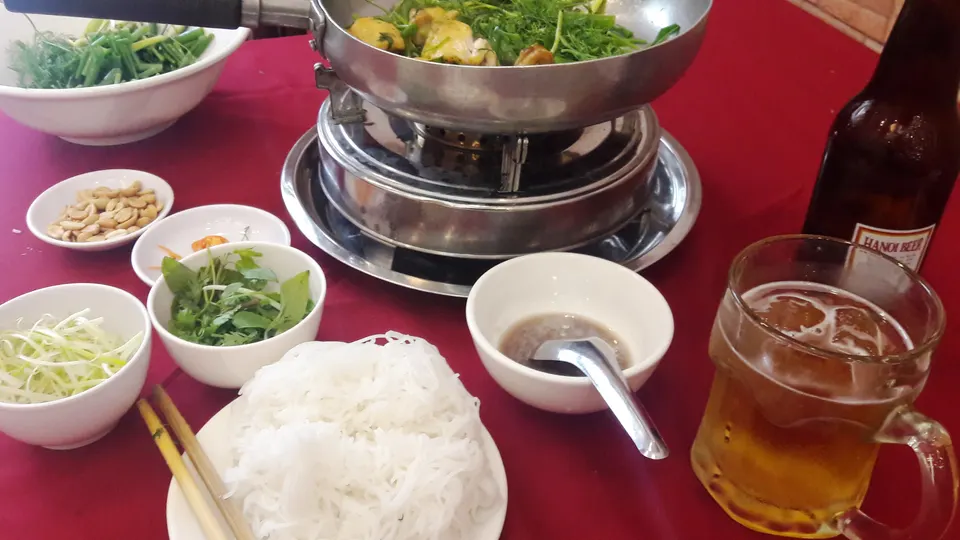
- Let the pan work. When the pan arrives, push the dill and spring onion into the hot fat and turn them with the fish for a moment. They only need to soften.
- Build a bowl. Put a little bun (bún) (rice vermicelli, often served in soft tangled nests called bun roi (bún rối)) in your bowl, add fish with dill and spring onion, then roasted peanuts and fresh herbs such as Lang (Láng) mint (hung Lang (húng Láng)). Some places also offer grilled rice crackers (banh da (bánh đa)).
- Add the dip. Spoon over a little mam tom, whipped with lime juice, chilli and sugar. The traditional version also takes a splash of rice spirit and a drop of ca cuong (cà cuống), a pungent essence from a giant water bug.
- Cut the richness. Thin spring-onion stalks soaked in diluted vinegar come on the side, because the dish is fatty and the sourness resets your palate (VnExpress).
- Eat it hot. Vietnamese food writers are firm that cha ca must be eaten hot, so cook and eat in small batches.
If mam tom is too strong for you, fish sauce (nuoc mam (nước mắm)) is an accepted alternative dip; our guide to Vietnam’s dipping sauces explains how to whisk and eat mam tom. For a sense of how this sharp, fermented dip differs from the shrimp paste that flavours Central Vietnam’s noodle soup, see our page on bun bo Hue and its mam ruoc.
Who created it, and why is a street named after it?

The family account, repeated in recent national press, is that Doan Xuan Phuc (Đoàn Xuân Phúc) and his wife Bui Thi Van (Bùi Thị Vân) created the dish in 1871 and first sold it at No. 14 Hang Son (Hàng Sơn), a street of lacquer and paint in the Old Quarter. During French colonial rule the house sheltered insurgents loyal to De Tham (Hoang Hoa Tham), who led an armed resistance to the French. The family served them grilled fish; guests encouraged them to open a shop, which also served as a discreet meeting place.
The date is not settled. A 2009 Nhan Dan (Nhân Dân) article on Hanoi’s street names places the invention in the early 19th century, earlier than the family’s 1871, and says the dish became so famous that the authorities gave up and accepted “Cha Ca” as the street’s name (Nhan Dan). None of the sources we checked gives a date for the renaming itself. What they agree on is the direction of travel: in a quarter where streets were named after the goods sold on them, here a single dish pushed out the old trade name. Our guide to Hanoi’s 36 streets explains how the Old Quarter’s other “Hang (Hàng)” streets got their names.
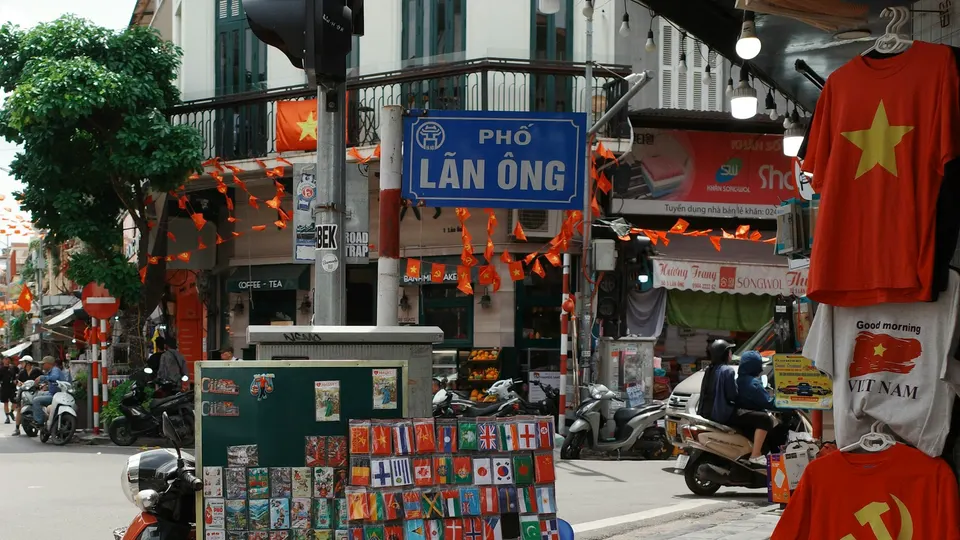
Cha Ca street lies in the heart of the Old Quarter. It used to be in Hang Dao (Hàng Đào) ward; since 1 July 2025, when Hanoi abolished its districts, it has been part of the new Hoan Kiem (Hoàn Kiếm) ward.
Who is La Vong, and why is his name on the dish?
La Vong (Lã Vọng) is the Vietnamese name for Khuong Tu Nha (Jiang Ziya in Chinese), a sage from ancient Chinese history and legend who is remembered for fishing quietly by a river while he waited for his time to serve. In Vietnamese culture he stands for a capable person biding his time.
The Doan family put a statue of La Vong crouching with his fishing rod in the shop, and adopted his image as its emblem. Regular customers began calling the place “Chả cá Lã Vọng”, and the name stuck to both the restaurant and the dish. VnExpress and Tap chi Cong Thuong (Tạp chí Công Thương) both describe the figure as a symbol of a talented person waiting for the right moment, a fitting emblem for a house that, by its own account, sheltered anti-colonial fighters.
So “La Vong” in the name is not a place, an ingredient or a person who cooked. It is a symbol, and you will also see the dish sold simply as “chả cá Hà Nội” (Hanoi-style cha ca).
Cha ca La Vong vs cha ca fish cake: which one is on the menu?
This is the most common confusion about the dish. In most of Vietnam, cha ca on its own means fish cake: fish pounded into a paste and then fried or steamed. Only in Hanoi, and on menus that say “La Vong” or “Hanoi (Hà Nội)”, does it reliably mean grilled turmeric fish.
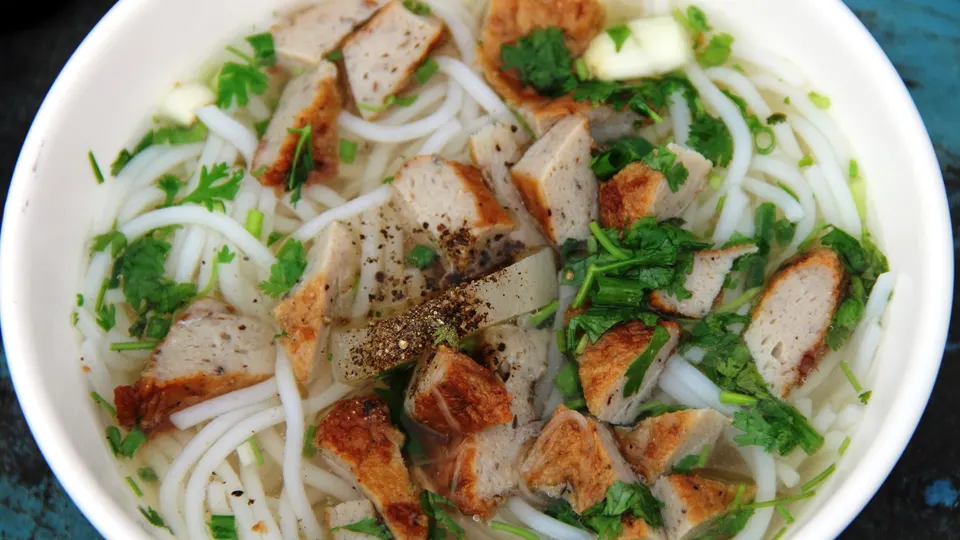
| Cha ca La Vong (Hanoi) | Cha ca as fish cake (e.g. Nha Trang, Hai Phong) | |
|---|---|---|
| What it is | Pieces of marinated fish fillet | Fish pounded to a paste and shaped |
| Typical fish | River fish: traditionally ca lang; today often snakehead or other catfish | Sea fish such as lizardfish (ca moi), mackerel (ca thu) or barracuda (ca nhong) in Nha Trang |
| Flavouring | Turmeric, galangal, me, fish sauce, pepper | Shallot, garlic, pepper, fish sauce; Hai Phong versions add dill |
| Cooking | Grilled over charcoal, then finished in hot fat with dill at the table | Fried until golden, or steamed |
| Texture | Whole pieces of fish, golden from the grill | Springy and chewy; the finer the paste, the chewier the cake |
| How it is eaten | A sit-down meal with bun, peanuts, herbs and mam tom | With rice, or in noodle soups such as banh canh (bánh canh) and bun ca (bún cá) |
The fish-cake column follows VnExpress’s description of Nha Trang fish cake, where cooks pound fish with shallots, garlic and pepper and say “the finer, the chewier” (VnExpress), and a Znews round-up of regional cha ca that describes Hai Phong’s as firm and chewy, scented with dill. Fish cakes are a speciality of many coastal towns in Central Vietnam, from Da Nang (Đà Nẵng) to Nha Trang, and the two foods share nothing but a name: if you order cha ca in Nha Trang you will get a fish cake, and in Hanoi you will get a pan.
The 2026 MICHELIN selection shows the split neatly: in Hanoi its cha ca picks are turmeric-fish restaurants, while in Da Nang its Bib Gourmand list includes two bun cha ca (fish-cake noodle soup) shops, Bun Cha Ca 109 and Bun Cha Ca Hon, VnExpress reported in June 2026.
Tradition and today
The family tradition. For more than a century the recipe has passed down five or six generations of the Doan family, depending on the account, and press reports say the secret was traditionally handed to the eldest son. The family shop’s fame spread abroad in 2003, when Patricia Schultz included it in her book 1,000 Places to See Before You Die.
What has changed. The method did not stay in one house. Historian Duong Trung Quoc (Dương Trung Quốc) has noted that many people learned the dish, cooked it and adapted it (Dai Doan Ket). Other cha ca shops opened on Cha Ca street itself, and cha ca restaurants now operate across Hanoi and beyond. Ca lang is now raised on fish farms along the Da (Đà) River, and many restaurants use cheaper fish such as snakehead (ca qua (cá quả)) or other catfish, which food writers describe as softer and bonier. Where the table pan once sat on a charcoal stove, many places now use a portable gas burner.
What the 2025 listing protects. The national heritage listing covers the knowledge of preparing and enjoying the dish, not a brand. According to DTiNews, the heritage dossier cites only two addresses, Nos. 14 and 5 Cha Ca street, both run by the Doan family, and acknowledges that many other places have moved away from the traditional method. So the common cha ca you will find around Hanoi and the version the heritage listing describes are not quite the same thing.
Where it stands in November 2026. When MICHELIN announced its 2026 Vietnam selection in Hanoi on 4 June 2026, it named 72 Bib Gourmand restaurants nationwide (good food at moderate prices), 23 of them in Hanoi, VnExpress reported. Cha Ca Thang Long at 6B Duong Thanh Street is one of those Hanoi Bib Gourmands, and its MICHELIN listing, re-checked in November 2026, puts it in the guide’s lowest price band; Cha Ca Anh Vu on Giang Vo Street appears in the wider 2026 selection without a Bib. Outside Vietnam the dish has a growing name too: in June 2025 VnExpress International reported that cha ca La Vong ranked 4th in the food site TasteAtlas’s list of the top 100 Asian fish dishes, based on reader ratings collected until 15 May 2025.
What this means when you order in Hanoi
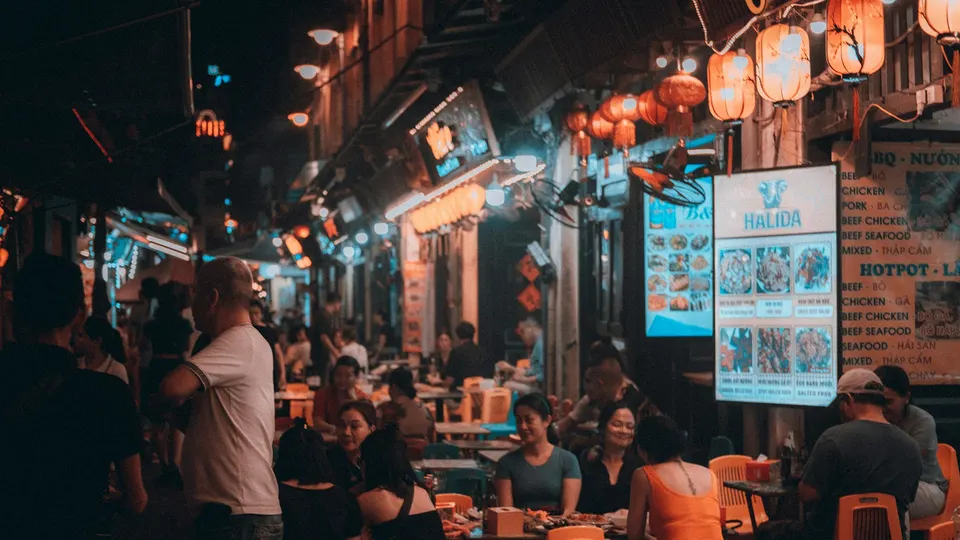
- “Cha ca” on a Hanoi sign means the turmeric fish. Outside the North, check the menu: if it says bun cha ca (bún chả cá) or bánh canh chả cá, it is fish cake in a soup.
- It is a sit-down meal, not a snack. The fish comes with its bun, herbs, peanuts and dip, and it suits sharing at a table rather than eating on the go.
- Ask about the fish if it matters to you. “Ca gi (Cá gì)?” (what fish?) is a normal question. Ca lang is the traditional choice.
- Mind the pan. The fat is very hot. Add herbs a handful at a time and lift the fish out as soon as the dill softens.
- Pair it with the rest of Northern food. Cha ca sits in the same Hanoi tradition of restrained, herb-led cooking as clear-broth pho; our guide to pho by region explains that style, the North Vietnam hub covers the region, and the food section collects more regional dishes.
Where to try chả cá in Hanoi
Local favourite
Chả Cá Lã Vọng · Chả cá Lã Vọng
Hanoi · Old Quarter, Hoàn Kiếm ward (former Hàng Đào ward, Hoàn Kiếm district)
14 Chả Cá Street
The Đoàn family's shop, where the dish was first sold, on the street that took its name. The 2025 national heritage dossier cites only Nos. 14 and 5 Chả Cá Street, both run by the family, whose fourth generation still serves diners there.
Order: Chả cá with rice vermicelli, roasted peanuts, dill, spring onion and herbs, and mắm tôm whipped with lime and chilli. Eat it hot.
'Chả cá Lã Vọng' is also the name of the dish, and many restaurants serve it under that name. This card means the Đoàn family's shop at No. 14 Chả Cá Street.
Recommended by: DTiNews (Dân Trí) (2025), Đại Đoàn Kết (2025), Tạp chí Công Thương (2020) · checked November 2026
MICHELIN Guide pick
Chả Cá Thăng Long · Chả cá Thăng Long
Hanoi · Old Quarter, Hoàn Kiếm ward (former Hoàn Kiếm district)
6B Đường Thành Street
A Bib Gourmand pick in the MICHELIN Guide Vietnam 2026, in a pale-yellow, century-old townhouse reached through a courtyard. The fish is deboned cá lăng, seasoned with turmeric, wrapped in banana leaves and grilled, then finished in a hot pan with spring onions and herbs.
Order: Chả cá with rice noodles; the inspectors suggest fish sauce as the dip.
The restaurant has three branches on the same street. This card means No. 6B, the one MICHELIN lists.
Listed in: MICHELIN Guide Vietnam 2026 · checked November 2026
MICHELIN Guide pick
Chả Cá Anh Vũ · Chả cá Anh Vũ
Hanoi · Ô Chợ Dừa ward (former Đống Đa district)
120-K1 Giảng Võ Street
Listed in the MICHELIN Guide Vietnam 2026: a family-run restaurant of more than 20 years, with chequered tablecloths and painted murals, serving tender turmeric-seasoned grilled catfish.
Order: Chả cá, with fish spring rolls (nem cá), fish soup (canh cá) or fish stomach (lòng cá) as extras.
Listed in: MICHELIN Guide Vietnam 2026 · checked November 2026
Addresses and details can change; check before you go. We do not accept payment for listings.
Frequently asked questions
Which cha ca restaurant in Hanoi should I go to?
For the original, go to the Doan family's Cha Ca La Vong at 14 Cha Ca Street in the Old Quarter, where the dish was first sold. For a guide-backed choice, Cha Ca Thang Long at 6B Duong Thanh Street is a MICHELIN Bib Gourmand in 2026, and Cha Ca Anh Vu at 120-K1 Giang Vo Street is also in the 2026 MICHELIN Guide Vietnam.
Is Cha Ca Thang Long still in the MICHELIN Guide?
Yes. Cha Ca Thang Long kept a Bib Gourmand in the MICHELIN Guide Vietnam 2026, announced on 4 June 2026. It has three branches on Duong Thanh Street, and the one MICHELIN lists is No. 6B.
Do I have to eat cha ca with shrimp paste?
No. Mam tom (fermented shrimp paste), whipped with lime, chilli and a little sugar, is the classic dip for cha ca La Vong, but fish sauce (nuoc mam) is an accepted alternative, and MICHELIN's inspectors suggest fish sauce at Cha Ca Thang Long.
Is cha ca in Da Nang or Nha Trang the same as cha ca La Vong?
No. In Da Nang and Nha Trang, cha ca means fish cake made from pounded fish paste, often served in noodle soups such as bun cha ca. Cha ca La Vong is a Hanoi dish of turmeric-marinated grilled fish finished with dill at the table.
Is cha ca La Vong a UNESCO heritage?
No. Cha ca La Vong is on Vietnam's national list of intangible cultural heritage, announced in December 2025, which is a national rather than a UNESCO listing.
Key sources
- Danh sách các nhà hàng Michelin vinh danh năm 2026 · VnExpress, 4 June 2026
- La Vong grilled fish named national intangible cultural heritage · DTiNews (Dân Trí), 17 Dec 2025
- A six-generation Hanoi family perfecting the essence of Cha Ca La Vong · Hanoi Department of Culture and Sports, Dec 2025
- Từ món ăn gia truyền đến di sản văn hóa của Hà Nội · Đại Đoàn Kết, 23 Dec 2025
- Hà Nội còn bao nhiêu phố mang chữ Hàng? · Nhân Dân, 10 Dec 2009
- Thơm mãi vị chả cá Lã Vọng · VnExpress, 5 Sep 2013
- Chả cá Lã Vọng có từ bao giờ? · Tạp chí Công Thương, 28 Sep 2020
- Chả cá tươi · VnExpress, 7 Feb 2007
All 16 sources and further reading
- 11 MICHELIN Stars Awarded in the 2026 MICHELIN Guide Hanoi · MICHELIN Guide, 4 June 2026
- 'Cha ca la vong' leads Vietnam's trio in top 100 Asian fish dishes · VnExpress International, 10 June 2025
- Tôn vinh văn hóa ẩm thực Hà Nội · Đại biểu Nhân dân, 16 Dec 2025
- Điểm danh món chả cá nổi tiếng 3 miền · Znews (from Kiến Thức), 15 Dec 2014
- Hàng Sơn 1871 evokes the past for today's diners · Viet Nam News, 29 Apr 2018
- Cha Ca – a dish carrying the culinary essence of Hanoi · VietNamNet, 20 Mar 2021
- Resolution 1656/NQ-UBTVQH15 on the reorganization of commune-level administrative divisions of Hanoi · LuatVietnam (text of the National Assembly Standing Committee resolution), 2025
- Chả cá Lã Vọng · Wikipedia (background only)
Keep exploring
 North Vietnam · Travel Hanoi: How Many Days, What to See and When to Go Hanoi travel guide for 2026: how many days and where to stay, Noi Bai airport, walking-street hours, the new low-emission zone, Train Street and where to eat.
 North · Central · South · Food Hanoi vs Saigon Pho (Phở): Differences and How to Order Hanoi vs Saigon pho: a clear, spare Northern broth or a sweeter Southern bowl with herbs and sauces, plus Central styles, 2026 prices and MICHELIN picks.
 Central Vietnam · Food Bun Bo Hue (Bún Bò Huế): Dac Biet, How to Order and Cook Bun bo Hue explained: what a dac biet bowl holds, how Hue cooks make the lemongrass and shrimp paste broth, what hot dieu mau does, and Hue vs Saigon bowls.