All three regions · Food
Nem Ran (Nem Rán) vs Cha Gio vs Ram: Which Roll to Order
Nem ran, cha gio or ram? Which Vietnamese fried spring roll to order in Hanoi, Saigon and the Centre, how fresh rolls differ, and where to try them in 2026.
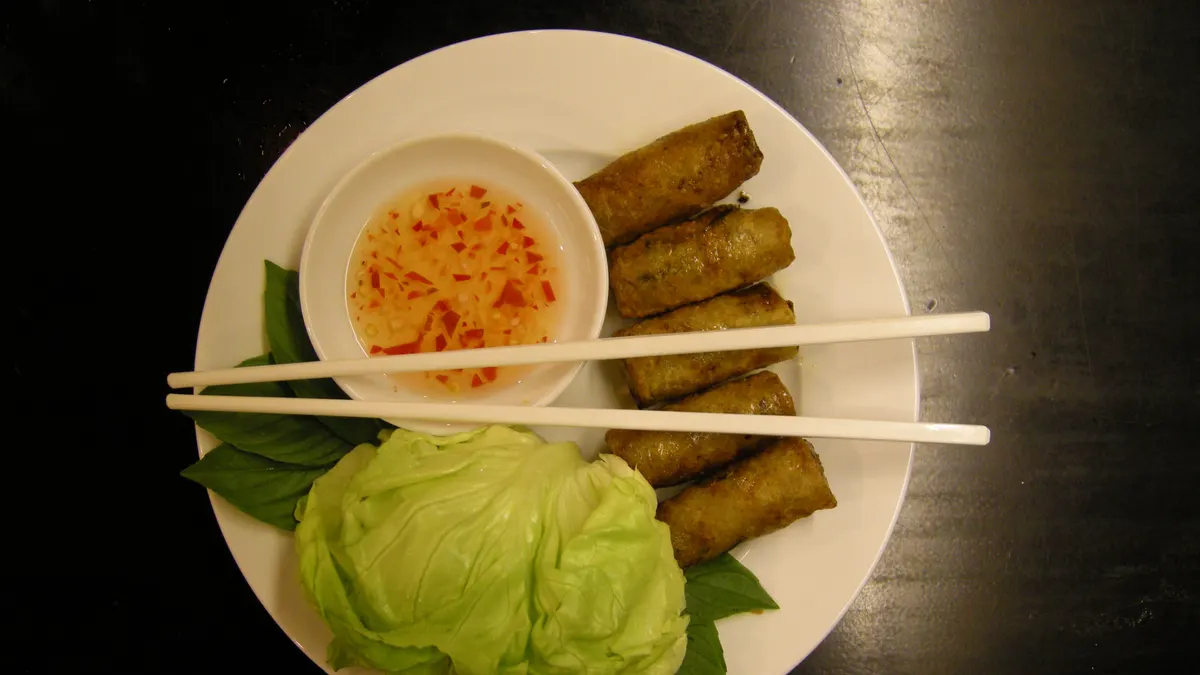
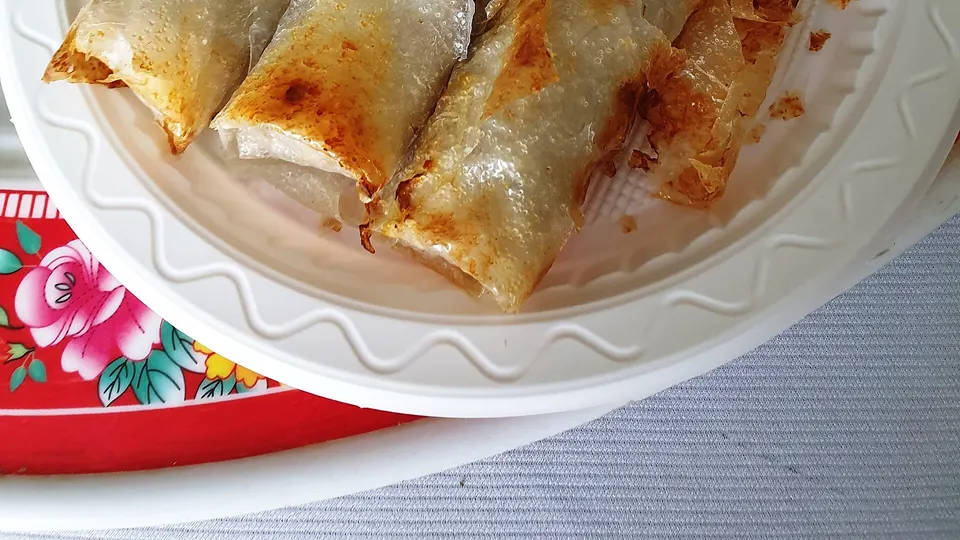
Nem ran (nem rán), cha gio (chả giò) and ram are one dish under three regional names: a rice-paper roll filled with seasoned meat and deep-fried. Order nem ran in Hanoi, where it is the classic side for bun cha, cha gio in Saigon, where it is cut over noodles with grilled pork, and ram on the central coast; for the soft, unfried roll, ask for nem cuon in the North or goi cuon in the South. As of November 2026, the MICHELIN Guide Vietnam 2026 lists Hanoi’s Bun Cha Ta, which makes crab, chicken and vegetarian fried rolls, as a Bib Gourmand, and VnExpress reported in July 2025 that cha gio topped TasteAtlas’s crowd-rated list of Vietnam’s best snacks at 4.3 out of 5.
Order “nem” in Hanoi and a plate of golden fried rolls arrives. Say the same word in Saigon and you may get grilled pork sausage instead, because there the fried roll is cha gio; travel the central coast and it becomes ram. All three are the same family of dish: a rice-paper wrapper around seasoned meat, deep-fried until it shatters. VietnamPlus, summarising a foreign food guide, puts it simply: nem ran is “also called cha gio or cha ram depending on the region”, and it is not the Chinese egg roll (VietnamPlus).
This guide sorts out the names, what goes into each regional roll, how the fresh rolls that share the “spring roll” label differ, and how to order and eat them. The sauces have their own page, Vietnamese dipping sauces by region, so here they get only a line or two.
Fried and fresh rolls by region at a glance
| North (Hanoi, Hai Phong (Hải Phòng)) | Centre (Ha Tinh (Hà Tĩnh), Binh Dinh (Bình Định)) | South (Saigon, Mekong Delta) | |
|---|---|---|---|
| Name for the fried roll | Nem, nem ran; “cha nem” in several Northern provinces | Ram, cha ram | Cha gio |
| Wrapper | Banh da nem (bánh đa nem), thin dried rice paper | Thicker rice paper; Ha Tinh’s is tinted with molasses | Rice paper |
| Typical filling | Minced pork, glass noodles, wood ear and shiitake, kohlrabi or carrot, egg | Ha Tinh: hand-chopped pork, glass noodles, spring onion, culantro. Binh Dinh: whole small river shrimp and pork belly | Pork and shrimp, wood ear, glass noodles, vegetables; taro in some recipes |
| Shape | Long and slim; Hai Phong’s crab roll is square and palm-sized | Slim, about two fingers wide (Ha Tinh) | Long and slim |
| Eaten with | Herbs, lettuce, rice noodles; the side dish for bun cha | Greens and more rice paper (Binh Dinh); steamed rice sheets (Ha Tinh) | Lettuce and herbs, or cut over bun thit nuong |
| Name for the fresh roll | Nem cuon | Banh trang cuon (rice-paper rolls), such as Da Nang’s with boiled pork | Goi cuon |
These are tendencies documented by the sources below, not borders: every family has its own recipe, and the names travel with the cooks.
Why does one fried roll have so many names?
The word nem is the root of the confusion. In Northern Vietnam it covers a whole group of pork dishes, and the trade ministry’s magazine Tap chi Cong Thuong (Tạp chí Công Thương) lists them: nem chua, pork cured with rice powder until sour; nem nuong, minced pork grilled on a skewer, famous in Nha Trang; nem chao, shredded pork skin tossed with roasted rice powder; nem cuon, the fresh roll; and nem ran, the fried one, which “in the South is called cha gio”.
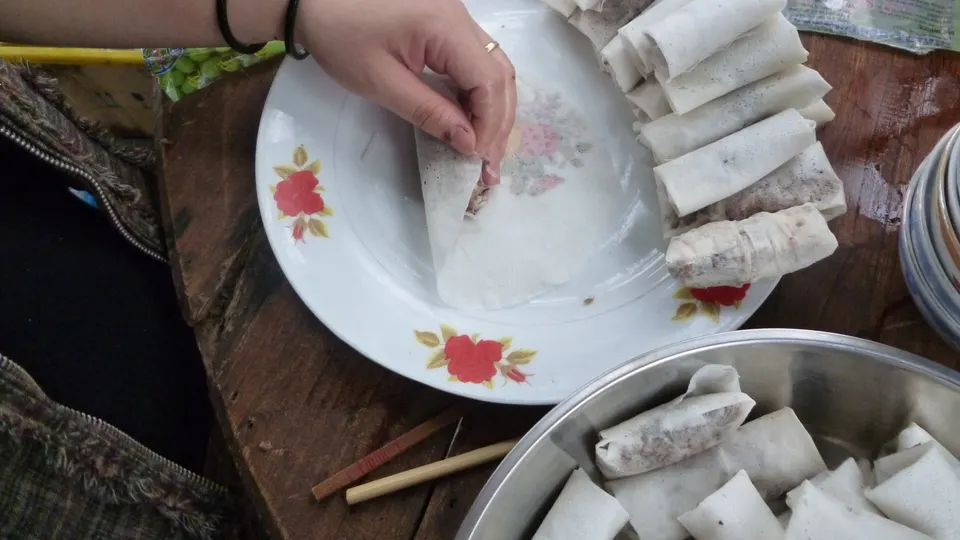
Within the North the names split further. Writing in Viet Nam News, Nguyen My Ha notes that in Hanoi “a simple order for nem is enough”, that Hai Phong and several neighbouring Northern provinces say cha nem, that from Thanh Hoa down the coast to Binh Dinh the fried roll is cha ram, and that the Mekong Delta and Saigon say cha gio (Viet Nam News). She also records that older Hanoians called the rolls “nem Saigon”, a clue to their history, and that in the early 20th century cha gio was also the name of a curled fringe hairstyle worn by Saigon women.
The practical result: a single word can mean four different dishes depending on where you say it. She describes a Hanoi bun cha shop where an order went wrong over exactly this. When in doubt, add the second word: nem ran (fried), nem cuon (fresh), nem nuong (grilled), nem chua (sour).
What goes into a Northern nem ran?
A Hanoi nem is a thin, crisp roll of rice paper around a dense, savoury filling. The Hanoi Times describes the old Hanoi mix as pork shoulder with kohlrabi, carrot (or jicama or bean sprouts), glass noodles, shiitake, wood ear mushrooms, egg and pepper, all minced and mixed, then rolled in rice paper and fried until golden. It is eaten with coriander, sawleaf, perilla and lettuce and a fish sauce dip sharpened with vinegar, garlic and chilli, sometimes with pickled kohlrabi or papaya.
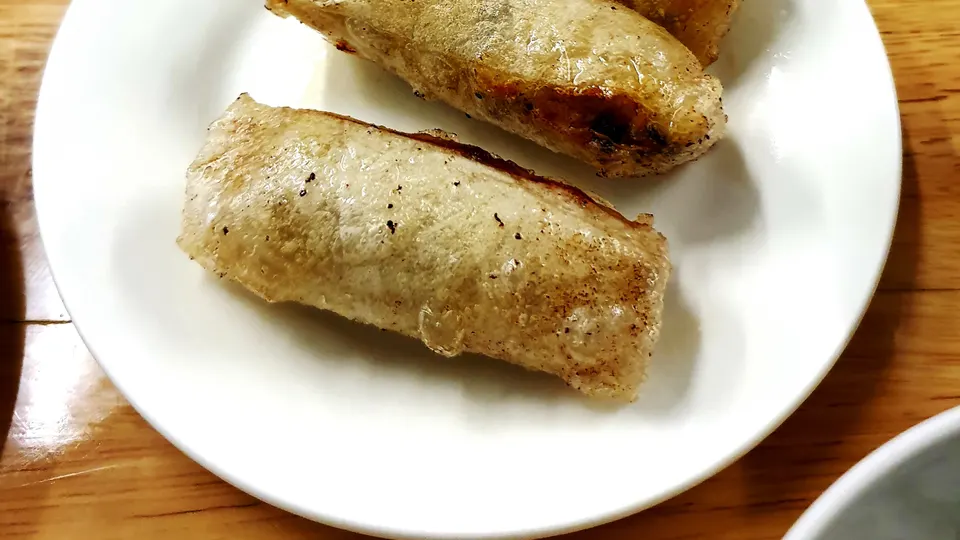
The wrapper matters. VietnamPlus’s recipe calls for banh da nem, a rice-flour sheet that is brittle and easy to tear, and notes that some cooks switch to wheat-flour wrappers because they are easier to roll, at the cost of the traditional texture. The roll must be sealed completely and is often fried twice: MICHELIN’s recipe from Hanoi’s Bun Cha Ta fries first on low heat to cook the filling, then on high heat to crisp the skin, and suggests brushing the rice paper with a little beer to keep it supple. Our banh trang guide explains how the sheets are made and where the heritage rice paper villages are.
The North’s showpiece is nem cua be (nem cua bể), the sea-crab roll of Hai Phong, which Vietnam’s national tourism authority lists among the country’s signature rolls: rice paper around crab, shrimp, pork, wood ear, vermicelli and bean sprouts, folded and deep-fried (Vietnam Tourism). Unlike the slim Hanoi roll it is square and about the size of a palm, wrapped in a chewier sheet so it does not burst, and served with rice noodles and herbs, according to VnExpress. The Hanoi Times adds that the squares are tied with bamboo string while frying and cut into four. In Hanoi, VnExpress’s cooking writer Bui Thuy calls the crab roll a winter favourite, especially for holidays and Tet (Tết). Other Northern cooks swap the pork for beef, prawn or even apple snails.
Fried nem is also part of the Hanoi bun cha meal: many diners order a plate on the side, and some shops in Hanoi’s Old Quarter, such as Bun Cha Ta, also make crab, seafood, chicken and vegetarian versions.
How is Southern cha gio different?
In the South the roll is cha gio, and the basic idea is the same. VnExpress International describes it as clear rice paper wrapped around ground pork, vegetables, wood ear mushrooms and glass noodles, deep-fried until golden and served with lettuce, herbs and fish sauce mixed with sugar; it adds that each family has its own recipe (VnExpress International).
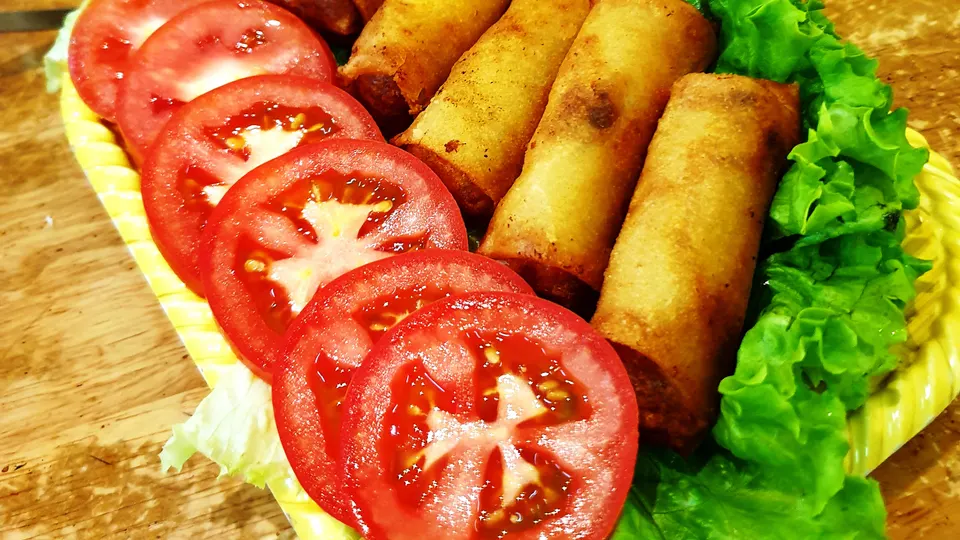
What changes in practice is the mix and the setting. Many Southern recipes combine pork with shrimp, and a VnExpress recipe for cha gio khoai mon adds shredded taro to minced shrimp and pork, which makes the roll lighter; it is cut over rice noodles with herbs and eaten with sweet-and-sour fish sauce. That is the everyday Southern way to eat it: sliced on top of bun thit nuong, cold rice noodles with grilled pork, as at the MICHELIN-listed Bun Thit Nuong Hoang Van (Bún Thịt Nướng Hoàng Văn) in Ho Chi Minh City. The dipping sauce is usually sweeter than in Hanoi.
The common pattern is pork, often with shrimp. The exceptions are many: crab spring rolls at seafood specialists such as Saigon’s MICHELIN-listed Thuy 94 Cu (Thúy 94 Cũ), and vegetarian rolls (cha gio chay), which even some Hanoi bun cha shops now offer.
What is ram in Central Vietnam?
From Thanh Hoa down the central coast, the fried roll is often called ram, and two local styles are well documented.
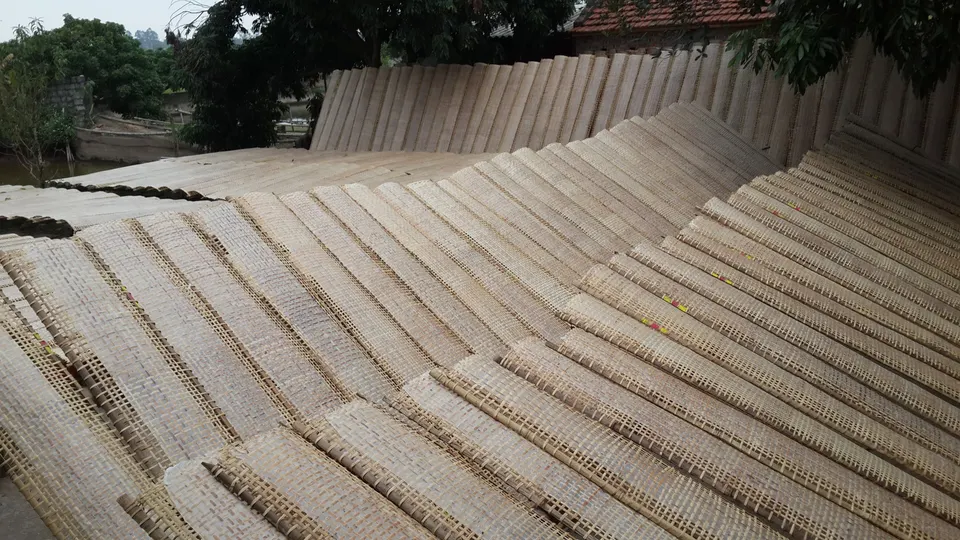
Ha Tinh’s ram. VTV describes the wrapper as thicker than spring-roll paper elsewhere and tinted yellow with molasses, and the filling as finely minced pork, glass noodles, spring onion, coriander and culantro (ngo gai), whose strong aroma and faint bitterness give the roll its character. Each ram is about two fingers wide and fried for three to four minutes (VTV). The same feature pairs ram with banh muot (bánh mướt), Ha Tinh’s word for the soft steamed rice sheets called banh cuon elsewhere, a local breakfast that our breakfast by region guide puts in context. Bao Phap Luat (Báo Pháp Luật) reports that the wrappers come from household workshops in the Thach Hung craft village, made from rice, salt and cane molasses and left out to take the evening dew so they can be rolled. Its local cooks stress that a good ram holds more greens than meat, so it does not feel heavy, and that rolls bigger than two fingers soak up oil.
Binh Dinh’s cha ram tom dat. In Binh Dinh (since July 2025 part of Gia Lai province), around Quy Nhon, the roll is built around tom dat, small river shrimp left whole, with pork belly, in dew-dried local rice paper. VietNamNet says it is eaten by hand, wrapped in greens and another sheet of rice paper, and dipped in chilli sauce or sweet-sour fish sauce; Bao Van Hoa (Báo Văn Hóa) calls it a specialty of the coastal villages.
In Hue (Huế) the word also turns up in banh ram it, a sticky rice dumpling sitting on a crisp fried rice base; the Vietnam News Agency’s magazine explains that the crispy base is “what people call ram”. It is a different dish, but it shows what the word means in the Centre: something fried crisp.
Fresh rolls: goi cuon, nem cuon and bo bia
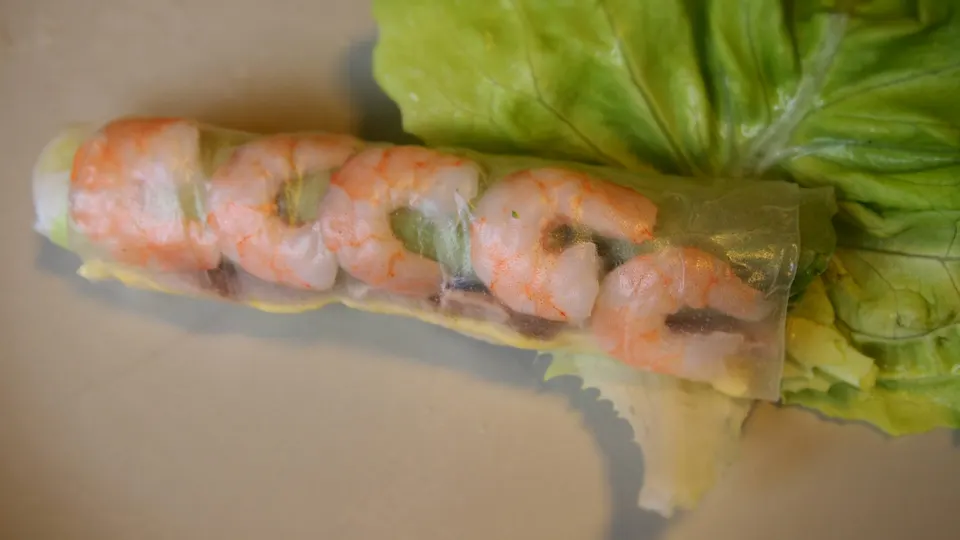
Fresh rolls share the rice paper but skip the oil. Goi cuon is a rice-paper wrapper around cooked shrimp or pork, rice vermicelli, lettuce and mint, a street snack in Saigon and a starter in many parts of the country, eaten with either a sweet garlic-chilli fish sauce or a hoisin-and-peanut sauce, VnExpress International explains. In the North the same roll is nem cuon. Because it is not cooked after rolling, it is soft, cool and best eaten soon after it is made.
Its origin is debated. Goi cuon is widely described as a Saigon dish, but a Tien Phong (Tiền Phong) essay disputes that, arguing that dishes built on rice paper eaten with more rice paper belong to Central Vietnam and spread from there (Tien Phong). The same essay lists other names (banh trang cuon, banh da cuon), fillings from Chinese sausage and tiny shrimp to grilled snakehead fish, and sauces from sweet soy to fermented anchovy. It also records a tradition: in some families the prospective bride rolls goi cuon for the groom’s family at the engagement meal, and her future mother-in-law reads her upbringing from the result.
Bo bia is a separate roll brought by Chaozhou (Teochew) immigrants. In the savoury version, VnExpress International lists Chinese sausage, egg, carrot, lettuce, jicama, dried shrimp and herbs, dipped in chilli sauce with peanut butter and fried onion; the sweet version holds crunchy sugar candy, shredded coconut and black sesame. Hanoi street vendors sell only the sweet kind, the same guide notes, while Saigon has both.
Other fresh rolls are named after their wrapper or filling rather than the word “spring roll”: Hanoi’s pho cuon uses fresh rice-noodle sheets around stir-fried beef, and Da Nang’s banh trang cuon thit heo is rolled at the table with boiled pork and dipped in fermented anchovy sauce.
Spring roll, summer roll or egg roll? Reading an English menu
Translations on menus are inconsistent, so it helps to know what each English name usually means:
- Fried spring roll, crispy roll, “nem”: nem ran or cha gio.
- Fresh spring roll, summer roll, salad roll, rice paper roll: goi cuon (nem cuon). “Summer roll” is an English menu name with no Vietnamese equivalent.
- Egg roll: in North America this usually means a Chinese-style roll. Tasting Table describes its wrapper as wheat flour, water and egg, which fries to a thicker, bubbly skin, and notes competing theories about its origin, from a 1930s Chinese-American chef to southern China. Vietnamese rolls in rice paper are thinner and crackle rather than crunch.
- Just “spring roll”: ask whether it is fried or fresh.
Some cooks make the fried rolls with wheat-flour wrappers because they are easier to roll, VietnamPlus notes, and you will meet them on restaurant menus too. If you need to avoid wheat, ask.
Where did the fried roll come from?
Nobody has dated it. The late writer To Hoai (Tô Hoài), in his memoir Chuyện cũ Hà Nội (Old Stories of Hanoi), wrote that no one knew when spring rolls first reached Hanoi and that the Saigon-style rolls served in Old Quarter restaurants changed a great deal once they arrived, according to a Saigon Times article republished by the national tourism authority (Vietnam Tourism). The Viet Nam News column also calls the deep-fried rolls “originally a creation” of Saigon people, and remembers the old Hanoi name “nem Saigon”.
Treat that Southern origin as one view rather than settled history: it rests on memoir and recollection, not on dated records, and the dish is now so rooted in the North that the same Saigon Times piece calls it “a specialty of Hanoi”. The Hanoi Times recalls that about three decades ago seafood rolls were a lavish treat at Hanoi weddings. What is clear is how the rolls are used today. In the North, nem ran is one of the classic dishes of the Tet feast (see Tet across Vietnam’s three regions); in Ha Tinh, Bao Phap Luat reports that one wrapper-making family turns out 200 to 350 packs a day in the run-up to Tet; and in everyday life the rolls have moved from feast food to a side dish you can order at almost any noodle shop.
How do you order and eat spring rolls?
Fried rolls are best straight from the oil. VietnamPlus notes that rolls in rice paper stay crisp for only about an hour, which is why good shops fry to order and home cooks fry twice.
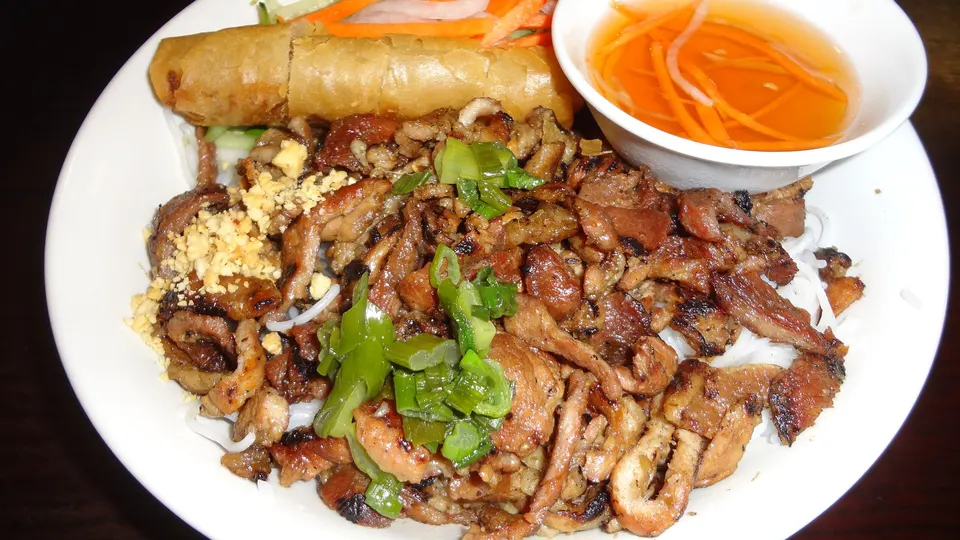
- Name the kind. Nem ran or nem in Hanoi, cha gio in the South, ram in Ha Tinh and cha ram in Binh Dinh. For fresh rolls, say nem cuon in the North and goi cuon in the South.
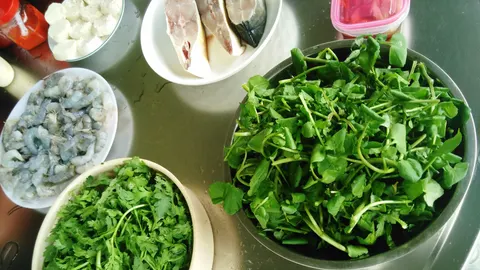
- Wrap, then dip. Take a lettuce leaf, add herbs such as perilla, mint or sawleaf (our guide to Vietnamese herbs explains what each one is), wrap a piece of roll and dip it. In Binh Dinh the cha ram goes inside a second sheet of rice paper as well.
- Use the sauce it comes with. Fried rolls take a sweet-sour fish sauce, lighter in Hanoi and sweeter in the South; goi cuon comes with hoisin-peanut sauce or fish sauce; Binh Dinh’s cha ram can come with chilli sauce.
- Pair them with noodles. In Hanoi, nem is the classic side for bun cha; in Saigon, cha gio is cut over bun thit nuong.
- Check the filling if you have allergies. Even “pork” rolls often contain shrimp, and the sauces contain fish sauce.
Which roll should you try first?
If you are travelling from north to south, you can taste the whole family in a few meals.
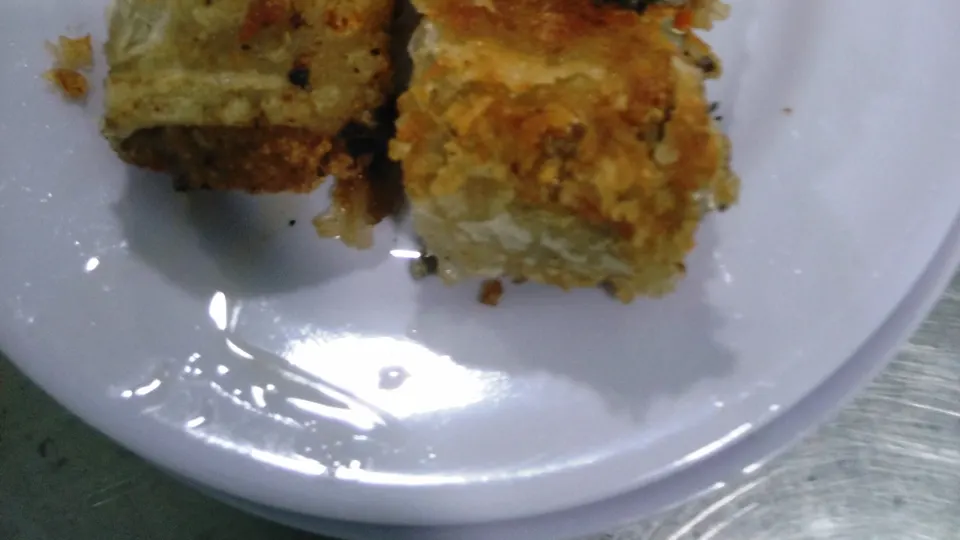
The three city shops in this table are in the MICHELIN Guide Vietnam 2026, the fourth Vietnam selection, announced in Hanoi on 4 June 2026 with 193 establishments (Tuoi Tre News). Opening hours are from their MICHELIN listings, checked in November 2026; for the regional rolls we have not verified a single shop, so look for them locally.
| Roll | Where to try it | Hours (as of November 2026) | Effort | Who it suits |
|---|---|---|---|---|
| Nem ran with bun cha | Bun Cha Ta, 21 Nguyen Huu Huan Street, Hanoi Old Quarter (Bib Gourmand 2026) | Daily 8am–10pm | Low: central Hanoi | First-timers in Hanoi; vegetarians (vegetarian rolls on the menu) |
| Crab spring rolls | Bun Cha Ta (Hanoi) or Thuy 94 Cu, 84 Dinh Tien Hoang Street, Ho Chi Minh City | Bun Cha Ta 8am–10pm; Thuy 94 Cu daily 9am–9pm | Low in either city | Seafood lovers |
| Cha gio over bun thit nuong | Bun Thit Nuong Hoang Van, 137 Chan Hung Street, Ho Chi Minh City | Daily 7am–8:30pm | Low: a one-dish shop | A quick Saigon meal |
| Ram with banh muot | Ha Tinh | No shop verified | Higher: a stop on the North–Central route; families make big batches for Tet | Travellers who want the Central version |
| Cha ram tom dat | Around Quy Nhon (Gia Lai province) | No shop verified | Higher: a coastal detour; eaten by hand with greens and rice paper | Shrimp lovers on the central coast |
| Goi cuon (nem cuon), fresh | Widely sold; a street snack in Saigon | Varies | Low | Anyone who wants a light, unfried roll |
- In Hanoi: order a plate of nem with bun cha, and try the square crab roll, nem cua be, if a shop offers it. Ask for nem cuon if you want fresh rolls.
- In Hai Phong: the square crab roll is the city’s own version, served with rice noodles and herbs.
- In Ha Tinh: look for ram, ideally with banh muot, and notice the thicker, golden wrapper and the culantro inside.
- Around Quy Nhon: order cha ram tom dat and eat it wrapped in greens and rice paper.
- In Saigon: have cha gio over bun thit nuong, and goi cuon with peanut sauce as a snack.
- Anywhere: ask “fried or fresh?” when a menu says only “spring roll”, and eat fried rolls hot.
For more dishes to try region by region, start at our Vietnamese food by region hub.
Where to try them
MICHELIN Guide pick
Bún Chả Ta · Bún chả Ta
Hanoi · Old Quarter, Hoàn Kiếm ward
21 Nguyễn Hữu Huân Street
A Bib Gourmand in the MICHELIN Guide Vietnam 2026 that serves several kinds of fried spring roll alongside its bún chả; the inspectors single out the seafood-and-crab roll and also note a chicken version and vegetarian rolls. MICHELIN has published the shop's own nem recipe.
Order: Bún chả with a crab and seafood spring roll (nem cua bể), or vegetarian rolls if you do not eat meat.
This card means the branch at 21 Nguyễn Hữu Huân Street listed by MICHELIN.
Listed in: MICHELIN Guide Vietnam 2026, MICHELIN Guide (2024) · checked November 2026
MICHELIN Guide pick
Bún Thịt Nướng Hoàng Văn · Bún thịt nướng Hoàng Văn
Ho Chi Minh City · Tân Hòa ward
137 Chấn Hưng Street
A family-run shop in the MICHELIN Guide Vietnam 2026 with a single dish, bún thịt nướng: cold rice noodles with grilled pork, meatballs and crisp spring rolls under a light, tangy dressing. It is the way many Southerners eat chả giò every day.
Order: Bún thịt nướng with the spring rolls cut over the top; mix in the dressing before eating.
Listed in: MICHELIN Guide Vietnam 2026 · checked November 2026
Addresses and details can change; check before you go. We do not accept payment for listings.
Frequently asked questions
Where can I try nem ran in Hanoi?
Bun Cha Ta at 21 Nguyen Huu Huan Street in the Old Quarter is a Bib Gourmand in the MICHELIN Guide Vietnam 2026 and serves crab-and-seafood, chicken and vegetarian fried spring rolls with its bun cha. As of November 2026 its MICHELIN listing gives opening hours of 8am to 10pm daily.
Which spring rolls should I try in Ho Chi Minh City?
For everyday cha gio, Bun Thit Nuong Hoang Van at 137 Chan Hung Street cuts crisp spring rolls over its grilled-pork noodles; for crab spring rolls, Thuy 94 Cu at 84 Dinh Tien Hoang Street is a crab specialist. Both are in the MICHELIN Guide Vietnam 2026.
Will I get fried spring rolls if I order 'nem' in Saigon?
Not always, because 'nem' covers many dishes. In Hanoi the word alone is enough for fried rolls, but nem chua is fermented pork, nem nuong is grilled pork sausage and nem chao is shredded pork skin with roasted rice powder; in Saigon, ask for cha gio.
Do I need to avoid Vietnamese spring rolls if I can't eat gluten?
Not necessarily: the traditional wrapper for nem ran and cha gio is rice paper, but some cooks and restaurants use wheat-flour wrappers, and the dipping sauces contain fish sauce. Ask how the rolls are made if you need to avoid wheat.
What is ram, and where in Vietnam should I order it?
Ram is the Central Vietnamese name for the fried spring roll. In Ha Tinh it is a slim roll in a thicker, molasses-tinted rice paper with pork, glass noodles and culantro, often eaten with banh muot; around Quy Nhon, cha ram tom dat holds whole small river shrimp and is eaten wrapped in greens and rice paper.
Key sources
- Vietnamese rolls: a brief guide · VnExpress International, 18 February 2023
- What's in a name? Spring rolls in different dialects · Việt Nam News (Nguyễn Mỹ Hà), 8 October 2023
- Báo nước ngoài mô tả độ khó của món nem rán truyền thống Việt Nam · VietnamPlus (Vietnam News Agency), 31 May 2023
- Ha Tinh's unique steamed rice rolls with spring roll stuffing · VTV (from Nhân Dân), 19 December 2020
- 10 delicious Vietnamese rolls · Vietnam Tourism (Vietnam National Authority of Tourism)
- A Hanoian dish which originates from Saigon · Saigon Times (Hoai Ly), republished by Vietnam National Authority of Tourism, 6 January 2022
- Tản mạn về gỏi cuốn · Tiền Phong (Trọng Thịnh), 4 September 2011
- 4th Michelin Guide Vietnam features 193 establishments, still overlooks banh mi · Tuoi Tre News, 5 June 2026
All 25 sources and further reading
- Ram cuốn – món không thể thiếu trong ngày Tết ở Hà Tĩnh · Báo Pháp Luật Việt Nam (Hữu Anh), 8 February 2024
- Quintessence of Vietnamese cuisine: Hanoi spring rolls · Hanoi Times (Jenna Duong), 10 March 2022
- Cách làm nem cua bể – món ngon mùa đông Hà Nội · VnExpress (Bùi Thủy), 19 November 2022
- Nem cua bể Hải Phòng · VnExpress, 25 April 2007
- Ẩm thực Việt Nam bao giờ mới hết 'phong ba', khi mà một chữ nem cũng dùng để gọi nhiều món thế này? · Tạp chí Công Thương (Ministry of Industry and Trade), 4 May 2019
- 5 đặc sản Quy Nhơn vừa ngon vừa rẻ · VietNamNet, 8 May 2023
- Về Bình Định, thưởng thức đặc sản xứ Nẫu · Báo Văn Hóa (Phan Hiếu), 13 November 2019
- Ram it, a Hue delicacy · Vietnam Pictorial (Vietnam News Agency), 25 August 2021
- Chả giò khoai môn · VnExpress, 26 July 2021
- How to Make Vietnamese Crispy Spring Rolls Like a MICHELIN Restaurant · MICHELIN Guide, 30 May 2024
- Bun Cha Ta (Nguyen Huu Huan Street) · MICHELIN Guide Vietnam 2026
- Bún Thịt Nướng Hoàng Văn · MICHELIN Guide Vietnam 2026
- Thúy 94 Cũ · MICHELIN Guide Vietnam 2026
- Chả giò, chạo tôm trong danh sách 'món ăn vặt ngon nhất Việt Nam' · VnExpress (Tuấn Anh), 24 July 2025
- What Makes Egg Rolls Different Than Spring Rolls? · Tasting Table (Luna Regina), 10 September 2023
- Chả giò · Wikipedia (background only)
- Gỏi cuốn · Wikipedia (background only)
Keep exploring
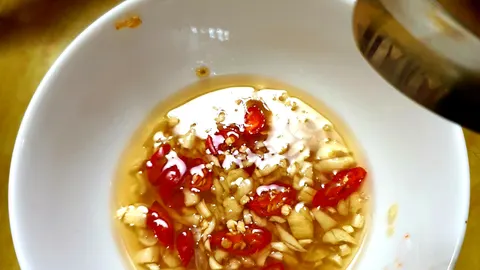 North · Central · South · Food Nuoc Cham (Nước Chấm) by Region: Which Dip Goes With What Which dipping sauce goes with bun cha, cha ca, banh xeo, goi cuon and com tam, how Hanoi, Da Nang and Saigon mix nuoc cham, and how to adjust your bowl.
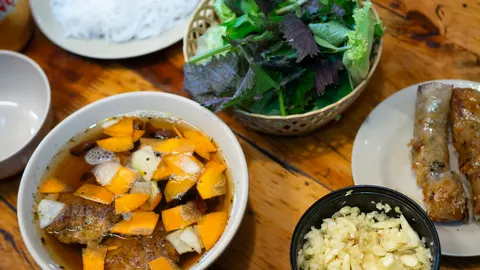 North Vietnam · Food Bun Cha (Bún Chả) in Hanoi: How to Eat It, What It Costs What bun cha is, why Hanoi eats it at lunch over charcoal smoke, how to eat it the local way, and how it differs from southern bun thit nuong.
 North · Central · South · Food Vietnamese Herbs: English Names and How to Eat Each One Vietnamese herbs by English name: rau ram, perilla, culantro, fish mint and more, with taste, the dishes each suits, regional herb plates and how to wash them.