All three regions · Food
Vietnamese vs Chinese Mooncakes: What Is Different?
Vietnamese vs Chinese mooncakes: banh nuong vs Cantonese cakes, banh deo vs snow skin, thap cam vs lotus paste, and how Mid-Autumn differs in 2027.
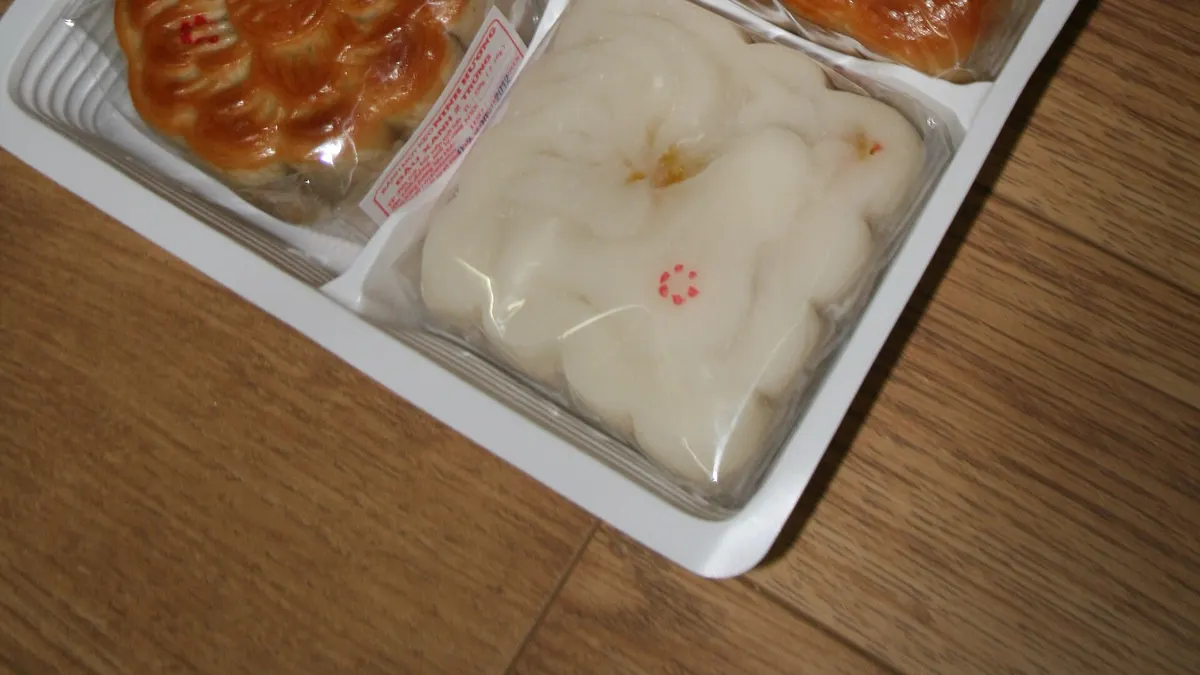
A Vietnamese mooncake is a close relative of the Chinese one, not a copy. Vietnam keeps two classic cakes, the baked banh nuong (bánh nướng) and the soft, white banh deo (bánh dẻo), with a mixed filling of its own, while China has a whole family of regional styles, of which the Cantonese lotus-paste cake is the one most like Vietnam’s baked cake. As of the 2026 season, a 150 g Vietnamese mooncake with mixed or salted-egg filling cost 65,000 to 80,000 dong in Hanoi (VietnamPlus).
This page compares the two traditions side by side: where the Vietnamese cake came from, how banh nuong differs from a Cantonese mooncake, why banh deo is not snow skin, and what changes around the festival itself. To choose between the two Vietnamese cakes, read our guide to banh nuong vs banh deo; for the festival, see Tet Trung Thu, the Mid-Autumn Festival.
Vietnamese vs Chinese mooncakes at a glance
| Vietnamese mooncakes | Chinese mooncakes | |
|---|---|---|
| Main styles | Two classics: baked banh nuong and sticky banh deo | Many regional styles; the best known are Cantonese, Suzhou (Su) and Beijing, plus Hong Kong’s snow skin |
| Baked crust | Wheat-flour crust, brushed and baked brown, with a moulded pattern | Cantonese: thin, tender crust with an embossed top; Suzhou: flaky, layered crust with sesame; Beijing: harder crust |
| Unbaked cake | Banh deo: toasted glutinous rice flour, sugar syrup, pomelo-flower water | Snow skin: glutinous rice flour skin, not baked, eaten chilled |
| Signature filling | Thap cam: candied pork fat, Chinese sausage, melon seeds, lime leaf, winter-melon jam, lotus-seed jam, sesame, Mai Que Lo liquor | Cantonese: lotus seed paste with salted duck egg yolks; also red bean, five seeds, Yunnan ham, Suzhou pork |
| Other common fillings | Mung bean, lotus seed, roast chicken; salted egg yolk | Sweet bean paste, nuts, osmanthus and rock sugar (Beijing), ice cream and custard in newer cakes |
| Shapes | Round and square cakes together, for “round sky, square earth” | Mostly round, as a sign of reunion |
| The festival | Tet Trung Thu, above all a children’s festival; not a paid public holiday | A family reunion festival; a one-day public holiday in mainland China (15 September 2027) |
Reading the table. The split is not “Vietnamese vs Chinese” so much as “two cakes vs many”. Each Chinese region has its own style; Vietnam’s baked cake is closest to the Cantonese type, and Vietnam adds its own sticky cake and filling.
Where do Vietnamese mooncakes come from?
Vietnam’s national tourism authority says the word “mooncake” first appears in China under the Song dynasty, that mooncakes were a regular part of the harvest-moon festival by the Ming dynasty, and that “nobody knows exactly when mooncakes first came to Vietnam” (Vietnam Tourism). Vietcetera describes the cake as arriving from China and changing over the centuries to suit Vietnamese taste.
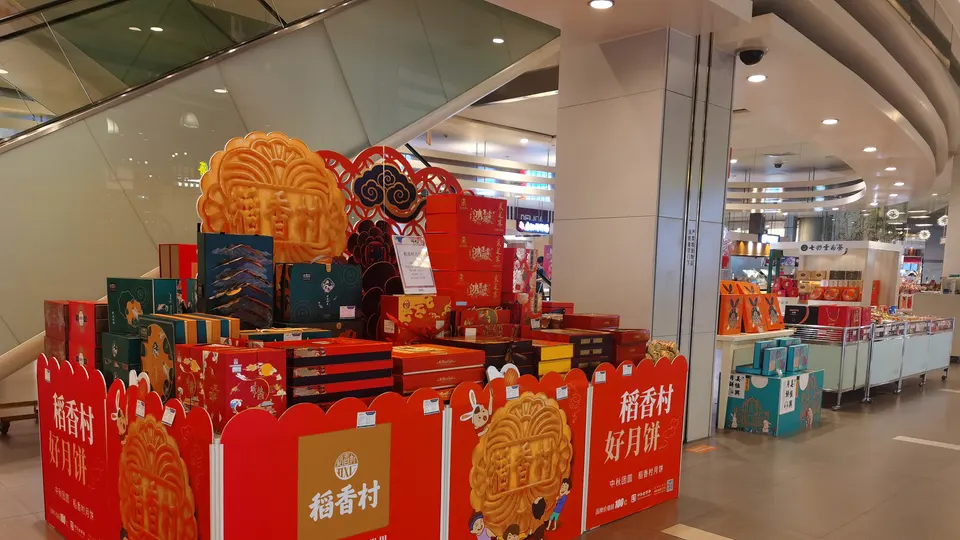
What is debated. The date is the open question. Bao Phap Luat sets out the common view that both the mid-autumn festival and its cake began in China and later influenced neighbouring countries, and notes that many scholars date the custom of eating mooncakes at the festival only to the 13th–14th centuries. The famous story of rebels hiding messages in mooncakes under the Yuan dynasty is a legend, not a record.
What changed in Vietnam. By the time Vietnamese writers describe the festival, the tray already held two cakes. The tourism authority describes the old pair as a square, baked cake with a savoury mixed filling of up to ten ingredients, offered on the family altar, and a round sticky-rice cake with mung bean filling, eaten fresh. A box with both square and round cakes stands for the round sky and the square earth, a reading Vietcetera also gives, comparing it with the square banh chung and round banh giay of the Lunar New Year.
Is banh nuong just a Cantonese mooncake?
It is the nearest relative. The Cantonese mooncake, the most common type in China, has a thin, tender wheat-flour crust, an ornate embossed top and a filling of lotus seed paste around salted duck egg yolks (CGTN). Banh nuong shares the method: a wheat crust wrapped round the filling, pressed into a carved mould and baked to a shine.
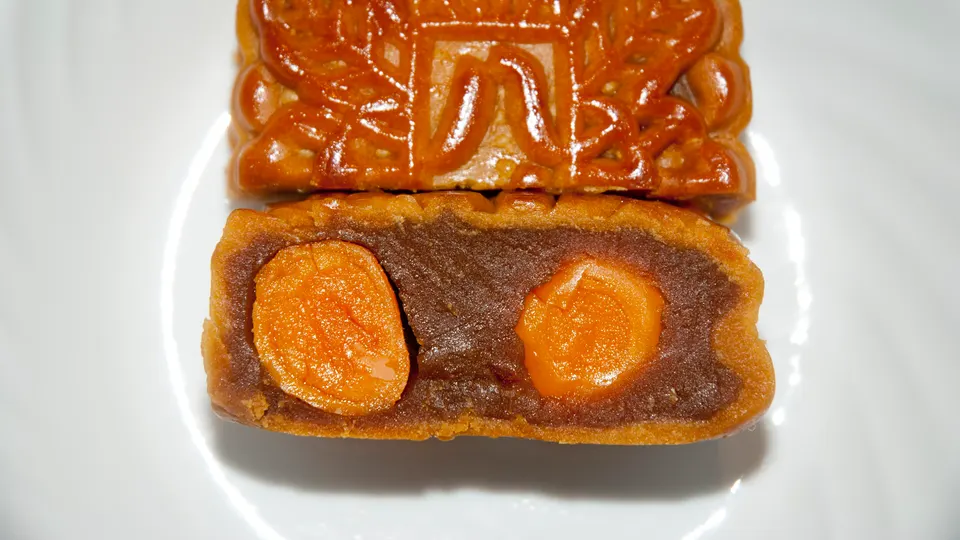
The filling is where they part. The classic Vietnamese filling is thap cam (thập cẩm), “mixed”. Nhan Dan lists its parts: candied pork fat, melon seeds, lime leaf, Chinese sausage or dried chicken, winter-melon jam, lotus-seed jam and roasted sesame, mixed with Mai Que Lo (Mai Quế Lộ) rose liquor and malt syrup. The result is chunky, sweet and savoury at once, with the citrus note of shredded lime leaf. The Cantonese favourite is a smooth, sweet paste.
Fillings Vietnam added. Vietnamese bakeries also make roast chicken (ga quay (gà quay)) and ham cakes, and VnExpress International found lemon-leaf aroma singled out as a mark of good thap cam at a Hai Phong bakery. The salted egg yolk is shared, but Vietnam’s tourism authority notes that finding one in your cake was once an envied piece of luck; today double-yolk cakes are common in both countries.
Is banh deo the same as snow skin mooncake?
No, although both are white, soft and made with glutinous rice. Snow skin was launched in 1989 by Taipan Bread and Cakes, a Hong Kong bakery founded in 1984, as a chilled, unbaked alternative to oily baked mooncakes (The Standard). The Wikipedia article on snow skin dates the first ones to the 1960s, so the exact start is disputed.
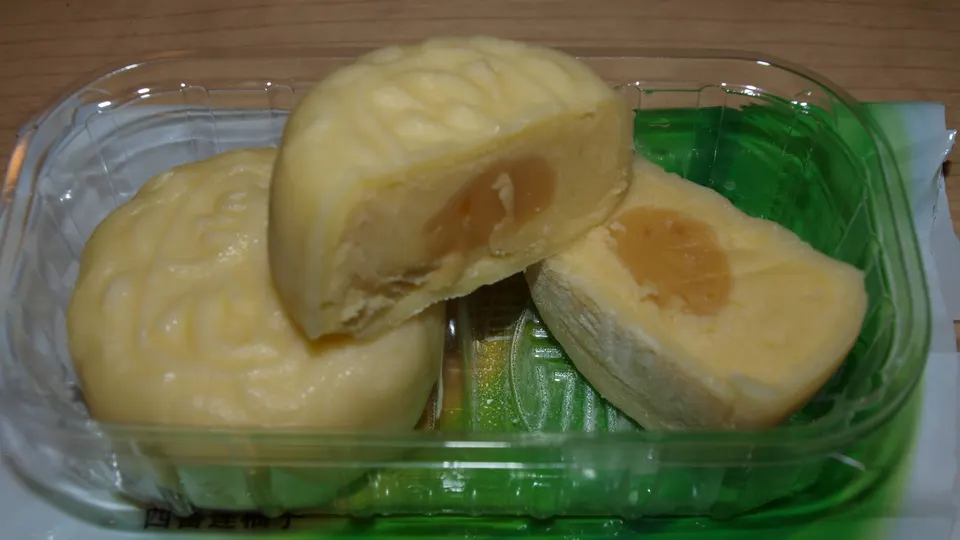
How banh deo is made. Vietcetera describes the old home method: toasted glutinous rice flour (bot nep rang (bột nếp rang)) mixed with sugar syrup and a few drops of pomelo-flower water, pressed into a mould. Nhan Dan says this faint pomelo-blossom scent is what sets the traditional Vietnamese banh deo apart; the flower water is distilled from blossoms picked in the third lunar month. Banh deo was the star of the old Hanoi tray: the writer Vu Bang (Vũ Bằng) remembered that the biggest banh deo had to sit in the middle.
What it means when you buy. Snow skin is meant to be eaten cold and comes in bright colours and modern flavours; Taipan itself closed all its shops on 24 June 2025 after 41 years. A Vietnamese banh deo is the plain white cake, usually with mung bean, lotus seed or thap cam inside. In English the two names are sometimes mixed: Vietnam’s tourism site itself labels banh deo “snow skin”, so check the cake rather than the label.
Which Chinese mooncake styles might you meet?
Outside the Cantonese cake, Chinese styles have little in common with Vietnam’s pair. China Daily names the Cantonese, Beijing and Su (Suzhou) styles as the traditional favourites (China Daily): the Su style has a flaky, layered crust and comes sweet or savoury, the savoury kind served hot with minced pork, while Beijing’s handmade zilaihong and zilaibai have a harder crust filled with rock sugar, osmanthus, walnuts and pumpkin seeds.
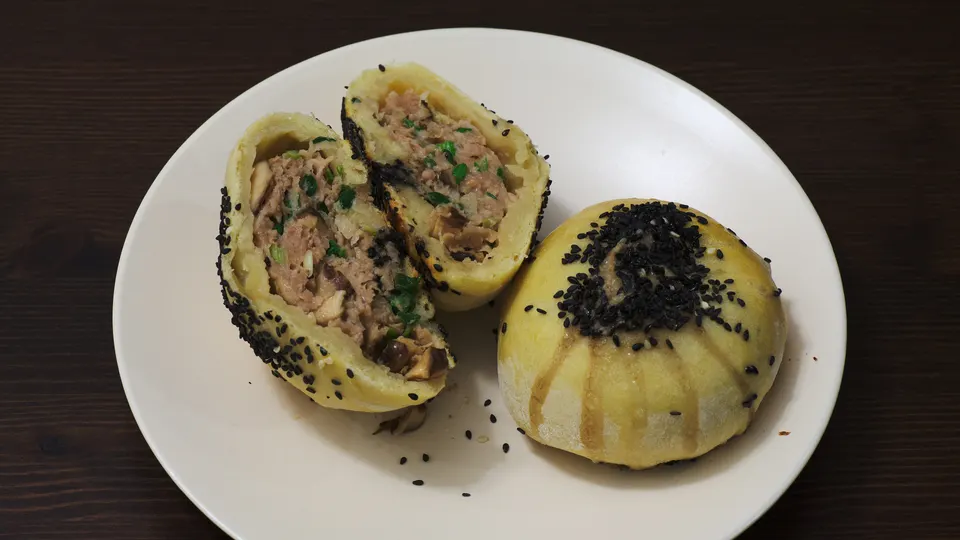
More regional cakes. CGTN adds the Yunnan cake, whose crisp crust holds diced Xuanwei ham with lard, honey and sugar, and notes that Cantonese cakes also come with red bean, mung bean, sesame or a mix of five seeds. None of these is a Vietnamese tradition.
The Vietnamese exception. The one Chinese-rooted pastry that became a Vietnamese regional speciality is in the Mekong Delta: banh pia (bánh pía), the flaky Teochew-style cake of Soc Trang. It is flaky like a Suzhou cake rather than glossy like a banh nuong. Saigon’s Chinese-Vietnamese community in Cholon also keeps its own bakeries and lantern streets.
Same full moon, different festival
Both countries eat mooncakes on the 15th day of the eighth lunar month, which in 2027 is Wednesday 15 September (Hong Kong Observatory). What the day means is different. Dai Doan Ket writes that Vietnam’s Tet Trung Thu stands apart from the festival in China, Korea and Japan because it is a festival for children, with toys, lanterns and games made for them, while in Chinese custom it is above all a family reunion.
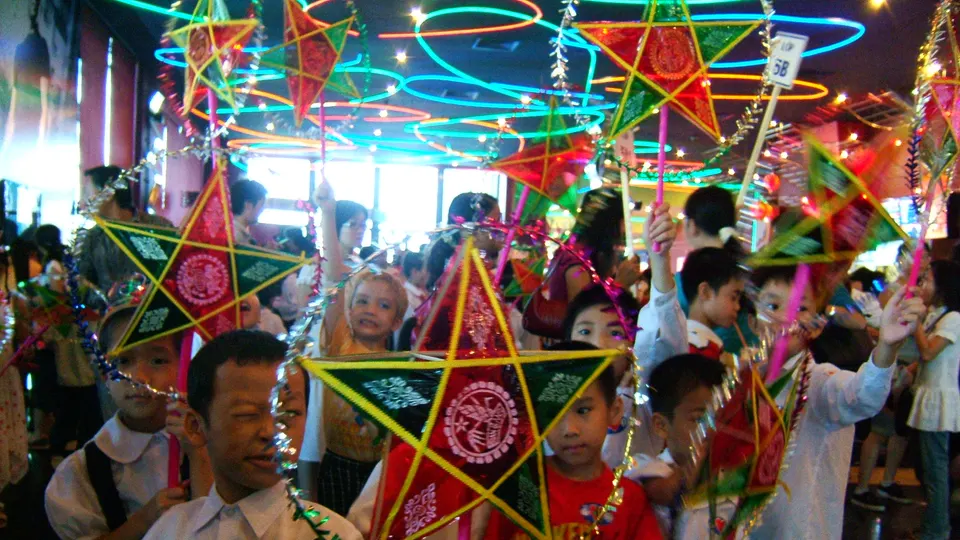
Holiday or not. On 5 November 2026 China’s State Council set Mid-Autumn 2027 as a one-day public holiday on 15 September (Xinhua). Vietnam gives no day off: as Tuoi Tre listed in December 2025, Article 112 of the 2019 Labour Code grants 11 paid public holidays, and Mid-Autumn is not among them. In Vietnam the evening belongs to children’s lantern parades and the family’s tray of cakes and fruit.
What travellers notice. In Vietnam the cakes are sold alongside star lanterns, masks and toys for children in the weeks before the full moon. The same two-tradition logic applies to the new year: see Tet vs Chinese New Year.
How to tell them apart when you buy
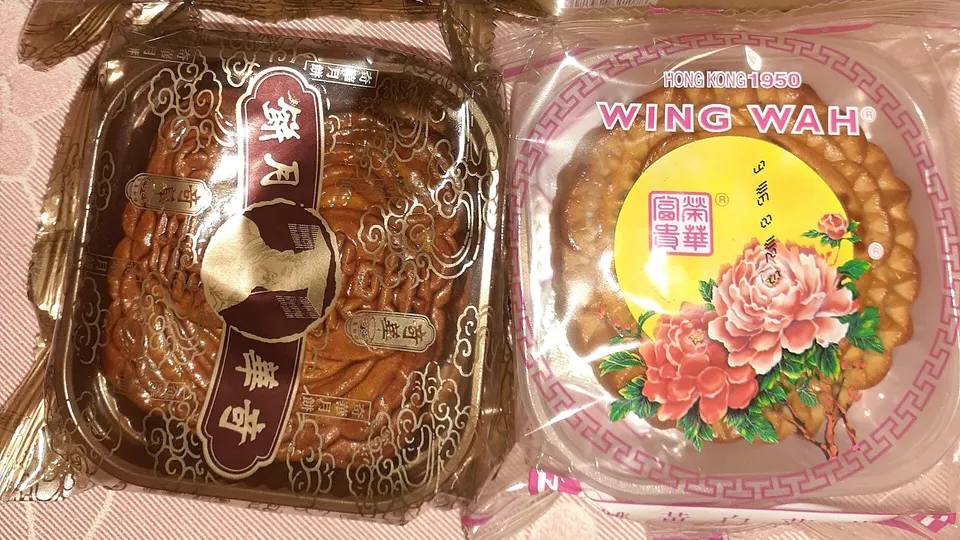
In a Vietnamese shop, the quickest test is the box. A traditional Vietnamese box mixes square and round cakes, baked and sticky, and the labels name fillings such as thap cam, mung bean or ga quay (roast chicken). VnExpress International’s round-up of long-running bakeries lists exactly these fillings, with roast chicken, Chinese sausage and lemon leaves (VnExpress International).
A quick checklist.
- Lotus seed paste with one or two yolks, in a round tin: Cantonese-style, the international standard.
- A chunky cut face with fat, seeds and green flecks of lime leaf: Vietnamese thap cam.
- A plain white, scented sticky cake: Vietnamese banh deo. A brightly coloured cake sold chilled is snow skin.
- Flaky layers and sesame: Suzhou-style, or banh pia if it comes from Soc Trang.
Prices and freshness. In September 2026 VietnamPlus found most Hanoi mooncakes at 65,000 to 80,000 dong for 150 g, single cakes at the Bao Phuong family bakery at about 90,000 dong, and boxes of four there from 360,000 dong. Traditional shops make fresh cakes in small batches: a Thanh Hoa bakery in the VnExpress round-up says its cakes have no preservatives and should be eaten within 7–10 days, so check the label for dates and storage.
Which should you try? If you have eaten Cantonese mooncakes, start with a Vietnamese baked thap cam cake: the shape is familiar and the filling is the difference. Then try a banh deo next to it, to taste the Vietnamese cake that has no Chinese twin. Buy from a fixed bakery a week or two before the full moon, eat with hot tea as Vietnamese families do, and for the full guide to the two Vietnamese cakes, timing and food-safety checks, read banh nuong vs banh deo. More regional sweets are in our food guides.
Where to try traditional Vietnamese mooncakes
Local favourite
Bảo Phương · Bánh trung thu Bảo Phương
Hanoi · Thụy Khuê street, near West Lake (former Tây Hồ district)
183 Thụy Khuê Street
A Hanoi family bakery whose fillings run from the traditional mixed nuts and cooked meat to mung bean, Chinese sausage and young green rice (VnExpress International, 2023). In September 2026 VietnamPlus found single cakes at about 90,000 dong and boxes of four from 360,000 dong.
Order: A baked thap cam cake to taste the classic Vietnamese filling, and a banh deo to compare with snow skin.
Seasonal: mooncakes are sold in the weeks before Mid-Autumn, and queues are long in the last days.
Recommended by: VnExpress International (2023), VietnamPlus (VNA) (2026) · checked November 2026
Local favourite
Đông Phương · Bánh trung thu Đông Phương
Hai Phong · Cầu Đất street, city centre (former Ngô Quyền district)
172 Cầu Đất Street
VnExpress International (2023) says the shop has stood for over 70 years and is known for thin crusts, balanced fillings and fragrant lemon leaves; Báo Văn Hóa (2025) calls it Hai Phong's pride, with no preservatives and fillings from thap cam and roast chicken to pandan mung bean.
Order: A thap cam or roast chicken baked cake, two fillings that show how Vietnamese bakers moved away from the Cantonese lotus paste.
Recommended by: VnExpress International (2023), Báo Văn Hóa (2025) · checked November 2026
Local favourite
Như Lan · Bánh trung thu Như Lan
Ho Chi Minh City · Hàm Nghi street, central Saigon (former District 1)
50 and 64-66-68 Hàm Nghi Street
Better known for bread and pork rolls, Nhu Lan has sold traditional mooncakes for more than 50 years (VnExpress International, 2023); Báo Văn Hóa (2025) describes golden crusts and fillings from thap cam and mung bean to roast chicken, ham and seafood.
Order: A baked thap cam ga quay (mixed filling with roast chicken), a Southern favourite you will not find in a Cantonese box.
Mooncakes are seasonal; the shop sells bread year-round.
Recommended by: VnExpress International (2023), Báo Văn Hóa (2025) · checked November 2026
Addresses and details can change; check before you go. We do not accept payment for listings.
Frequently asked questions
Is a Vietnamese mooncake the same as a Chinese mooncake?
Not quite. Vietnam's baked banh nuong is a close cousin of the Cantonese mooncake, but its classic thap cam filling with lime leaves, candied pork fat and Mai Que Lo liquor is Vietnamese, and Vietnam's second classic, the sticky banh deo, has no exact Chinese twin.
Is banh deo the same as snow skin mooncake?
No. Banh deo is a traditional Vietnamese cake pressed from toasted glutinous rice flour, sugar syrup and pomelo-flower water. Snow skin is a Hong Kong invention served chilled, launched by Taipan Bread and Cakes in 1989, though some accounts date it to the 1960s.
Which Chinese mooncake tastes most like Vietnamese banh nuong?
The Cantonese style: a thin, soft wheat-flour crust with a moulded top, often around salted duck egg yolks. The usual Cantonese filling is smooth lotus seed paste, while the classic Vietnamese one is the chunky, sweet-savoury thap cam.
When is Mid-Autumn in 2027, and is it a holiday in Vietnam?
Mid-Autumn falls on Wednesday 15 September 2027, the 15th day of the eighth lunar month. Mainland China gives a one-day public holiday that day; in Vietnam it is a festival but not one of the paid public holidays in the 2019 Labour Code.
Where can I buy traditional Vietnamese mooncakes?
Long-running bakeries include Bao Phuong at 183 Thuy Khue Street in Hanoi, Dong Phuong at 172 Cau Dat Street in Hai Phong and Nhu Lan on Ham Nghi Street in Saigon. They sell mooncakes in the weeks before the festival.
Key sources
- Thị trường bánh Trung Thu Hà Nội ghi nhận sức mua chậm dù giá bán tăng nhẹ · VietnamPlus (VNA), 17 September 2026
- All about Vietnam's mooncakes · Vietnam National Authority of Tourism (vietnam.travel)
- From northern to southern provinces: Mooncakes across China · CGTN, 29 September 2023
- HK's iconic Taipan bakery closes, marking end of era for snow skin mooncake pioneer · The Standard (Hong Kong), 24 June 2025
- Mooncakes a savory way to round out Mid-Autumn Festival · China Daily, 9 September 2022
- 国务院办公厅关于2027年部分节假日安排的通知 · General Office of the State Council, via Xinhua (news.cn), 5 November 2026
- 12 long-lasting mooncake shops: a culinary tour from north to south · VnExpress International, 28 September 2023
- Gregorian-Lunar Calendar Conversion Table, 2027 · Hong Kong Observatory
All 16 sources and further reading
- Bánh Trung thu · Nhân Dân, 10 September 2022
- Để chiếc bánh Trung thu kể cho bạn nghe về một ngày lễ cổ truyền · Vietcetera, 3 October 2025
- Nét riêng Tết Trung thu Việt Nam · Đại Đoàn Kết, 4 September 2022
- Bánh trung thu, lễ hội trăng rằm có từ bao giờ? · Báo Pháp Luật Việt Nam, 23 September 2018
- Chi tiết số ngày nghỉ trong các dịp lễ năm 2026 · Tuổi Trẻ, 31 December 2025
- Giữ hồn xưa trong từng vị bánh · Báo Văn Hóa, 25 September 2025
- Mooncake · Wikipedia
- Snow skin mooncake · Wikipedia
Keep exploring
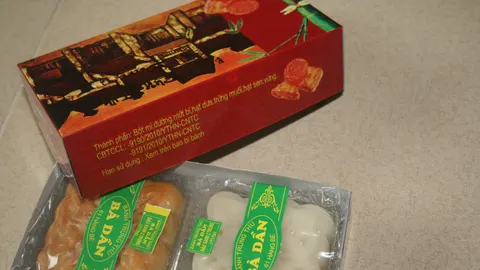 North · Central · South · Food Banh Nuong vs Banh Deo: Which Vietnamese Mooncake to Buy Banh nuong vs banh deo, Vietnam's baked and sticky mooncakes: crust, thap cam filling, 2026 prices, safety checks and when to buy before Mid-Autumn 2027.
 North · Central · South · Culture Mid-Autumn 2027 in Vietnam (Tet Trung Thu): Where to Go Tet Trung Thu, Vietnam's Mid-Autumn Festival, by region: Hang Ma lanterns in Hanoi, Hoi An and Hue, Saigon's Cholon lantern street, and the 2027 date.
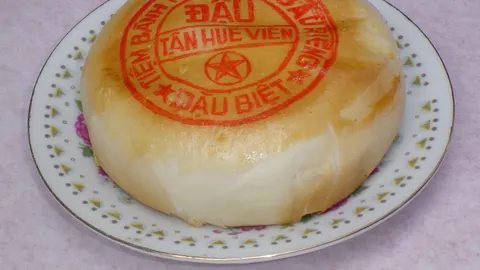 South Vietnam · Food Banh Pia (Bánh Pía): Which to Buy and Where in Soc Trang Banh pia, Soc Trang's flaky Teochew pastry: durian, mung bean, salted egg or can xai fillings compared, where to buy it, and how to store and carry it home.