North Vietnam · Travel
Van Long Wetland (Vân Long): Worth It, and the Langurs
Is Van Long worth it? Ninh Binh's quiet wetland vs Tam Coc and Trang An, when to look for Delacour's langurs, the ticket, getting there and a half-day plan.
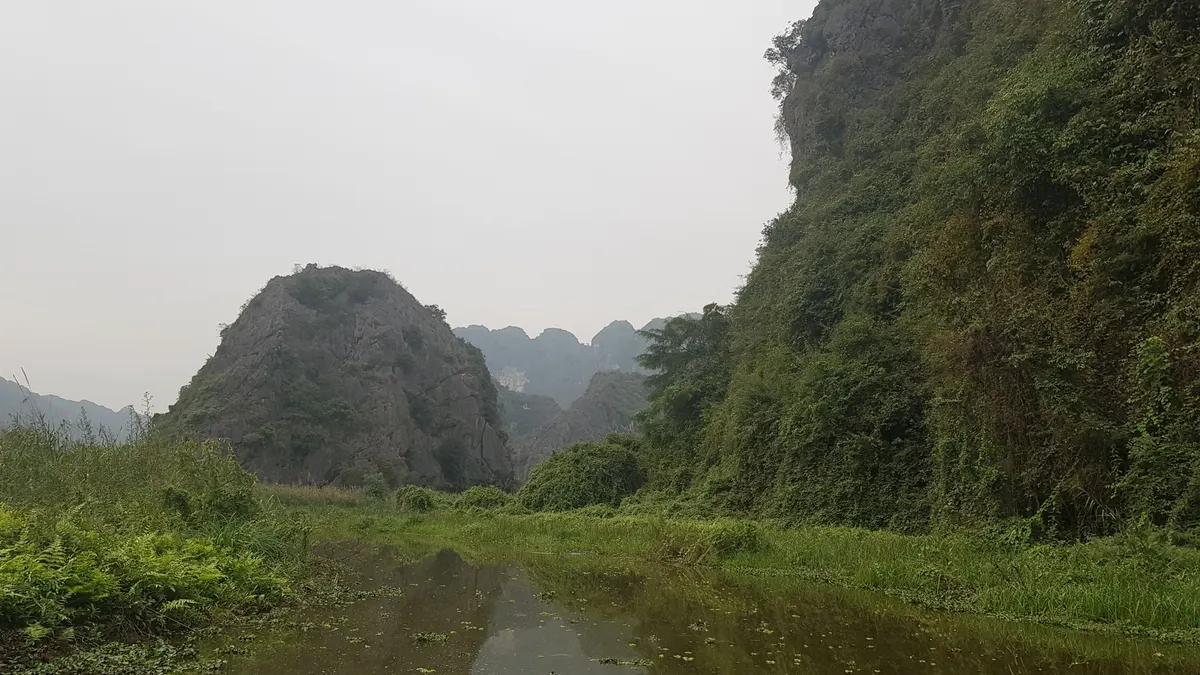
Van Long (Vân Long) is worth a half day if you want stillness and wildlife rather than caves: it is a rowed-boat trip across open water and reed beds below limestone hills, and the best place in the world to look for Delacour’s langur, a monkey found only in northern Vietnam. As of late October 2026 it received about 70,000–80,000 visitors a year, according to the local commune quoted by VietnamPlus, a tiny share of the crowds at Trang An (Tràng An) and Tam Coc (Tam Cốc) (VietnamPlus).
This page helps you decide whether to add it, and how to give yourself the best chance of seeing langurs. For the bigger picture of the province, see our Ninh Binh guide; for the two famous boat trips, Tam Coc vs Trang An; and for the rest of the region, the North Vietnam hub.
Van Long at a glance
| Van Long wetland nature reserve | |
|---|---|
| Where | Gia Vien area of Ninh Binh province, about 85 km south of Hanoi (IUCN) and about 18 km north of the Hoa Lu ancient capital (Vietnam Airlines) |
| Province now | Ninh Binh, enlarged on 1 July 2025 with the former Ha Nam and Nam Dinh provinces |
| What it is | A freshwater wetland among limestone hills, formed after a dyke on the Day river was built in 1960; roughly 2,600–3,500 hectares depending on the source |
| Known for | Delacour’s langur; birds; a mirror-flat lake locals call the “bay without waves” |
| Status | Ramsar wetland of international importance (2019); IUCN Green List (2020); being prepared for a UNESCO World Heritage nomination with Kim Bang and Tam Chuc |
| The trip | Rowed boat, about 1.5 hours |
| Ticket | 100,000 dong per person (provincial list updated 4 March 2025) |
| Best time of day | Early morning or late afternoon |
| Closed | Last day of the lunar year and the first day of Tet (16–17 February in 2026) |
Is Van Long worth it, or should you choose Tam Coc or Trang An?
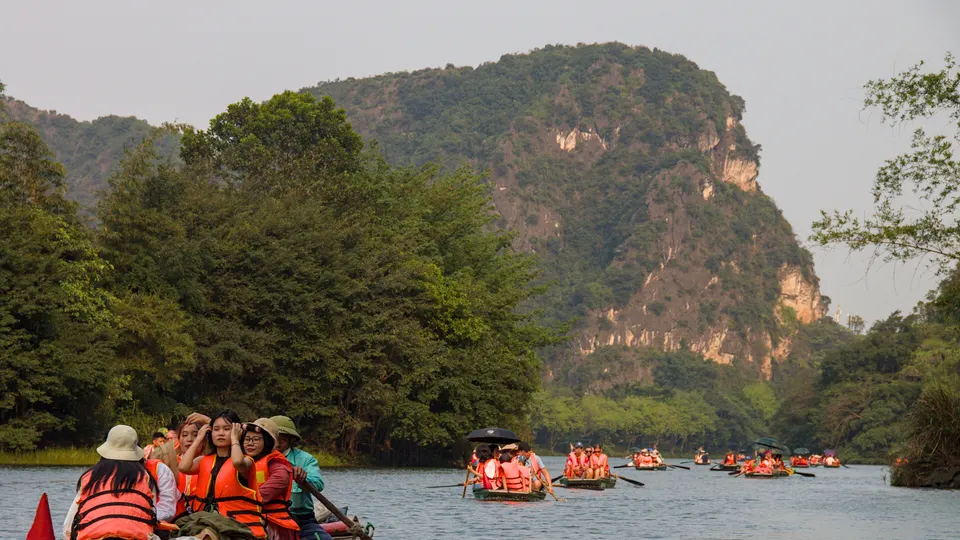
Choose by what you want from the boat. All three trips share the same limestone scenery, but they are different experiences: Trang An is a cave-and-temple circuit, Tam Coc a shorter river trip through rice fields, and Van Long an open wetland where the point is quiet and wildlife.
| Van Long | Tam Coc | Trang An | |
|---|---|---|---|
| What you see | Open lake, reeds, cliffs, birds; a chance of langurs | River, rice fields, three caves | Long caves, riverside temples, bigger karst |
| Time on the water | About 1.5 hours | About 2 hours round trip | Routes of about 2–4 hours |
| Ticket (as reported) | 100,000 dong (list of March 2025) | 250,000 dong; 350,000 with electric car (list of March 2025) | 300,000 dong (CafeF, 31 July 2026) |
| Crowds | About 70,000–80,000 visitors a year (2026) | Among the busiest trips | Among the busiest trips |
| Effort | Low; need your own transport | Low; walkable from Tam Coc village | Low; a longer sit in the boat |
| Suits | Nature lovers, photographers, birdwatchers, a second or third day | First visit, rice season, a short morning | First visit, caves and history, one big trip |
Prices for Van Long and Tam Coc come from Ninh Binh’s provincial price list, last updated on 4 March 2025 (Ninh Binh Tourism); route lengths for Tam Coc and Trang An come from the national tourism authority’s boat-tour guide, which also lists Van Long among the options “not as busy” as the famous two.
How to decide. With one day in Ninh Binh, do Trang An or Tam Coc. With two days or more, add Van Long as the quiet half day, ideally at the start or end of the day when the light and the wildlife are best. If you have already seen Halong-style karst from a crowded boat and want the same landscape almost to yourself, Van Long is the better choice. The crowd figure is relative: Ninh Binh’s sights counted 17.6 million visits in the first six months of 2026, VnEconomy reported on 2 July.
How do you see Delacour’s langurs at Van Long?
Delacour’s langur (in Vietnamese vooc mong trang (voọc mông trắng), “white-rumped langur”) is a black leaf monkey with white fur on its thighs and hips that lives on limestone cliffs. It is critically endangered and found only in a small part of northern Vietnam, and Van Long holds the largest group of it.
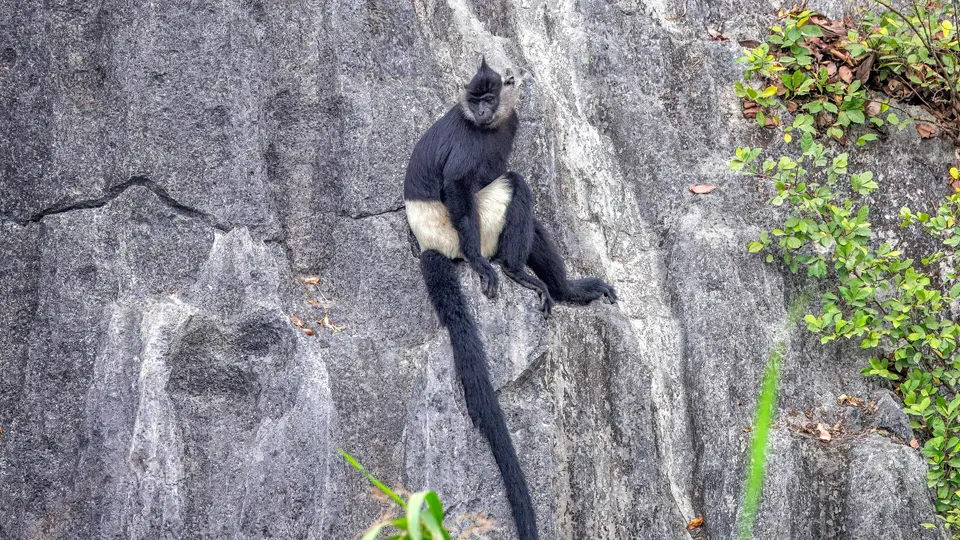
The numbers explain why Van Long matters. A 2022 survey recorded 44 groups and 308 animals in the Van Long–Dong Tam area, about 60% of the species, Viet Nam News reported in June 2026. The Centre for Nature Conservation and Development (CCD) counted about 81–82 groups and 562–570 langurs in its 2022–2025 survey of the whole range, and said that after the 2025 merger about 95% of them live in Ninh Binh province (Nhan Dan). Inside the reserve itself, a 2018 count found 176–184 langurs in 21 groups, up from 60–67 when it was set up, according to the IUCN Green List.
Give yourself the best chance:
- Go early or late. Vietnam Airlines’ guide names early morning and late afternoon as the best times for wildlife at Van Long.
- Bring binoculars or a long lens. The langurs stay on the cliffs; the same guide says that with patience and good binoculars you may spot groups climbing the rock.
- Look for small groups on the rock faces. Groups usually number around ten animals, one adult male with several females and young, and they feed mainly on leaves, according to Viet Nam News.
- Ask your rower to keep close to the cliffs and stay quiet; boats keep to set routes, so you cannot go anywhere you like.
- Treat a sighting as a bonus. No source promises one, and the reserve exists to protect the animals, not to show them.
What is the Van Long boat trip like?
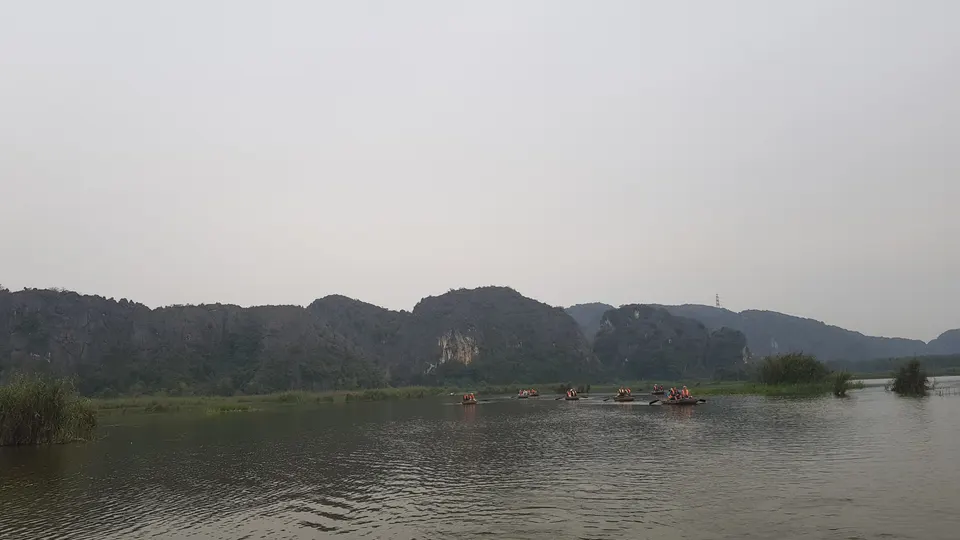
The trip is in a small rowed boat on still, very clear water. Vietnam Airlines’ guide describes a trip of about an hour and a half past limestone outcrops with nicknames such as Meo Cao (Mèo Cào), “the cat’s scratch”,, Mam Xoi (“the sticky-rice tray”) and Co Tien (“the fairy”). Most visits are by boat on designated routes, a low-impact way of moving through the reserve (Viet Nam News).
What you will notice:
- The water. VnEconomy describes it as clear enough to see the water plants on the bottom, and the lake as flat as a mirror, which is where the “bay without waves” nickname comes from.
- Caves. The reserve has many caves; Hang Ca (Fish Cave), about 250 metres long, is the best known, and fish breed inside it, VnEconomy reported in November 2025.
- The Meo Cao cliff. In 2010 Vietnam’s book of records listed Van Long as the place with the most Delacour’s langurs and the “largest natural painting”, the patterned rock face on Meo Cao mountain, VietnamPlus notes.
- Information on the way. The management board has added QR-code points, LED screens and free visitor guides inside the reserve, Viet Nam News reported.
When is the best time to visit Van Long?
Any season works, but each gives a different trip. Vietnam Airlines’ guide suggests May and June for lotus flowers on the water, and the dry season from November to April for birdwatching, when migratory birds arrive. Early mornings bring mist on the water; late afternoons bring sunset light behind the hills.
| When | What you get | Note |
|---|---|---|
| November–April | Dry season, migratory birds, cool air | Best for birds; misty mornings |
| May–June | Lotus in flower | Hotter; go early |
| Early morning | Mist, calm water, wildlife active | Best chance of langurs |
| Late afternoon | Sunset light, birds returning | Also good for wildlife |
| Tet | Closed on the first days | 16–17 February in 2026 |
Avoid the start of Tet. For Tet 2026 the Ninh Binh tourism department closed Van Long, Trang An and Tuyet Tinh Coc on 16 and 17 February, the last day of the old year and the first day of the new one, while most other sights stayed open (VnEconomy). Expect a similar pattern around Tet 2027.
How do you get to Van Long?
Van Long lies in the Gia Vien area, north of the Trang An and Hoa Lu sights, so you need a car, a taxi or a motorbike for the last stretch. From Hanoi, Vietnam Airlines’ guide routes you south on National Route 1A and then road 477 to the reserve, about 1 hour 45 minutes to 2 hours 30 minutes by road; from the Hoa Lu ancient capital it is about 18 km, 20–40 minutes (Vietnam Airlines).

- From Hanoi in a day: a private car or a tour that combines Van Long with Trang An, Hoa Lu or Tam Coc. Our Hanoi to Ninh Binh guide compares train, bus and tours to the province.
- From a base in Ninh Binh: take a taxi, a hotel car or a rented motorbike from Tam Coc, Trang An or the city, and agree the return trip in advance rather than counting on finding a ride at the reserve.
- Staying nearby: our where to stay in Ninh Binh guide explains the quiet base near Van Long and Hang Mua, and when it makes sense.
A half-day plan that adds Van Long
Van Long fits around the other Ninh Binh sights rather than replacing them. These plans use the times above and leave room for the light and the langurs.
- Morning wildlife plan: leave Tam Coc or Trang An early and be on the water at Van Long soon after it opens, the best window for langurs and mist. Return for lunch, then visit the Hoa Lu ancient capital, about 18 km away, in the afternoon.
- Afternoon plan: do the Trang An or Tam Coc boat in the morning, see Hoa Lu around midday, and reach Van Long in the late afternoon for the light and the birds.
- Two-day trip from Hanoi: day one Hoa Lu and Tam Coc, with a sunset climb at Hang Mua; day two Van Long at first light, then Trang An before heading back.
For a primate trip elsewhere in Vietnam, the red-shanked douc langurs of the Son Tra peninsula near Da Nang are a different species in a very different setting; Van Long is the place for the rarer Delacour’s.
Before you go: ticket, rules and what to bring
Van Long is a nature reserve first, run by a management board and on the IUCN Green List since 2020 for protecting the langurs and the wetland (IUCN Green List). Local people row the boats and run the services, and VietnamPlus reports that tourism gives regular work to about 80–110 people.
Checklist:
- Ticket: 100,000 dong per person on the provincial list updated in March 2025; confirm at the desk, and ask whether the price includes the boat.
- Time it: arrive early in the morning or in the late afternoon; avoid the first days of Tet.
- Bring: binoculars, a hat and sunscreen or an umbrella, water, and a dry bag for your phone.
- Behave like a guest of the langurs: keep your voice down near the cliffs, never throw food or litter into the water, and do not ask the rower to leave the set route.
- Combine it well: pair Van Long with Tam Coc or Trang An and Hoa Lu, using the comparison above, and check the province-wide tickets and timing in the Ninh Binh guide linked at the top of this page.
- Watch the heritage bid: Ninh Binh set up a steering committee on 20 November 2025 to prepare a UNESCO nomination for Van Long, Kim Bang and Tam Chuc, so visitor rules may tighten in coming years.
Frequently asked questions
Is Van Long worth it if I have already done Trang An or Tam Coc?
Yes, if you want something different rather than more of the same: Van Long has open, still water, reed beds and wildlife instead of a cave-and-temple circuit, and far fewer boats. If you only have time for one boat trip in Ninh Binh and want caves, choose Trang An instead.
Will I definitely see Delacour's langurs at Van Long?
No. Van Long holds the largest population of the species, about 308 animals in the Van Long–Dong Tam area in a 2022 survey, but the langurs live on the cliffs and keep their distance. Early morning or late afternoon, binoculars and a quiet boat give you the best chance.
How much is the Van Long boat ticket?
Ninh Binh's tourism information centre listed the Van Long entrance ticket at 100,000 dong per person in its price list updated on 4 March 2025. Check the price at the ticket desk, because the list has not been reissued since.
How long does the Van Long boat trip take?
Plan on about an hour and a half on the water, the length Vietnam Airlines' guide gives for the rowed boat trip, plus time to get to and from the reserve. A visit fits easily into half a day.
Is Van Long open during Tet?
Not on the first days. For Tet 2026 the Ninh Binh tourism department closed Van Long, like Trang An, on 16 and 17 February, the last day of the old year and the first day of the new one, so check the Tet 2027 schedule before you go.
Key sources
- Bảo tồn giá trị di sản Vân Long-Tam Chúc: Phát huy sức mạnh cộng đồng · VietnamPlus (VNA), 27 October 2026
- Bảo tồn loài voọc đặc hữu nguy cấp ở Ninh Bình · Nhân Dân, 16 September 2026
- Ninh Bình a home for endangered Delacour's langur · Việt Nam News (VNS), 7 June 2026
- Ticket price list for tourist destinations in Ninh Binh 2025 · Ninh Binh Tourism Promotion Information Center, updated 4 March 2025
- Lịch hoạt động các điểm tham quan Ninh Bình trong dịp tết Nguyên đán 2026 · VnEconomy, 13 February 2026
- Khu bảo tồn Vân Long: "Vương quốc" loài voọc mông trắng lớn nhất Việt Nam hướng tới Di sản thế giới · VnEconomy, 21 November 2025
- Van Long Nature Reserve · IUCN Green List of Protected and Conserved Areas
- Khu bảo tồn thiên nhiên đất ngập nước Vân Long: Thiên đường sinh thái tiềm ẩn của Ninh Bình · Vietnam Airlines travel guide
All 12 sources and further reading
- Ninh Bình đón 17,6 triệu lượt khách trong nửa đầu năm 2026 · VnEconomy, 2 July 2026
- A guide to the boat tours of Ninh Binh · Vietnam National Authority of Tourism (vietnam.travel)
- Từ hôm nay 31/7, Tràng An tạm dừng tuyến tham quan này: Du khách chú ý · CafeF, 31 July 2026
- Resolution 202/2025/QH15 on the reorganization of provincial-level administrative units · National Assembly of Vietnam (via LuatVietnam)
Keep exploring
 North Vietnam · Travel Ninh Binh (Ninh Bình): How Many Days, Boats and Tickets Ninh Binh: how many days you need, Trang An or Tam Coc boats, 2026 ticket prices, when the rice turns gold, the Hoa Lu capital, what to eat and a 2-day plan.
 North Vietnam · Travel Tam Coc vs Trang An (Tràng An): Which Ninh Binh Boat Trip? Tam Coc or Trang An? Compare Ninh Binh's boat trips by route, caves, crowds, season and time, plus Thung Nham, Van Long and half-day or full-day plans.
 North Vietnam · Travel Where to Stay in Ninh Binh: Tam Coc, Trang An or the City Where to stay in Ninh Binh: Tam Coc for a first visit, Trang An and Hoa Lu for early boats, the city for night trains, plus nights, transport and seasons.