Central Vietnam · Food
Com Hen (Cơm Hến) in Hue: What It Is and Where to Eat It
Com hen is Hue's cold rice with baby clams and hot broth. What is in it, how to eat it, com hen vs bun hen, and three verified clam shops to try in Hue in 2026.
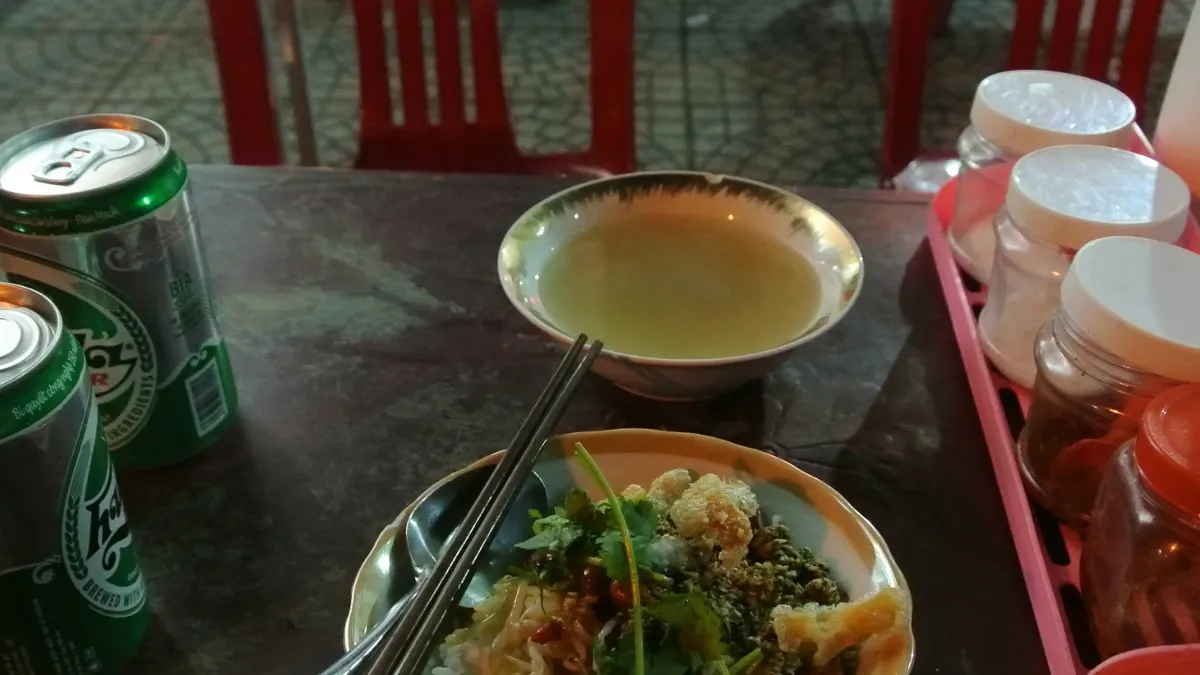
Com hen is Hue’s clam rice: cold cooked rice topped with tiny stir-fried river clams, herbs, crackling, peanuts, shrimp paste and chilli, eaten with a bowl of hot clam broth that you spoon over it. The best place to try it is one of the small clam shops in Vy Da (Vỹ Dạ) ward on the east bank of the Perfume River, which Hue’s official tourism portal still listed as of November 2026.
Com hen (Cơm hến) is a rice dish from Hue (Huế), the former imperial capital in Central Vietnam. Com (Cơm) means cooked rice and hen (hến) are tiny river clams, so the name means “clam rice”. A bowl holds cold, cooked rice topped with stir-fried clams, a heap of sliced fruit, vegetables and herbs, crisp pork crackling, roasted peanuts, shrimp paste and chilli, and it comes with a separate small bowl of hot clam broth. The clams are as small as a baby’s fingertip and live in the brackish rivers of Central Vietnam (Tuoi Tre News).
It is street food, not a banquet dish: cheap, quick, very spicy and eaten mostly at small shops and stalls. That makes it a useful counterweight to the image of Hue as a city of refined court cooking.
What is in a bowl of com hen?
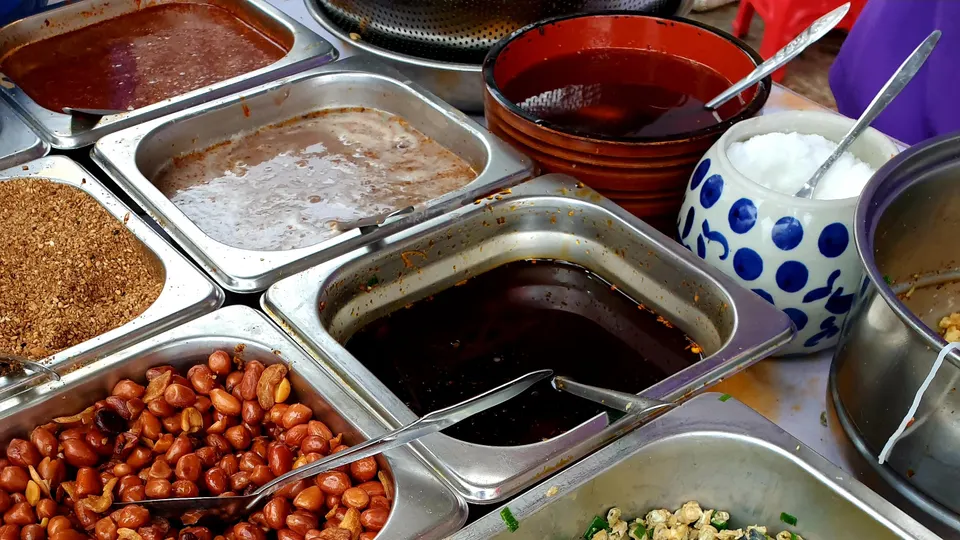
No two shops build the bowl in exactly the same way, and Vietnamese and English sources list anything from about ten to thirteen ingredients. Vietnam News lists cold rice, baby clams, fried pork fat, roasted peanuts, chilli, banana flower, starfruit, green apple, mint, fermented shrimp sauce and hot clam broth (Vietnam News). Most bowls are built from the same groups of parts.
- The rice. Plain white rice, cooked ahead and served cool.
- The clams. Boiled, taken out of their shells and stir-fried with seasoning so the meat firms up and takes on flavour.
- Sour and fresh. Thinly sliced starfruit (khe (khế)), finely shaved banana blossom (bap chuoi (bắp chuối)), shredded taro stem (doc mung (dọc mùng) or mon bac ha (môn bạc hà)), mint and other herbs, sometimes pennywort (rau ma (rau má)). Some shops add young green mango.
- Crunch and fat. Roasted peanuts, toasted sesame, fried shallots and crisp pork crackling or puffed pork skin (top mo (tóp mỡ), da heo chien (da heo chiên)).
- Seasoning. Mam ruoc (Mắm ruốc), Hue’s fermented shrimp paste, which a 2012 VnExpress article calls indispensable, plus chilli in several forms: chilli paste, chilli oil, chilli pounded into fish sauce, and fresh chillies on the side. Some English write-ups translate ruoc (ruốc) as pork floss; Hue recipes describe shrimp paste.
- The broth. The water the clams were boiled in, served hot in its own bowl.
The result is a bowl that VietNamNet, reprinting Nhan Dan (Nhân Dân), describes as sweet, rich, salty, sour, bitter and very spicy all at once.
| Com hen | Bun hen (Bún hến) | Hen xuc banh trang (Hến xúc bánh tráng) | |
|---|---|---|---|
| Base | Cold cooked rice | Rice vermicelli (bun (bún)) | Grilled rice crackers used as scoops |
| Clams | Shelled, stir-fried | Shelled, stir-fried | Shelled, stir-fried with shallots, ginger, lemongrass and chilli |
| Broth | Hot clam broth in a separate bowl | Hot clam broth | None |
| Toppings | Starfruit, banana blossom, herbs, crackling, peanuts, sesame, shrimp paste, chilli | Same as com hen | Vietnamese coriander (rau ram (rau răm)) |
| Where it belongs | Hue | Hue | Central Vietnam, especially the former Quang Nam (Quảng Nam) province |
| When | Breakfast or a snack, now at all hours | Common breakfast | Shared dish or beer snack |
Why is the rice cold and the broth hot?
The cold rice is deliberate. Bao Phap luat Vietnam (Báo Pháp luật Việt Nam), describing how Hue vendors make the dish, says the rice should be left overnight and the grains separated, and calls this a sign of local thrift (Bao Phap luat). A 2020 VnExpress feature puts it the same way: pairing the previous night’s rice with river clams is Hue’s way of wasting nothing.
The broth supplies the heat and the sweetness. Vendors soak the clams, often in the cloudy water left from washing rice, to purge sand, then boil them, sometimes with ginger, lift out the meat and keep the cooking water. A VnExpress writer insists that com hen without its clam water is not com hen at all. Several sources note the seasonal logic: the cold rice and raw greens feel refreshing in Hue’s summer heat, while the hot broth warms you in the rainy winter.
The work behind a cheap bowl is considerable. According to VnExpress in 2020, vendors start slicing herbs around 8 pm the night before, a job of three to four hours, because taro stem goes limp if it is cut too early. Wholesalers deliver boiled clams at about 4:30 am, and the sellers still have to rinse out the sand.
Where do the clams come from? Con Hen and the Perfume River
The dish is tied to one place: Con Hen (Cồn Hến), a small islet in the Perfume River (song Huong (sông Hương)) just downstream of central Hue, today part of Vy Da ward. It splits the river into two branches, and in 2014 VietNamNet counted about 600 households living there. Locals once called it Con Soi (Cồn Soi), after night fishing by torchlight. Two explanations are offered for the later name: that the islet looks like a clam from above, or that it took its name from the clam trade. Feng shui tradition casts it as one of the guardians of the Hue Citadel (VOV).

The same VOV report describes how the trade worked and how it changed. Clam workers once gathered by hand or with rakes that had bamboo teeth and baskets woven to let young clams escape. Later, fine-mesh nylon nets caught everything. Flood-control works also cut the flow of salt water up the river, and the clams became scarce. By the mid-2000s, the report says, the roughly ten clam workshops on Con Hen were buying in three to five tonnes a day, partly from Phong Dien (Phong Điền), in the north of what is now Hue city, but mainly from Quang Tri (Quảng Trị) and Khanh Hoa (Khánh Hòa). One benefit was that com hen could be sold all year instead of pausing during the flood months.
Reports since then do not fully agree. A 2022 Hue food guide by Vietnam Coracle says the river no longer has the salinity needed to harvest clams and that they are shipped in. A 2020 VnExpress feature, by contrast, still says the best clams for the bowl come from the stretch of river at Con Hen. The safe reading is that Con Hen remains the dish’s home and a centre of clam processing, while much of the supply now comes from elsewhere.
A poor people’s dish in a royal city?
Hue is best known for the elaborate dishes of the Nguyen (Nguyễn) court, which have their own guide on Hue royal cuisine. Com hen sits at the other end of the city’s table. VOV called it “the most humble of humble dishes”, and VnExpress described it as an everyday meal of Central Vietnam’s working people. VietNamNet, reprinting Nhan Dan, says it is “no longer the preserve of the poor” and has become a favourite of locals and visitors alike (VietNamNet).
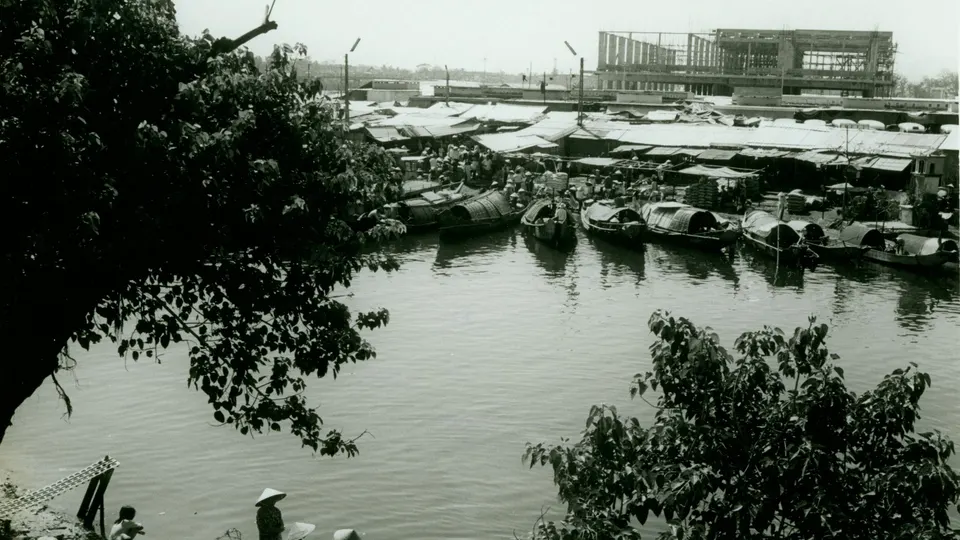
Nobody knows exactly when it began. A local account, reported by VOV and VnEconomy, says the clam trade started about 200 years ago under Emperor Gia Long with a woman surnamed Huynh (Huỳnh), who gathered clams to feed her family, and that Emperor Thieu Tri (Thiệu Trị) later exempted the trade from tax after tasting a clam dish. Treat this as a story told on Con Hen, not documented history. What is better documented is how the dish was sold: women once carried it through the streets on shoulder poles, and by 2011 VOV described Truong Dinh (Trương Định) and Pham Hong Thai (Phạm Hồng Thái) streets as Hue’s “com hen centre”, with shops and tables instead of poles.
Com hen also has a place in Hue writing. VnExpress notes that the essayist Hoang Phu Ngoc Tuong (Hoàng Phủ Ngọc Tường) wrote a piece called “Chuyen com hen (Chuyện cơm hến)” (The story of com hen), and that Anthony Bourdain ate the dish at a pavement stall in his 2014 Parts Unknown episode on Vietnam. Clams mattered beyond Hue too: in the former Quang Nam province (since July 2025 part of Da Nang), Tuoi Tre (Tuổi Trẻ) News writes, wartime families who had little rice found that river clams “became the savior of many families”.
Bun hen, chao hen and hen xuc banh trang: the other clam dishes
Most com hen shops are really clam shops, and the rice is only one option. Bun hen swaps the cold rice for rice vermicelli and keeps the clams, toppings and broth; Tuoi Tre News sums up the difference as rice versus noodles (Tuoi Tre News). It is a common Hue breakfast. Shops also offer mi hen (mì hến) (with noodles), chao hen (cháo hến) (rice porridge with clams), hen xao (hến xào) (stir-fried clams) and a bowl of plain clam broth (nuoc hen (nước hến)).
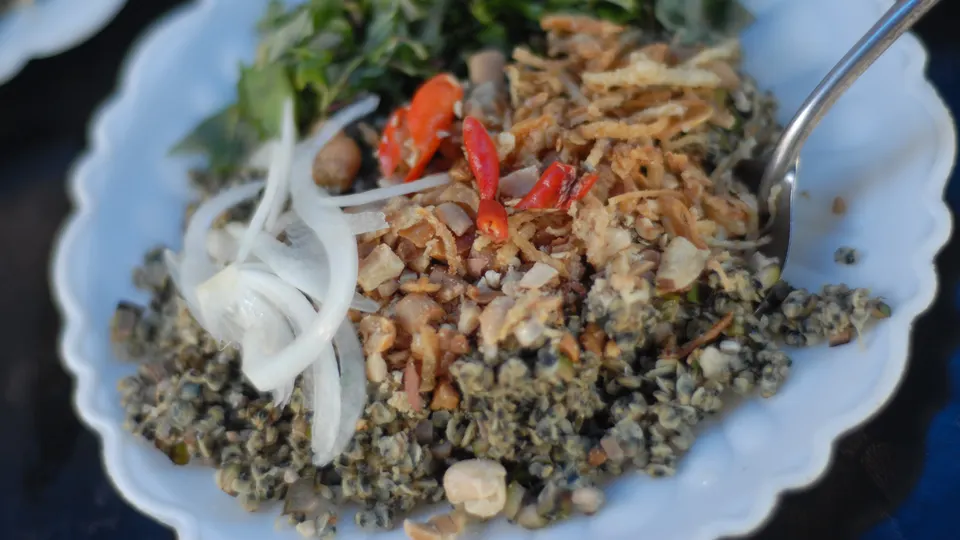
Hen xuc banh trang (or banh da (bánh đa)) belongs more to the wider central region than to Hue alone. The clams are stir-fried with shallots, garlic, lemongrass, ginger and chilli, finished with Vietnamese coriander, and set in the middle of the table with grilled sesame rice crackers that you break up and use as spoons. Vietnam News describes it as a favourite snack with beer, and quotes an 82-year-old cook who adds ginger to prevent stomach ache. Tuoi Tre News also describes a simple clam soup from towns such as Hoi An (Hội An) and Tam Ky (Tam Kỳ), eaten with steamed rice and pickles.
If you are working through the region’s bowls, com hen makes a good contrast with Hue’s beef noodle soup, bun bo Hue, and with mi Quang further south, another central dish built on a small amount of intense liquid rather than a full bowl of soup.
How do you eat com hen?
Most shops hand you the rice bowl already dressed and the broth on the side, with jars of chilli, shrimp paste and sometimes fish sauce on the table. VnExpress describes the dish as so hot that diners eat it while sucking in air between mouthfuls (VnExpress).
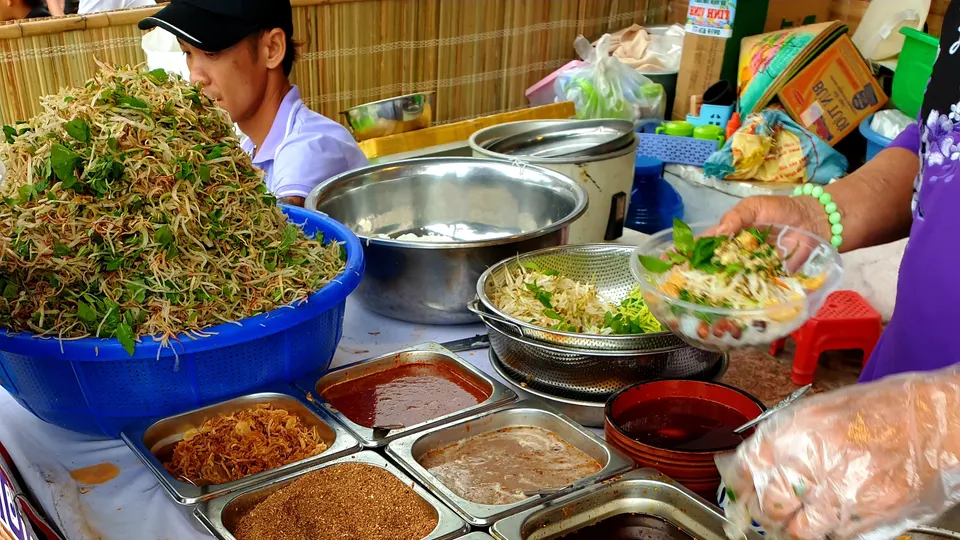
- Pour in some broth. Add a spoonful or two of the hot clam broth to the rice; Tuoi Tre News calls this eating it “the Hue way”.
- Mix thoroughly. Turn everything over so the shrimp paste, peanuts and crackling are spread through the rice.
- Season to taste. Add chilli and shrimp paste a little at a time. Some shops also offer mam nem (mắm nêm), a pungent fermented fish sauce; the Vietnam National Authority of Tourism notes that diners not used to its smell can leave it out.
- Order another. Bowls are small. VnExpress noted in 2020 that many diners eat two or three.
Street vendors traditionally sold com hen in the morning, roughly from breakfast until noon, while larger shops now serve it all day, and some only in the evening. If the Hue dialect at the counter is hard to follow, our guide to Vietnamese accents by region explains why Hue speech sounds so different.
Where to try com hen in Hue
The traditional heartland is on the east bank of the Perfume River, in Vy Da ward, which includes Con Hen. Hue’s official tourism portal lists a string of small hen shops on Han Mac Tu (Hàn Mặc Tử) Street there, at numbers 1, 3, 5, 17 and 51. In 2020 VnExpress named three addresses, two of them in Vy Da and one on Pham Hong Thai Street on the south bank (VnExpress). Tuoi Tre News added in 2024 that one of the best-known spots is near Dap Da (Đập Đá) Bridge, and Hue’s tourism portal lists a “Cơm hến Đập Đá” at 1 Han Mac Tu. To fit com hen into a day of eating across the city, see our map of where to eat in Hue.

The MICHELIN Guide’s 2026 Vietnam selection, announced in June 2026, again covered only Hanoi, Ho Chi Minh City and Da Nang, VietNamNet reported, so the shops below are local favourites confirmed by the press and by Hue’s own tourism portal (listings re-checked on 19 November 2026). Prices and opening hours change, so check them on the day.
| Shop | Area | On the menu (Hue tourism portal) | Choose it if |
|---|---|---|---|
| Com hen Hoa Dong, lane 7, 64 Ung Binh St | Vy Da, near Con Hen | Com hen, bun hen, mi hen, clam broth, stir-fried clams | You want the classic Vy Da clam-shop setting and the full hen menu |
| Com Hen Be Liem, 64 Nguyen Cong Tru St | Thuan Hoa ward, south bank | Com hen, bun hen, mi hen, clam broth | You are staying on the south bank near the hotels and want a family-run breakfast stop (Saigoneer, August 2025) |
| Com hen, 17 Han Mac Tu St | Vy Da, on the street of hen shops | Com hen, bun hen, chao hen | You want a warm, milder bowl of clam porridge as well as rice |
For more of the region, start from the Central Vietnam hub, and browse more regional dishes in the food section.
Where to try cơm hến in Huế
Local favourite
Cơm hến Hoa Đông
Huế · Vỹ Dạ ward, the ward that includes Cồn Hến
64/7 Ưng Bình Street (lane 7, house 64)
A long-running shop in the Vỹ Dạ area that VnExpress named among Huế's cơm hến addresses in 2020 and that Huế's official tourism portal lists today. It serves the whole hến family: rice, vermicelli, noodles, broth and stir-fried clams.
Order: Cơm hến with its bowl of broth; bún hến if you prefer noodles.
The shop sits down a lane (kiệt) off Ưng Bình Street, so look for lane 7 rather than a street-front number.
Recommended by: VnExpress (2020), HueTripo, Huế Department of Culture, Sports and Tourism (2026), Vietnam Airlines · checked November 2026
Local favourite
Cơm Hến Bé Liêm
Huế · Thuận Hóa ward (former Phú Hội ward)
64 Nguyễn Công Trứ Street
A family-run breakfast shop in the front of the family's house, profiled by Saigoneer in 2025: cold rice and clams with crackling, chilli oil, shrimp paste, starfruit, young mango and dọc mùng (taro stem). Also listed on Huế's tourism portal.
Order: Cơm hến; you can swap the rice for bún (vermicelli).
Recommended by: Saigoneer (2025), HueTripo, Huế Department of Culture, Sports and Tourism (2026) · checked November 2026
Local favourite
Cơm hến – Bún hến – Cháo hến (17 Hàn Mặc Tử) · Cơm hến Hàn Mặc Tử
Huế · Vỹ Dạ ward
17 Hàn Mặc Tử Street
Hàn Mặc Tử Street in Vỹ Dạ has a run of small hến shops; VnExpress named the one at number 17 in 2020, and Huế's tourism portal lists it with cơm hến, bún hến and cháo hến (clam rice porridge).
Order: Cơm hến, or cháo hến if you want something warm and mild.
VnExpress calls it 'Cơm hến Hàn Mặc Tử', while the tourism portal lists it as 'Cơm hến – Bún hến – Cháo hến'. Several other hến stalls trade on the same street; this card means the one at number 17.
Recommended by: VnExpress (2020), HueTripo, Huế Department of Culture, Sports and Tourism (2026) · checked November 2026
Addresses and details can change; check before you go. We do not accept payment for listings.
Frequently asked questions
Is the rice in com hen really served cold?
Yes. Hue vendors cook the rice ahead, traditionally the day before, and serve it cool; the warmth comes from the bowl of hot clam broth you spoon over it. The cold-and-hot contrast is the point of com hen.
Which should I order in Hue, com hen or bun hen?
Order com hen if you want the classic cold-rice version and bun hen if you prefer rice vermicelli; both use the same clams, toppings and hot broth. Most Hue clam shops, such as Com hen Hoa Dong, sell both, plus clam porridge (chao hen).
Is com hen very spicy?
Usually, yes. Hue shops add chilli paste, chilli oil and fresh chilli, and VnExpress describes diners gasping at the heat. You can ask for less chilli and add it yourself from the jars on the table.
Is there a MICHELIN-listed com hen shop in Hue?
No. The MICHELIN Guide's 2026 Vietnam selection, announced in June 2026, covered Hanoi, Ho Chi Minh City and Da Nang only. For Hue, use local favourites confirmed by the press and by Hue's official tourism portal, such as the shops on this page.
What time of day do people eat com hen?
Traditionally in the morning, from breakfast until about noon, when street vendors sold it from shoulder poles. Many Hue shops now serve com hen all day, and some only in the evening.
Key sources
- Central Vietnam's baby mussels shine in simple cuisine · Tuổi Trẻ News, 17 Mar 2021
- Everything you need to know for a full day of eating in Hue · Tuổi Trẻ News, 2 Apr 2024
- Hồn Huế từ phần cơm nguội · VnExpress, 14 Feb 2020
- Cơm hến, bình dị và đậm đà · VnExpress, 17 Oct 2012
- Xôn xao cồn Hến · VOV, 21 Jan 2011
- Cầu kỳ cơm hến Cố đô · Báo Pháp luật Việt Nam, 24 Jun 2018
- Dishes from clams, a highlight in Việt Nam's cuisine · Việt Nam News, 16 Jun 2020
- Com hen – rice with baby clams · VietNamNet (from Nhân Dân), 9 Jan 2017
All 18 sources and further reading
- 4 món đặc sản ở Huế · VnExpress, 5 Feb 2020
- Cơm hến xứ Huế khó quên · VnEconomy, 21 Nov 2009
- Con Hen – an oasis in Hue city · VietNamNet, 23 Aug 2014
- Hue clam rice · Vietnam Pictorial (VNA), 5 Jun 2016
- Com Hen – a rustic specialty of Hue City · Vietnam National Authority of Tourism, 30 Jul 2012
- Com Hen soul of Hue street cuisine · Vietnam National Authority of Tourism (from VnExpress), 21 Feb 2020
- Huế food guide · Vietnam Coracle, May 2022
- Hẻm Gems: In Huế, Cơm Hến Bé Liêm Is Breakfast With a Side of Warm Hospitality · Saigoneer, 20 Aug 2025
- Michelin Guide Vietnam 2026 adds 23 new dining destinations · VietNamNet, 5 June 2026
- Cơm hến Hoa Đông (listing) · HueTripo, Huế Department of Culture, Sports and Tourism
Keep exploring
 Central Vietnam · Travel Hue (Huế): How Many Days, What to See, 2026 Tickets How many days Hue needs, which Citadel sights and royal tombs to pick, 2026 ticket prices, the flood months to avoid and where to eat in the old royal capital.
 Central Vietnam · Food Bun Bo Hue (Bún Bò Huế): Dac Biet, How to Order and Cook Bun bo Hue explained: what a dac biet bowl holds, how Hue cooks make the lemongrass and shrimp paste broth, what hot dieu mau does, and Hue vs Saigon bowls.
 Central Vietnam · Food Mi Quang (Mì Quảng): What to Order and Where in Da Nang Mi Quang explained: which version to order, how to eat it, 2026 prices, three MICHELIN-listed Da Nang shops and how it differs from cao lau and pho.
 Central Vietnam · Food Hue (Huế) Royal Cuisine: What to Eat and Where to Try It Hue royal cuisine explained: what Nguyen court cooking was, how banh beo, banh nam and banh bot loc differ, and when 2026 palace banquets ran in Hue.