North Vietnam · Travel
Ha Long Bay (Hạ Long) or Lan Ha Bay: Which to Choose
How Ha Long Bay and Lan Ha Bay differ: what the drowned limestone karst is, UNESCO status since 1994 and 2023, floating villages then and now, and when to go.

Choose Ha Long Bay for the most cruise options and the easiest transfer from Hanoi, or Lan Ha Bay off Cat Ba island for a quieter trip with fewer boats; since 1 April 2026 a sea route also links the two, so some cruises now cover both (VietnamPlus). Ha Long is busy: it received about 2,975,000 visitors in the first ten months of 2026, about 1,934,500 of them foreign, Bao Quang Ninh reported on 8 November 2026. Its official sightseeing fee is 200,000 or 250,000 dong for the main day routes, according to the management board’s fee schedule, still the one in force when we checked on 19 November 2026, and storms can stop all boats at a few hours’ notice, as on 3 July 2026.
Ha Long (Hạ Long) Bay (Vinh Ha Long (Vịnh Hạ Long)), on the coast of Quang Ninh (Quảng Ninh), a centrally governed city since September 2026, in the far north-east of Vietnam, is a sea full of limestone: islands and islets that rise sheer from green water, many of them too steep to land on. Lan Ha (Lan Hạ) Bay (Vinh Lan Ha (Vịnh Lan Hạ)), to the south off Cat Ba (Cát Bà) island in Hai Phong (Hải Phòng), is part of the same seascape. The question most visitors face is not whether to go but which bay. The short answer: they are the same kind of landscape, and the difference lies in how busy each one is, where you start from and what you want to do on the water. To choose well it helps to know what the bay actually is.
Ha Long Bay and Lan Ha Bay at a glance
| Ha Long Bay | Lan Ha Bay | |
|---|---|---|
| Province (since July 2025) | Quang Ninh (not merged in 2025; a centrally governed city since 1 Sep 2026) | Hai Phong (absorbed Hai Duong (Hải Dương) in 2025); Cat Hai (Cát Hải) special zone |
| What it is | Drowned limestone (tower karst) landscape | The same karst, in the Cat Ba archipelago |
| Islands | Roughly 1,600–2,000, depending on what is counted | Cat Ba archipelago: more than 360 |
| UNESCO | World Heritage 1994 (scenery) and 2000 (geology) | Added in 2023 extension, Ha Long Bay – Cat Ba Archipelago |
| Feel on the water | Larger, busier, most boats and services | Quieter, fewer boats, working fish farms |
| Sightseeing fee | 200,000–250,000 dong per main day route; 500,000–750,000 dong for one or two nights (management board schedule, checked 19 November 2026) | Cat Ba bays: 120,000 dong per adult per day since August 2024, kept unchanged in 2025 (Dai Doan Ket; VnEconomy) |
| Usual base | Tuan Chau (Tuần Châu) and Ha Long international passenger ports | Cat Ba island |
| Who stops boats in a storm | Quang Ninh’s inland waterway port authority | Hai Phong’s authorities, separately |
| Best months | April–June, September–November | Same |
| Watch out for | Summer storms, winter mist | Same |
What the bay actually is: a drowned karst landscape
Think of Ha Long not as islands that rose from the sea but as hills the sea climbed over. The rock is limestone laid down in a shallow sea in the Carboniferous and Permian periods, roughly 359 to 251 million years ago, in a layer more than a kilometre thick (Ha Long Bay Management Board). Later folding cracked it; millions of years of tropical rain then dissolved it into the steep cones and towers typical of karst. When the last ice age ended and sea levels rose, water flooded the valleys between the peaks, and the hilltops became islands.

UNESCO describes the result as “the most extensive example of marine-invaded tower karst globally”, with two forms side by side: fengcong, clusters of cones sharing a common base, and fenglin, isolated towers standing alone. The sea-level story is written on the rock. Many islands have a notch cut into their base by waves, which geologists read as evidence of former sea levels; caves fall into three types, including old caves once at the foot of hills and notch caves cut by the sea. Where the sea broke into enclosed karst hollows it formed saltwater lagoons, known locally as tung (tùng) and ang (áng). These are the quiet enclosed lakes that boats and kayaks slip into through low arches.
The IUCN adds an important point for anyone choosing between the bays: Ha Long shows the later stages of the sea drowning the karst, while Cat Ba still shows land and intertidal stages. Put simply, Lan Ha and Cat Ba are the same process caught a little earlier, with more land, forest and beaches between the towers.
People have lived here for a very long time. The geology board links sediments from the last 11,500 years to the prehistoric Soi Nhu (Soi Nhụ), Cai Beo (Cái Bèo) and Ha Long cultures, which archaeologists name after sites in and around the bay.
The legend of the descending dragon
Ha Long means “descending dragon”, and the name comes with a legend. Long ago, when invaders from the north attacked, the Jade Emperor sent a Mother Dragon and her children down to help. They spat out jewels and precious stones that fell into the sea, became islands and formed a barrier that wrecked the enemy fleet; the dragons then stayed on earth. The same story names neighbouring places: Bai Tu Long (Bái Tử Long), the bay to the north-east, for the young dragons, and Bach Long Vi (Bạch Long Vĩ), the White Dragon’s tail.
It is a legend, not a record, and the name itself is not ancient. It first appears on a French sea chart of the late 19th century; older Vietnamese texts used names such as An Bang and Luc Thuy (Lục Thủy). What the legend shows is how a seascape that looks like a defensive wall became part of a national story of resistance. Hanoi’s own founding name, Thang Long (Thăng Long), “Soaring Dragon”, draws on the same imagery, as our Hanoi guide explains.

How many islands? Why the numbers differ
You will read anything from about 1,100 to nearly 2,000. The numbers depend on what is being counted. Quang Ninh counts 1,969 islands in the whole Ha Long Bay area of 1,553 km². The IUCN and several language versions of UNESCO’s text describe the bay with some 1,600 islands and islets, while the current English UNESCO page gives 1,133 for the inscribed property (UNESCO). The Cat Ba archipelago adds more than 360 more; Hai Phong gives 366. “Roughly 1,600 to 2,000 for Ha Long” is the honest range.

One World Heritage site, three dates
Ha Long Bay was first inscribed on the World Heritage List on 17 December 1994 for its outstanding natural beauty (criterion vii), then a second time on 2 December 2000 for its geological and geomorphological value (criterion viii).

On 16 September 2023, at the World Heritage Committee’s session in Riyadh, the boundary was extended to the Cat Ba archipelago in Hai Phong, and the site became Ha Long Bay – Cat Ba Archipelago, Vietnam’s first World Heritage site shared between two provinces (Tuoi Tre). Lan Ha Bay lies within that archipelago. The extension also brought in Cat Ba island’s forests and the critically endangered Cat Ba langur, a primate found nowhere else. Cat Ba became a national park in 1986 and a UNESCO Biosphere Reserve in 2004.
Recognition has not removed the pressure. In its 2025 assessment the IUCN rated the site’s outlook as of “significant concern”, listing tourism as a very high threat and water pollution from industry, shipping and boats as a high one.
Ha Long vs Lan Ha in practice
Ha Long Bay is the classic version: the best-known caves and the largest choice of boats, with departures from the Ha Long and Tuan Chau passenger ports. That scale is also its drawback. National Geographic described Ha Long as a bay where “dozens of ships ply the waters daily”, and the IUCN counts more than a thousand tour boats operating in the property, with some caves taking up to 10,000 visitors a day (IUCN World Heritage Outlook).

Lan Ha Bay is the same karst on a smaller, quieter scale. National Geographic called it “the area’s quieter alternative” and reported that few cruise operators then had permission to sail there, so most boats you meet are fishing boats. Cat Ba island, the largest in the region, is the natural base: it adds the forests of the national park and a small town to a bay trip, as our Cat Ba Island and Hai Phong guide explains.
Which Ha Long route most people take. Route 2 (VHL2), the cave route past Ti Top island and Sung Sot cave, is by far the busiest: of more than 685,000 visitors on the bay from August to October 2026, over 510,000 took it, most of them foreign, Bao Quang Ninh reported on 8 November 2026, citing the bay’s management board. The new Ha Long–Lan Ha inter-bay routes carried just over 10,600 visitors in the same three months. If you want the classic caves, route 2 is the one; if you want fewer boats, routes 3 and 4 (Cua Van and the eastern islands) or Lan Ha are the quieter choices.
How to choose:
- First visit, short on time, want the iconic caves and the widest choice of boats: Ha Long.
- Want fewer boats, kayaking among towers and lagoons, and a working fishing landscape: Lan Ha, staying on or sailing from the Cat Ba side.
- Not sure: remember that the water is continuous. Only a provincial border runs between the two bays, and the rock, the towers and the lagoons are the same. Since April 2026 some overnight cruises sail through both (more under getting there, below). To pick the bay, the cruise length and the port, including Bai Tu Long, use our bay cruise decision guide.
Whichever you pick, it pays to compare it with the inland version of the same rock. Ninh Binh has limestone towers standing in rice fields and rivers instead of the sea, the same karst story without the flooding.
Floating villages: tradition and today
For generations, Ha Long’s fishing families lived on the water in floating houses and boats, in villages such as Cua Van (Cửa Vạn) and Vong Vieng (Vông Viêng). That way of life largely ended in 2014. In May that year Ha Long city began moving houseboats to a resettlement area of more than 360 apartments in Ha Phong (Hà Phong) ward on the mainland, aiming to clear the bay’s houseboats by 30 June; at the time 626 private houseboats were home to more than 2,100 people. The IUCN now records that all the floating villages in Ha Long Bay, about 2,000 people, have been removed, and notes concerns about how far residents were consulted. (Ha Phong is now part of Ha Tu (Hà Tu) ward, one of the wards that replaced the old Ha Long city in July 2025, according to the Quang Ninh government portal.)

What you see today is a preserved version. Nearly 70 floating houses and classrooms were handed to the bay’s management board, a floating cultural conservation centre was built at Cua Van, and a small group of families was allowed to keep farming fish from the old houses. Former boat people have been brought back to perform the bay’s old folk songs, and the villages are now mainly tourist destinations. When you row through Cua Van, you are looking at heritage being kept, not at a community going about its old life. Seeing it that way is more respectful and more accurate.
Lan Ha changed later and less completely. Hai Phong had aquaculture rafts in the Cat Ba bays dismantled and moved to designated farming areas, a process the city reported as nearly complete by mid-2023, ahead of the UNESCO decision. The IUCN describes a relocation scheme on the Cat Ba side that leaves some families farming in designated areas. So in Lan Ha you are still more likely to pass working fish farms and floating houses, especially around Cai Beo, described by Hai Phong’s news portal as the oldest floating fishing village of its kind in Vietnam. These are workplaces and homes: ask before photographing people, and do not climb onto rafts uninvited.
Storms, Typhoon Yagi and safety on the water
The bay’s weather is not just a matter of views. Typhoon Yagi hit Quang Ninh on 7 September 2024. Across the province 23 cruise vessels and 41 fishing boats sank or were set adrift, and the bay was left full of broken fish rafts and debris (VTV). In Quang Ninh and Hai Phong together, 3,269 fish cages were destroyed or swept away. Tourist boats resumed normal operation in Ha Long on 13 September, but the storm showed how exposed both the boats and the fish-farming families are.

Summer danger is not limited to named typhoons. On 19 July 2025 the tourist boat Vinh Xanh (Vịnh Xanh) 58 capsized in Ha Long Bay; dozens of people died. Meteorologists said the violent storm was triggered by a tropical convergence zone after days of heat, not by the approaching Typhoon Wipha, and Quang Ninh then suspended all tourist boat departures as Wipha neared.
Will my boat sail? What happens when a storm is forecast
Tourist boats on Ha Long Bay need a departure permit from the port authority, and when a storm approaches the authority simply stops issuing them. In Quang Ninh the order comes from the inland waterway port authority, under the Department of Construction, together with the civil defence command. When storm No. 1 of 2026, Maysak, approached on 3 July 2026, they declared an urgent sea ban that also stopped overnight sightseeing boats. A visitor from Hanoi said his captain told the group at noon that they had to turn back, and by late afternoon tour boats were queuing at the port to land their passengers before leaving again to shelter (Tien Phong).

Overnight trips are usually the first to go. That day, according to the business paper Doanh nghiep (Doanh nghiệp) & Hoi nhap (Hội nhập), permits for boats staying overnight or running evening trips on the bay stopped from noon, and those for other vessels from 5 pm. The pattern repeats from year to year. As Storm Prapiroon approached in July 2024, authorities in Quang Ninh and Hai Phong stopped licensing tourist boats to sail out and stay overnight from midday on a Monday; the bay’s management board had counted more than 18,000 visitors on the bay the day before, 1,700 of them overnight, VnExpress reported. Ahead of Typhoon Wipha in July 2025 the port authority suspended departure permits for all passenger vessels, while boats returning to shore could still operate, SGGP reported.
Lan Ha is decided separately, because it belongs to Hai Phong. When Typhoon Kajiki approached in August 2025, Hai Phong halted all tourism operations, including the Dong Bai (Đồng Bài)–Cai Vieng (Cái Viềng) ferry and the Cat Hai–Phu Long (Phù Long) cable car, the links to Cat Ba, while Quang Ninh suspended sightseeing and overnight stays at sea, according to VietnamPlus. A storm can therefore close the road to the island as well as the bay.
What about your money? In 2024 operators told VnExpress that they treated the storm as force majeure and worked out solutions with passengers case by case, and one warned that rescheduling was difficult because its cruises were almost fully booked until the end of September. No source sets a standard refund rule, so plan around it:
- Before you pay, ask the operator in writing what happens if the authorities cancel: refund, credit or a new date.
- In the storm months, put the cruise early in your trip and keep a spare day after it. The storms described on this page fell between early July and early September; the national tourism authority calls June to August stormy, and our Vietnam weather by month guide sets this against the rest of the country.
- Expect short notice. In July 2026 passengers learned of the ban at noon on the day it began.
- Choose an operator that briefs passengers on life jackets, and accept a cancellation without argument: the order comes from the authorities, not the crew.
When to go
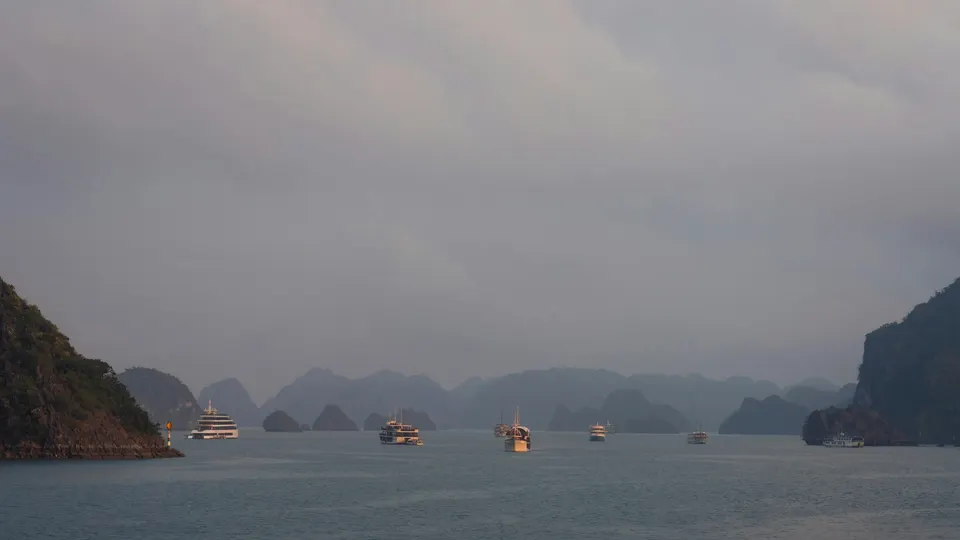
Vietnam’s tourism authority suggests April to June or September to November for Ha Long, when you have the best chance of clear skies (Vietnam National Authority of Tourism). December to March is cool to cold, misty and cloudy, and January can be properly cold on deck; June to August is hot, humid and stormy, and tropical storms can cancel sailings. Mist is not all loss, as the same source notes: the karsts half-hidden in grey show a more mystical side of the bay. Bring a warm layer in winter. The same seasonal pattern shapes the whole of the North, the only part of Vietnam with a winter you will feel.
Getting there and how long to stay
Ha Long is usually visited from Hanoi, as a day trip or, more commonly, with one or two nights on a boat or in town. The bay’s management board gives about 1 hour 30 minutes by road from Hanoi on the Hanoi–Hai Phong expressway, about two hours from Noi Bai (Nội Bài) airport, and about 45 minutes from Van Don (Vân Đồn) airport in Quang Ninh or Cat Bi (Cát Bi) airport in Hai Phong. Treat these as best cases: other guides give longer times, and hotel pick-ups add more. Whether that drive is worth a day trip or calls for a night on the water is the subject of our day trip vs overnight cruise guide. Boats into the bay leave from Tuan Chau International Passenger Port and Ha Long International Passenger Port, the two ports named in the board’s and the press’s 2026 reports.
Since April 2026 you no longer have to choose strictly between the bays. Quang Ninh and Hai Phong opened a sea route linking Ha Long and Lan Ha on 1 April, with tickets sold at both ports, VietnamPlus reported; on 20 April the first two overnight cruises on approved itineraries set off, combining Ha Long sights such as the Cua Van floating cultural centre with Lan Ha’s caves and the Cai Beo fishing village, according to VietnamNet. Cat Ba and Lan Ha still suit a slower trip of two or three nights, combining the bay with the island’s national park. Both bays can be linked with Ninh Binh (Ninh Bình) for a week of northern karst, with the mountains of Sa Pa or Ha Giang if you have longer, or with the whole country in a two-week route.

A note on names after July 2025. Quang Ninh was one of the provinces left unchanged in Vietnam’s 2025 reorganisation, while Hai Phong absorbed the former Hai Duong province (Resolution 202/2025/QH15). On 1 September 2026 Quang Ninh itself became a centrally governed city, made up of 30 wards, 22 communes and two special zones, according to VietnamNet; you may still see “Quang Ninh province” on older signs and maps. Inside Hai Phong, Cat Ba town and the communes of the former Cat Hai district now form the Cat Hai special zone, and on the Ha Long side addresses now use wards such as Bai Chay (Bãi Cháy), Hong Gai (Hồng Gai) and Tuan Chau. For more planning across the country, see our travel section.
Where to eat before or after a cruise: two verified seafood restaurants
Local favourite
Talata · Nhà hàng Talata
Ha Long (Quang Ninh) · Hon Gai side of the bay (former Hong Ha ward)
87 Hải Đông Street (tổ 6, khu 8)
A multi-storey seafood restaurant with a rooftop view over the bay, recommended by Tuoi Tre in June 2024 and by Znews; Viet Nam News reviewed it as a seafood restaurant with a view of Ha Long Bay.
Order: Shrimp salad, sweet snails (oc huong) and a seafood or snail hotpot to share.
Sources disagree on the number of floors (six or seven); the address is Tuoi Tre's.
Recommended by: Tuổi Trẻ (2024), Znews (2020), Việt Nam News (2019) · checked November 2026
Local favourite
Viễn Dương · Nhà hàng Viễn Dương
Cat Ba (Hai Phong) · Cat Ba town (Cat Hai special zone since July 2025)
Tùng Dinh street, Cat Ba town
A long-running Cat Ba seafood restaurant with live seafood in tanks out front, named by VnExpress's Ngoi Sao in April 2025 among the town's lunch spots and reviewed by Viet Nam News for fresh seafood served fast.
Order: Whatever is fresh in the tanks, steamed or grilled, with home-style side dishes.
Sources give different streets: Ngoi Sao (2025) says Tung Dinh street, Viet Nam News (2020) 12 Nui Ngoc street. Check the location in a map app before you go.
Recommended by: Ngôi Sao (VnExpress) (2025), Việt Nam News (2020) · checked November 2026
Addresses and details can change; check before you go. We do not accept payment for listings.
Frequently asked questions
Is Lan Ha Bay part of Ha Long Bay?
Geographically it is the southern continuation of the same karst seascape, but administratively Lan Ha belongs to Hai Phong, not Quang Ninh. Since 2023 both lie within one UNESCO World Heritage site, Ha Long Bay – Cat Ba Archipelago.
How much is the Ha Long Bay entrance fee?
It depends on the route. As of November 2026 the Ha Long Bay management board lists 200,000 or 250,000 dong per person for the main day routes (70,000 for the short coastal route, 600,000 for the combined route) and 500,000 to 750,000 dong for one or two nights on board. Cruise prices usually include it, so check before you pay twice.
Can you still visit floating villages in Ha Long Bay?
Yes, but most residents were resettled on the mainland in 2014. Cua Van and Vong Vieng are now kept mainly as heritage sites with a floating cultural centre, while a small number of families continue aquaculture.
Did Quang Ninh or Hai Phong change in the 2025–2026 administrative reforms?
Quang Ninh was not merged in July 2025, but on 1 September 2026 it was upgraded from a province to a centrally governed city. Hai Phong absorbed the former Hai Duong province on 1 July 2025, and Cat Ba now sits in the new Cat Hai special zone.
What happens if a storm cancels my Ha Long Bay cruise?
When a storm approaches, Quang Ninh's inland waterway port authority stops issuing departure permits, usually for overnight boats first, and boats already out bring passengers back to port; Hai Phong decides separately for Lan Ha. Operators treat storms as force majeure and settle refunds or new dates case by case, so ask for the weather policy in writing before you pay.
Key sources
- Ha Long Bay - Cat Ba Archipelago · UNESCO World Heritage Centre
- Ha Long Bay - Cat Ba Archipelago: 2025 Conservation Outlook Assessment · IUCN World Heritage Outlook
- The Geological and Geomorphological Value of Ha Long Bay · Ha Long Bay Management Board (halongbay.com.vn)
- Vietnam's Ha Long Bay-Cat Ba Archipelago recognized as world heritage · Tuổi Trẻ News, 17 September 2023
- Quang Ninh speeds up storm recovery efforts to attract tourists · VTV, 25 September 2024
- Weather and climate in Vietnam · Vietnam National Authority of Tourism (vietnam.travel)
- Resolution 202/2025/QH15 on the reorganization of provincial-level administrative divisions · LuatVietnam (text of the National Assembly resolution)
- Khẩn cấp cấm biển, khách du lịch vịnh Hạ Long cuống cuồng chạy bão (urgent sea ban as storm No. 1 nears) · Tiền Phong, 3 July 2026
All 40 sources and further reading
- Mức phí tham quan vịnh Hạ Long (Ha Long Bay sightseeing fees) · Ha Long Bay Management Board (halongbay.com.vn), updated 31 March 2025, checked 19 November 2026
- Du lịch Vịnh Hạ Long 2026: Cẩm nang từ A-Z · VnExpress, updated 12 June 2026
- Vịnh Hạ Long hút khách nước ngoài mùa thu đông · Báo Quảng Ninh, 8 November 2026
- Hải Phòng điều chỉnh mức phí tham quan vịnh Cát Bà từ ngày 1/8 · Đại Đoàn Kết, 30 July 2024
- Hải Phòng điều chỉnh phí tham quan danh thắng · VnEconomy, 6 November 2025
- Titles of Ha Long Bay · Ha Long Bay Management Board (halongbay.com.vn)
- Geological - Geomorphological values · Ha Long Bay Management Board (halongbay.com.vn)
- The Legend of the Ha Long Dragon: The Story behind the name · Ha Long Bay Management Board (halongbay.com.vn)
- Cat Ba islands: a new world natural heritage · Hải Phòng Department of Planning and Investment
- Hạ Long Bay celebrates 30 years as a world heritage site · Việt Nam News, 13 December 2024
- Ha Long City moves floating villages ashore · Dân Trí International (DTiNews), 19 May 2014
- Quảng Ninh makes effort to preserve old fishing villages in Hạ Long Bay · Việt Nam News, 10 October 2023
- Old floating villages open to tourists · Vietnam National Authority of Tourism (from Việt Nam News), 30 November 2017
- Completing the dismantlement of aquacultural cages in Cat Ba archipelago · Hải Phòng City Portal
- Lan Ha Bay, Vietnam: explore a floating wonderland · National Geographic (adapted from National Geographic Traveller UK), 2023
- Hạ Long city welcoming tourists back · Việt Nam News, 14 September 2024
- Typhoon Yagi damage to fish farms in Quảng Ninh and Hải Phòng · Dân Trí International (DTiNews), 17 September 2024
- Ha Long Bay tourist boats banned from departing as typhoon Wipha nears · Tuổi Trẻ News, 20 July 2025
- Ha Long Bay boat tours halted after Vịnh Xanh capsizing · Dân Trí International (DTiNews), 21 July 2025
- US magazine selects Lan Ha Bay among Southeast Asia's most beautiful places · Hải Phòng News (Hải Phòng city portal)
- Resolution 1669/NQ-UBTVQH15 on the reorganization of commune-level administrative divisions of Hai Phong city · LuatVietnam (text of the National Assembly Standing Committee resolution)
- 54 wards and communes · Quảng Ninh Provincial Portal
- Hạ Long Bay · Wikipedia (see its cited sources)
- Vietnam adds Quang Ninh and Bac Ninh to its centrally governed cities · VietnamNet, 25 Aug 2026
- Quảng Ninh, Hải Phòng khẩn trương ứng phó bão số 1 (Quảng Ninh and Hải Phòng respond to storm No. 1) · Doanh nghiệp & Hội nhập, 3 July 2026
- Quang Ninh temporarily suspends tourist boat permits in Ha Long Bay · Sài Gòn Giải Phóng (SGGP), 20 July 2025
- Thousands of tourists affected as Ha Long cruise tours canceled over storm Prapiroon · VnExpress International, 22 July 2024
- Coastal tourism suspended as Typhoon Kajiki approaches · VietnamPlus (Vietnam News Agency), 25 August 2025
- Đường đến Hạ Long (routes to Hạ Long) · Ha Long Bay Management Board (halongbay.com.vn)
- Over 12,000 visitors to Ha Long Bay on the first day of the New Year 2026 · Ha Long Bay Management Board (halongbay.com.vn), 1 January 2026
- Sea tour launched to connect Ha Long, Lan Ha bays · VietnamPlus (Vietnam News Agency), 2 April 2026
- New cruise route linking Ha Long and Lan Ha bays launched · VietnamNet, 21 April 2026
Keep exploring
 North Vietnam · Travel Hanoi: How Many Days, What to See and When to Go Hanoi travel guide for 2026: how many days and where to stay, Noi Bai airport, walking-street hours, the new low-emission zone, Train Street and where to eat.
 North Vietnam · Travel Ninh Binh (Ninh Bình): How Many Days, Boats and Tickets Ninh Binh: how many days you need, Trang An or Tam Coc boats, 2026 ticket prices, when the rice turns gold, the Hoa Lu capital, what to eat and a 2-day plan.
 North Vietnam · Travel Sa Pa (Sapa): When to Go, How Many Days and What to See Sa Pa (Sapa) trip planner: when to see golden or flooded rice terraces, how many days to stay, which Hmong and Dao villages to visit, and Fansipan in brief.