Central Vietnam · Travel
Hue Royal Tombs (Lăng tẩm Huế): Which to Visit, Which Ticket
Which Hue royal tombs to visit in November 2026: Minh Mang, Tu Duc or Khai Dinh, the right ticket or combo, opening times and half-day routes in the best order.
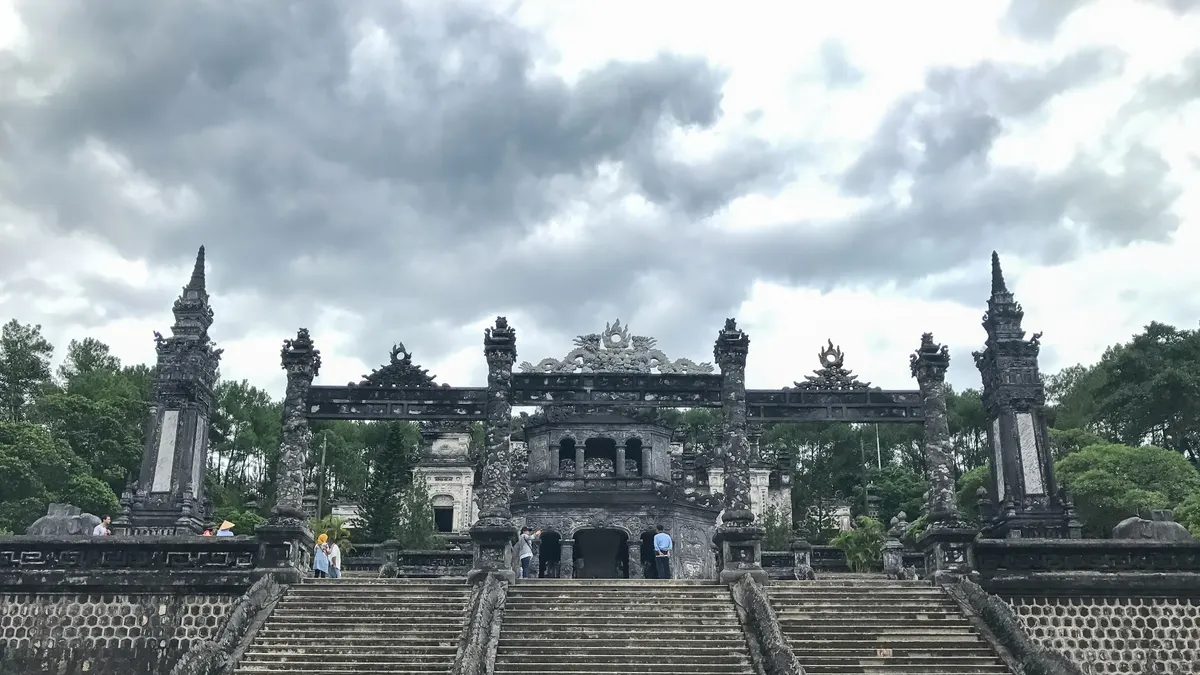
If you can see only one Hue (Huế) royal tomb, choose Minh Mang (Minh Mạng) for classical order, Tu Duc (Tự Đức) for a poet’s garden of lakes and pavilions, or Khai Dinh (Khải Định) for a dark concrete hillside that glitters with mosaic inside. As of November 2026, each of the three costs 150,000 dong for an adult and opens at 7 am, and Khai Dinh closes half an hour before the others, at 5 pm. With half a day, see two that contrast, usually Minh Mang and Khai Dinh, or all three if you start at 7 am; add Gia Long, Dong Khanh (Đồng Khánh) or Thieu Tri (Thiệu Trị) only if you want quiet more than spectacle.
The emperors of the Nguyen (Nguyễn) dynasty, who ruled from Hue from 1802 to 1945, built their tombs upstream along the Perfume River, and they belong to the UNESCO-listed Complex of Hue Monuments (UNESCO). Our Hue city guide explains what each tomb says about its emperor, and our Central Vietnam hub shows how Hue fits the wider region; this page helps you choose between them, then gives the 2026 tickets, half-day routes in the right order, and the mistakes that cost visitors time.
Which Hue tomb should you choose?
Pick by what you enjoy, not by a ranking. The three main tombs are equally famous for different reasons, and two of them seen together tell you more than four seen in a rush.
| Tomb | Built | What it feels like | Distance from centre | Adult ticket | Best for |
|---|---|---|---|---|---|
| Minh Mang | 1840–1843 | Formal, symmetrical, about 40 structures on a 700 m axis with lakes and bridges | about 12 km, west bank | 150,000 dong | Architecture and history; the “classic” tomb |
| Tu Duc | 1864–1873 (some sources 1867) | A garden retreat: lake, waterside pavilions, a court theatre, pine valley | about 6–7.5 km | 150,000 dong | Gardens, photography, a slower walk |
| Khai Dinh | 1920–1931 | One steep, compact hillside of dark concrete; mosaic interior; wide views | about 10 km | 150,000 dong | The unusual; short visits; views |
| Gia Long | 1814–1820 | The founder’s tomb, sparse and spread over pine hills and lakes | 16–20 km, west bank | 150,000 dong | Solitude, landscape, a half-day outing |
| Dong Khanh | 1888–1923 | Small temple and tomb mixing Vietnamese and Western decoration | a few hundred metres past Tu Duc | 100,000 dong | An add-on to Tu Duc |
| Thieu Tri | – | The only tomb without an enclosing wall; partly ruined, rarely visited | near Dong Khanh | 50,000 dong | Escaping the crowds |
Ticket prices are from the official fee schedule in force since 2023 and confirmed unchanged by Tuoi Tre in August 2025 and Bao Van Hoa for 2026 (Tuoi Tre); children aged 7 to 12 pay 30,000 dong at the three main tombs and nothing at the other three. Construction dates and distances come from Hue’s city tourism portal, Kham pha Hue (Khám phá Huế), and Vietnam’s national tourism authority (VNAT); where they differ, the table gives the range.
How to decide. If you have one tomb’s worth of time, go to Minh Mang. If you have half a day, pair Minh Mang with Khai Dinh: one is the dynasty at its most confident and classical, the other its last, most European-looking monument, built under the French. Choose Tu Duc over either if you prefer water and gardens to stone, or if you want the tomb closest to town. VNAT’s own guide sums the three up as “best for history and culture buffs”, “best for dreamers and romantics” and “best for something completely different”.
What makes Minh Mang’s tomb different?
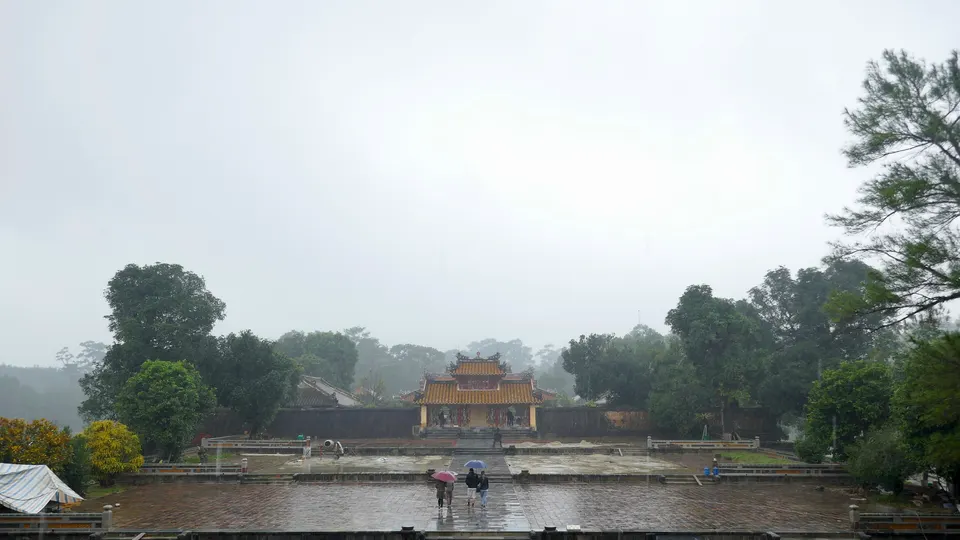
Order. Minh Mang’s tomb is a single straight line of gates, courtyards, halls, lakes and bridges, about 700 metres from the main gate to the burial mound, with some 40 structures set symmetrically along it (Kham pha Hue). It sits on Cam Khe (Cẩm Khê) hill near the confluence where two streams join to form the Perfume River, about 12 km from the city.
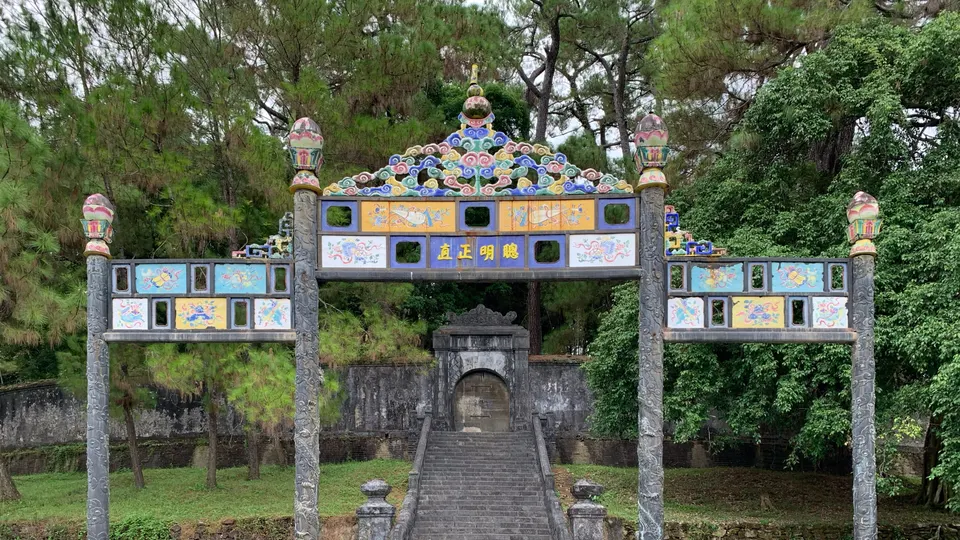
History. Minh Mang had the site surveyed in 1840 and died in early 1841, before much was built. His son Thieu Tri completed the tomb in 1843 to his father’s plan, the city portal says. The result is the most stately of the tombs, VNAT writes, a reflection of an emperor known for military success and cultural conservatism.
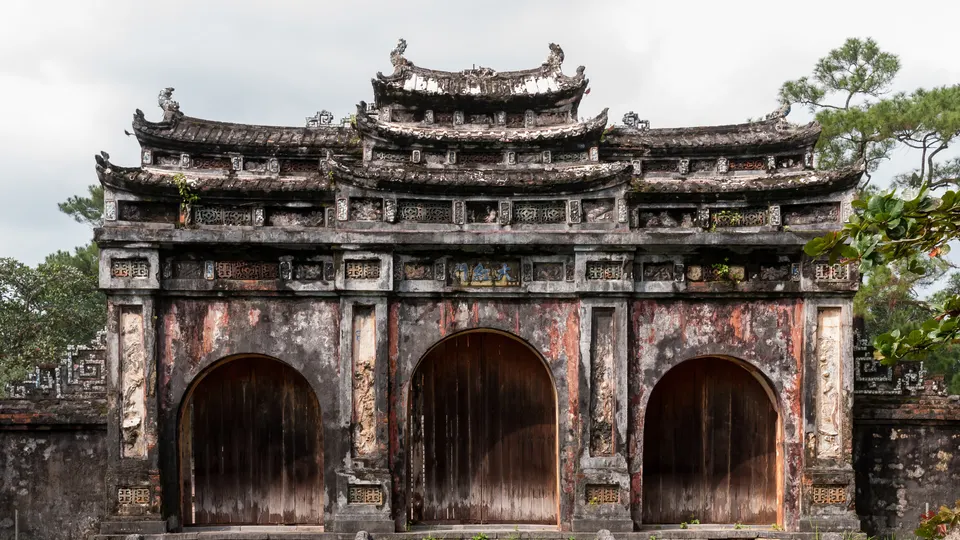
What you walk through. The axis starts at the Dai Hong Mon (Đại Hồng Môn), the great gate, which was opened only once, for the emperor’s coffin; visitors enter by the side gates, Vietnam Airlines’ travel guide notes. Then come a courtyard of stone mandarins, elephants and horses, a stele pavilion, the main worship hall, and the Trung Minh (Trừng Minh) lake, crossed by three stone bridges. At the end a crescent-shaped lake wraps around the circular walled mound, the Buu Thanh (Bửu Thành), where the emperor is buried. Its gate is locked and opens once a year, VNAT says, so you see the burial mound only from outside.
Who it suits. Anyone who wants to understand imperial Hue: the symmetry, the hierarchy of spaces and the poems carved on the buildings are the same ideas that shaped the Citadel, laid out in a landscape. It is also the most walking of the three, so it rewards a cool morning.
Why do people love Tu Duc’s tomb?
Because it is a garden first and a tomb second. Tu Duc, who reigned for 36 years, built it while he was alive as a retreat. Work began in 1864 under the name Van Nien Co (Vạn Niên Cơ). After opposition at court and the Chay Voi (Chày Vôi) uprising of 1866, it was renamed Khiem Cung (Khiêm Cung), the “modest palace”, and it was completed in 1873, according to Hue’s city tourism portal (Kham pha Hue). Other sources date its completion to 1867, and Vietnam Airlines’ guide gives 1863 for the start; the dates are debated.
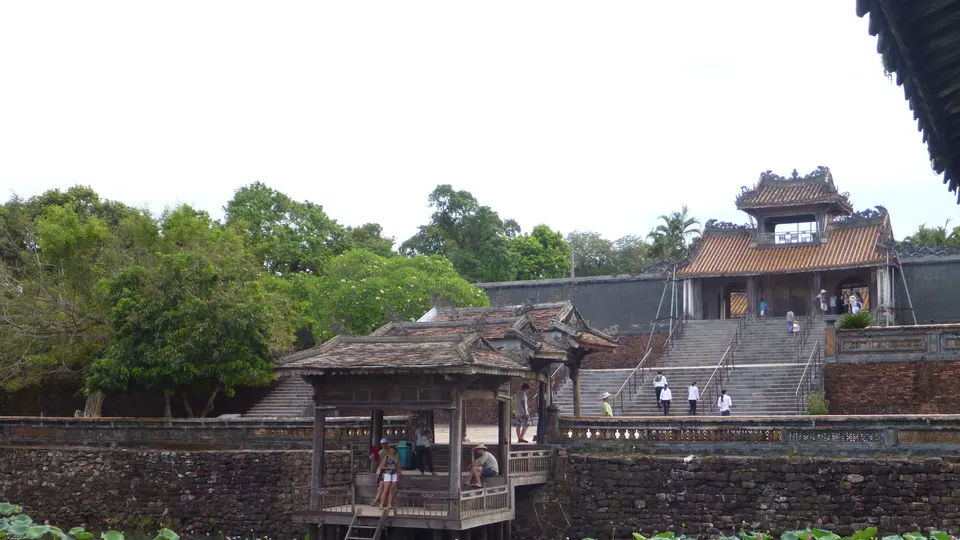
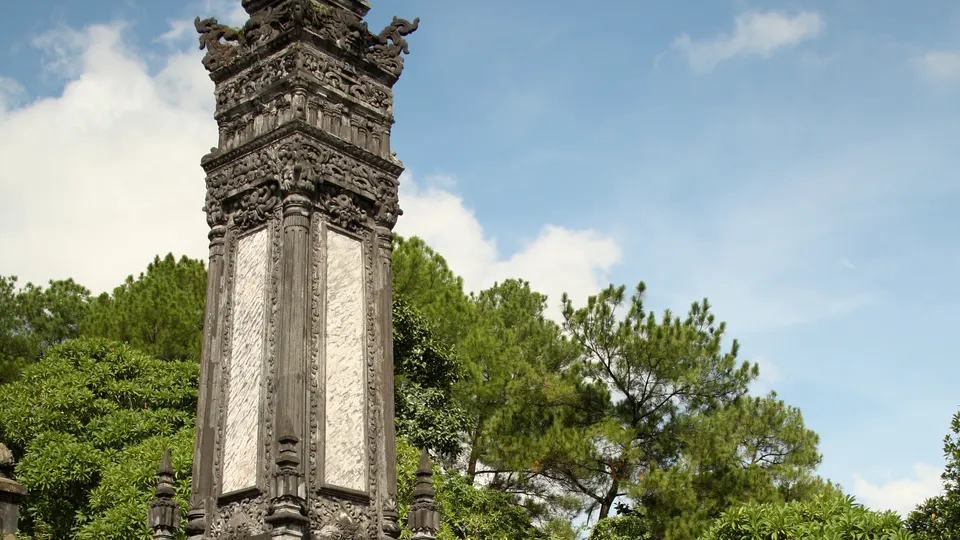
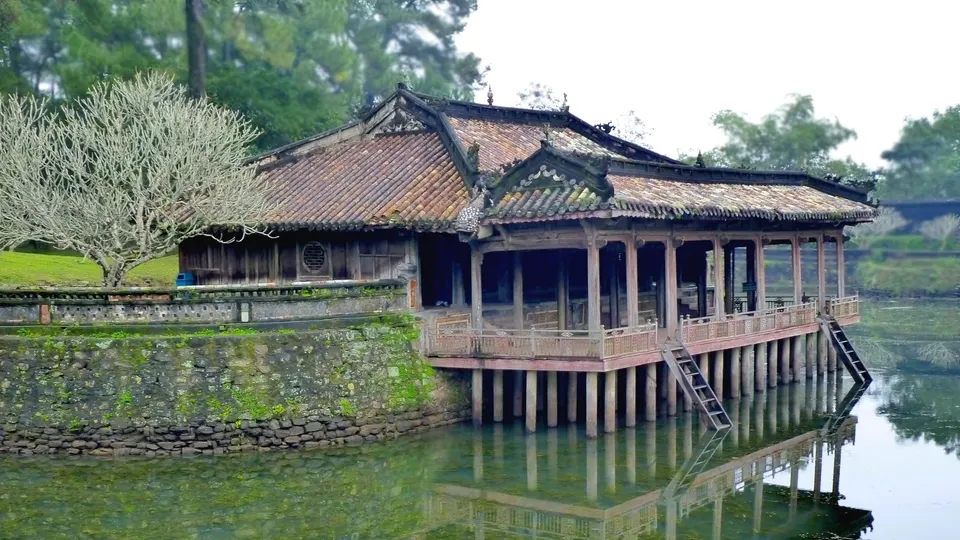
What you see. Nearly 50 buildings, almost all with “Khiem” (modest) in their names, are set around the Luu Khiem (Lưu Khiêm) lake in a narrow valley of pine hills. Two wooden pavilions stand over the water, where the emperor rested, read and wrote poetry, VNAT says. Behind the palace hall is the Minh Khiem (Minh Khiêm) theatre, which the city portal calls one of the oldest theatres still standing in Vietnam. Further on, a stele pavilion holds a stone of about 20 tonnes inscribed with 4,935 characters: the emperor’s own account of his life, the only stele an emperor wrote for himself, and a national treasure since 2015.
The burial question. The walled tomb you see is widely described as symbolic. Vietnam Airlines’ guide says the emperor’s real burial place is unknown, and VNAT repeats the old rumour that he was buried elsewhere to protect his treasures. Treat it as a story, not a fact.
Who it suits. Visitors who like water, trees and a slower pace, and anyone with limited time, since it is the closest of the three to the city. Vietnam Airlines’ guide suggests at least an hour, and one and a half to two hours for a relaxed visit. It is also the busiest, so go early or late. If Hue’s court culture interests you, the same refined taste shows in the city’s royal cuisine and small cakes.
Is Khai Dinh’s tomb worth it?
Yes, as long as you know it is the odd one out. Khai Dinh’s tomb is a single compact block climbing the slope of Chau Chu (Châu Chữ) mountain, 117 by 48.5 metres and 127 steps high, according to the city portal. Work started in 1920 and was finished in 1931 under his successor Bao Dai (Bảo Đại), the last emperor, six years after Khai Dinh’s death.
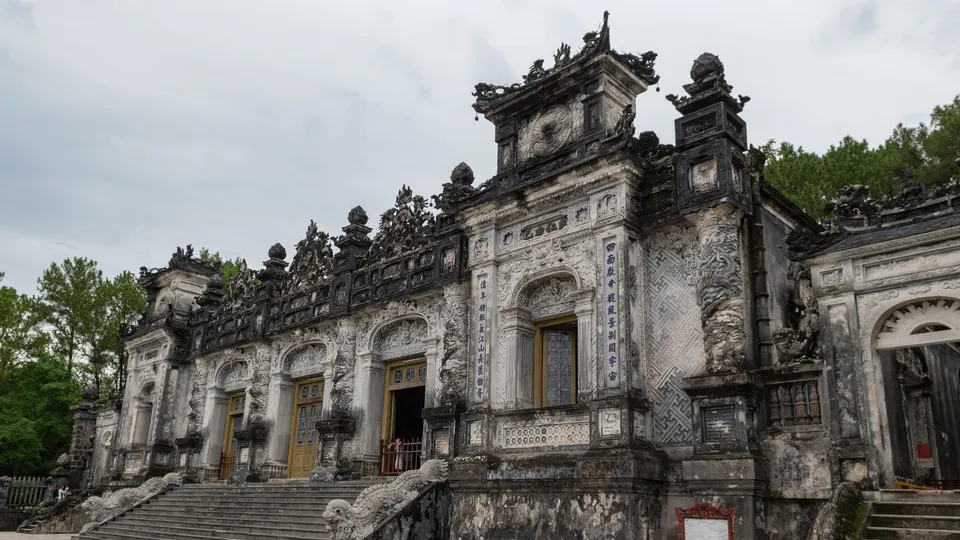
Why it looks different. It is built of reinforced concrete, with iron, steel, cement and slate tiles brought from France and porcelain and coloured glass from China and Japan, the portal says. VNAT describes a mix of Chinese, Vietnamese, French and Cambodian influences; the white concrete has turned dark grey with time, which gives the exterior its brooding look. Khai Dinh was seen as eccentric and was criticised by nationalists for his closeness to the French, and the tomb is often read as a portrait of that era.
Inside Thien Dinh. The top hall, Thien Dinh (Thiên Định), is the reason to climb. Its walls, columns and ceilings are covered in mosaic made from broken porcelain and coloured glass, the ceiling is painted with nine dragons in clouds, and a bronze statue of the emperor, cast in France, sits on a throne above the grave (Vietnam Airlines).
Who it suits. Anyone short of time (it is one building, not a park), photographers, and visitors who want a view: VNAT suggests looking back from the road beyond the tomb for the panorama. It is the least suitable for anyone who struggles with stairs, and it closes at 5 pm.
Are Gia Long, Dong Khanh and Thieu Tri worth adding?
Yes, for different reasons, and none of them is a substitute for the main three on a first visit. VNAT’s guide covers seven Nguyen tombs, and says Gia Long alone needs a full morning or afternoon (VNAT).
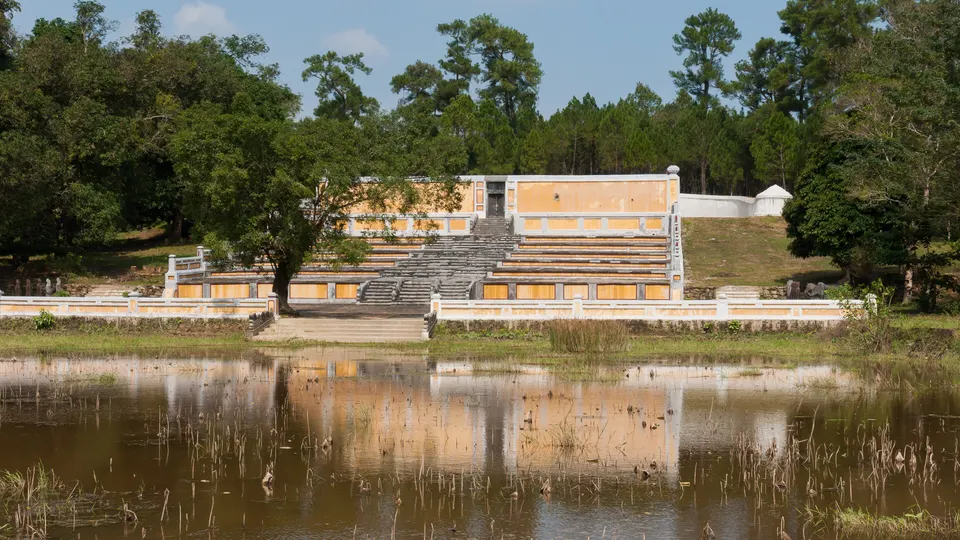
Gia Long, the founder. The first Nguyen emperor’s tomb was built from 1814 to 1820, after the death of his queen, Thua Thien Cao; the two lie side by side in identical plain stone tombs on a hilltop, according to the city portal. The setting is the point: 42 hills, lakes and pine forest, with no great pavilion or citadel. It is the remotest of the main tombs, about 16 km from the city by VNAT’s count and about 20 km by the portal’s, on the west bank. Cars reach a wharf and the last stretch involves a short crossing; motorbikes and bicycles can use a pontoon bridge, and boats come by river, VNAT and Vietnam Coracle explain. Vietnam Coracle, a travel site that has visited since 2009, describes it as “seldom visited and largely forgotten”. Tickets are 150,000 dong for adults; children enter free.
Dong Khanh, the add-on. A short walk past Tu Duc, Dong Khanh’s tomb was built across four reigns, from 1888 to 1923, the only Nguyen tomb to take that long, the city portal says. Its temple, Ngung Hy (Ngưng Hy), has glazed terracotta roofs and fine gilded lacquer inside, and the decoration mixes Vietnamese and Western styles. It reopened after restoration in January 2022. At 100,000 dong, or 200,000 dong with Tu Duc on a two-site ticket, it is the easiest extra.
Thieu Tri, the quiet one. Minh Mang’s son and successor has the only royal tomb not enclosed by a wall. VNAT calls it probably the least visited of the accessible tombs and notes that much of it lies in ruin. The ticket is 50,000 dong, and children enter free.
Which ticket or combined pass should you buy in 2026?
Count your sites first. Single prices have not changed since the fee schedule of 2022, and from early 2026 Hue kept them and the two- and three-site route tickets, added an all-sites ticket and kept the four-site ticket, Bao Van Hoa reported (Bao Van Hoa).
| Your plan | Best ticket | Adult price | Instead of |
|---|---|---|---|
| One main tomb | Single ticket | 150,000 dong | – |
| Tu Duc + Dong Khanh | Two-site route | 200,000 dong | 250,000 dong |
| Minh Mang + Gia Long | Two-site route | 240,000 dong | 300,000 dong |
| The three main tombs, no Imperial City | Three single tickets | 450,000 dong | no tombs-only combo |
| Imperial City + two of the main tombs | Three-site route | 420,000 dong | 500,000 dong |
| Imperial City + all three main tombs | Four-site ticket | 530,000 dong | 650,000 dong |
| Four sites + Gia Long or Dong Khanh, over several days | All-sites ticket, valid 5 days | 600,000 dong | 680,000 dong or more |
Sources: Resolution 22/2022 of the People’s Council of what was then Thua Thien Hue province, a centrally governed city since 1 January 2025 (in force since 1 January 2023), for single and route prices; Bao Van Hoa and Bao Quoc Te, December 2025, for the 2026 four-site and all-sites tickets. Children aged 7 to 12 pay 100,000 dong for the four-site ticket and 120,000 dong for the all-sites ticket; under-7s are free.
Validity. Under the 2022 schedule, route tickets are valid for up to two days from purchase. The 2026 reports give five days for the all-sites ticket but do not say how long the four-site ticket lasts, so ask at the counter. Buy the combined ticket at the first site you visit and keep it with you.
Arriving by tourist train. Since early November 2026, a valid ticket on the Hue–Da Nang heritage train or the Hue–Phong Nha tourist train gives 50 percent off one visit within seven days to the Dong Khanh, Thieu Tri or Duc Duc (Dục Đức) tomb (or the Imperial City or Royal Antiquities Museum), for foreign visitors too, VietnamPlus reported on 4 November 2026. The three main tombs are not included, and the discount does not combine with other reductions.
The Imperial City. It is part of every three- and four-site ticket; our guide to Hue Imperial City tickets and how long to spend covers its hours, free days and route. If you plan to see it, decide on the ticket before your first tomb; our Hue itinerary for 1, 2 or 3 days shows where it fits.
How do you plan a half day at the tombs, and in what order?
Hire a car, taxi or motorbike for the whole loop, because the tombs are spread across the hills several kilometres apart. Start as early as you can: the sites open at 7 am, and morning is cooler and quieter. Tu Duc is nearest the city, Khai Dinh further south, and Minh Mang and Gia Long are on the west bank, across the river.
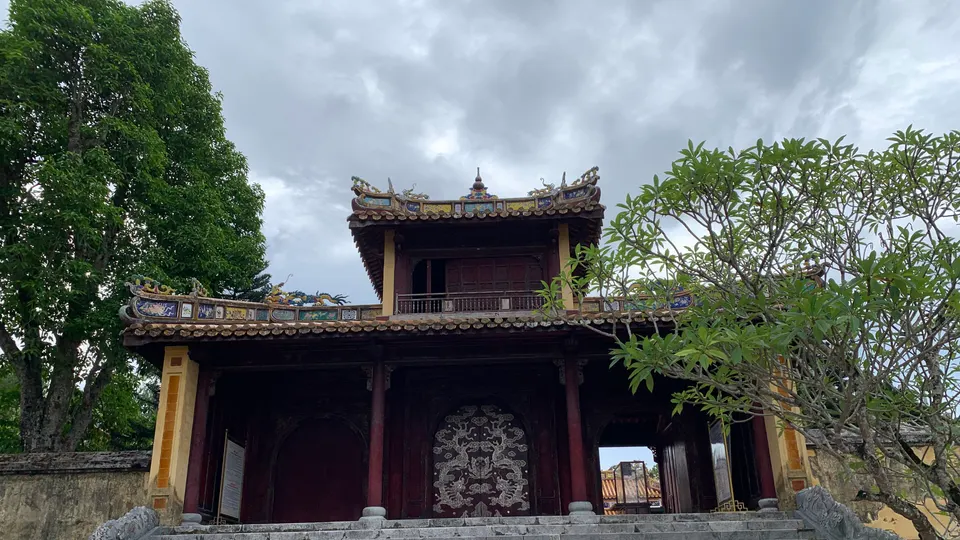
Route 1: the classic three (a long half day). Tu Duc first, then Khai Dinh, then Minh Mang. Minh Mang is about 7 km from Tu Duc and 9 km from Khai Dinh, Vietnam Airlines’ guide says, and is 20 to 30 minutes from the centre. In the afternoon, start by 1 pm and do not leave Khai Dinh until last, because it closes at 5 pm while Minh Mang and Tu Duc stay open until 5.30 pm (Vietnam Airlines’ guides, checked November 2026). If you are also visiting the Imperial City, buy the four-site ticket at the first tomb.
Route 2: two contrasts (a short half day). Minh Mang and Khai Dinh: the most classical and the most unusual. This is the pair our five-day Hue, Hoi An and Da Nang plan suggests on the morning before the transfer south.
Route 3: close to town (a relaxed morning). Tu Duc, Dong Khanh and Thieu Tri, which lie close together. Buy the Tu Duc and Dong Khanh two-site ticket (200,000 dong) and a single for Thieu Tri (50,000 dong), as the official fee schedule lists them (Resolution 22/2022).
Route 4: first and grandest (a full morning or afternoon). Minh Mang and Gia Long on the west bank, on the 240,000 dong two-site ticket. Agree with your driver beforehand how to reach Gia Long, and allow extra time for the last stretch. Both tombs can also be reached by boat on the Perfume River, the city portal says; our Perfume River boat trip guide explains how slow that is and what to agree with the boat owner.
Lunch and evening. Vietnam Airlines’ guide warns that there are few places to eat near Minh Mang, so bring water and snacks, or plan lunch in town between two shorter routes; two south-bank restaurants recommended by the press and the city portal are listed below, and our guide to where to eat in Hue groups more places by area. After a day of tombs, an evening of Hue court music and ca Hue on the river keeps you in the same world.
What mistakes do visitors make at the Hue tombs?
Most come from treating the tombs like one site close to town rather than separate parks spread across the hills.
- Trying to fit Gia Long into a three-tomb half day. It is 16–20 km out with a slow last stretch; VNAT says it needs a morning or afternoon on its own.
- Leaving Khai Dinh until late afternoon. It closes at 5 pm, half an hour before Minh Mang and Tu Duc, on Vietnam Airlines’ guide.
- Buying the four-site ticket without visiting the Imperial City. It only pays off with the Citadel; for the three tombs alone, three single tickets (450,000 dong) are cheaper than 530,000.
- Expecting to enter the emperors’ graves. Minh Mang’s walled mound opens once a year, its great gate opened only for the coffin, and Tu Duc’s real burial place is unknown.
- Underestimating the stairs and heat. Khai Dinh is 127 steps high; in summer, start at 7 am and carry water. Dress modestly, with shoulders and knees covered, as the guides recommend for these sacred sites.
- Ignoring the rainy season. In Hue most rain falls from about September to December, when riverside sites can become hard to reach; check our weather by month and keep a spare half day.
Before you go: a short checklist
The tombs are easy once you have chosen; these steps make the half day work.
- Choose by interest: Minh Mang for order, Tu Duc for gardens, Khai Dinh for the unusual; two that contrast if you have half a day.
- Decide on the ticket before the first site: single tickets for tombs only, the four-site ticket if the Imperial City is in your plan, the all-sites ticket (five days) for three or more days of sightseeing.
- Book transport for the whole loop, and agree the route and waiting time with your driver; for Gia Long, agree how you will cross.
- Start at 7 am and put Khai Dinh before 5 pm.
- Bring water, a hat and modest clothes, and comfortable shoes for steps.
- Plan the rest of Hue around it: the Hue city guide for what you are seeing, the itinerary page for the Citadel and Thien Mu Pagoda, and our Hue to Hoi An guide if you move on afterwards.
Where to eat in Hue between tomb routes
Local favourite
Quán Tài Phú
Huế · Thuận Hóa ward (south bank, former Vĩnh Ninh)
2 Điện Biên Phủ Street
A simple south-bank restaurant of Hue home-style dishes, recommended by VnExpress in June 2026 and listed by Hue city's tourism portal for bun thit nuong; an easy lunch in town between a morning and an afternoon tomb route.
Order: Nem lui (lemongrass pork skewers) rolled in rice paper with herbs, or bun thit nuong (rice noodles with grilled pork).
Recommended by: VnExpress (2026), Khám phá Huế (Hue city tourism portal) · checked November 2026
Local favourite
Quán Hạnh
Huế · Thuận Hóa ward (south bank, former Phú Hội)
11 Phó Đức Chính Street
A south-bank restaurant that Hue city's tourism portal calls a favourite with foreign visitors, for banh khoai and other Hue dishes; VnExpress included it in its July 2025 list of restaurants travellers like in Hue.
Order: Banh khoai (a small crisp rice-flour pancake with shrimp and pork), banh beo or nem lui.
Recommended by: VnExpress (2025), Khám phá Huế (Hue city tourism portal) · checked November 2026
Addresses and details can change; check before you go. We do not accept payment for listings.
Frequently asked questions
What time do the Hue royal tombs open and close?
As of November 2026, Minh Mang and Tu Duc open daily from 7 am to 5.30 pm and Khai Dinh from 7 am to 5 pm, according to Vietnam Airlines' travel guides; Hue's city tourism portal gives 7.30 am to 5.30 pm for Dong Khanh.
Do I get a discount on Hue tomb tickets if I take the heritage train?
Only at the smaller tombs. Since early November 2026, a valid ticket on the Hue–Da Nang heritage train or the Hue–Phong Nha tourist train gives 50 percent off one visit to the Thieu Tri, Duc Duc or Dong Khanh tomb, the Imperial City or the Royal Antiquities Museum within seven days, foreign visitors included, VietnamPlus reported on 4 November 2026; Minh Mang, Tu Duc and Khai Dinh are not on the list.
How long should I spend at Tu Duc's tomb?
At least an hour, and one and a half to two hours for a relaxed walk round the lake and pavilions, Vietnam Airlines' guide suggests. Go in the morning, because Tu Duc is the closest tomb to Hue and the busiest.
Is there anywhere to eat near Minh Mang's tomb?
Not much: Vietnam Airlines' guide says there are few restaurants near Minh Mang, only drink stalls at the gate. Bring water and snacks, or eat in Hue between two shorter tomb routes.
Do I need a guide at the Hue tombs?
No, but it helps. Vietnam Airlines' guides say an audio guide costs 50,000 dong at the ticket counters of Minh Mang and Tu Duc; without one, the tomb descriptions in this guide cover the main buildings.
Key sources
- Nghị quyết 22/2022/NQ-HĐND: mức thu phí tham quan di tích lịch sử văn hóa trên địa bàn tỉnh Thừa Thiên Huế (official fee schedule) · Hội đồng nhân dân tỉnh Thừa Thiên Huế (People's Council), in force 1 January 2023
- Mở rộng đối tượng miễn, giảm phí tham quan di tích Huế từ năm 2026 · Báo Văn Hóa, 27 December 2025
- Vé tham quan di sản Huế: Đắt hay xứng đáng từng đồng? · Tuổi Trẻ, 15 August 2025
- Complex of Hué Monuments · UNESCO World Heritage Centre
- Tomb of Minh Mang (Hieu Mausoleum) · Khám phá Huế (Hue city tourism portal)
- Tomb of Tu Duc (Khiem Mausoleum) · Khám phá Huế (Hue city tourism portal)
- Lăng Khải Định · Vietnam Airlines travel guide, checked 9 November 2026
- Cẩm nang khám phá các lăng tẩm Huế (guide to the Hue tombs) · Vietnam National Authority of Tourism (vietnam.travel)
All 20 sources and further reading
- Huế mở rộng đối tượng miễn, giảm phí tham quan di tích lịch sử văn hóa từ năm 2026 · Báo Quốc tế, 28 December 2025
- Tomb of Khai Dinh (Ung Mausoleum) · Khám phá Huế (Hue city tourism portal)
- Tomb of Gia Long Emperor (Thien Tho Mausoleum) · Khám phá Huế (Hue city tourism portal)
- Tomb of Dong Khanh (Tu Mausoleum) · Khám phá Huế (Hue city tourism portal)
- Lăng Minh Mạng · Vietnam Airlines travel guide, checked 9 November 2026
- Lăng Tự Đức · Vietnam Airlines travel guide, checked 9 November 2026
- Explore the 3 most visited Emperor's tombs in Hue · Vietnam National Authority of Tourism (vietnam.travel)
- Tomb of Gia Long · Vietnam National Authority of Tourism (vietnamtourism.vn)
- Tomb of the First Emperor: Gia Long · Vietnam Coracle, last modified 22 December 2024
- Huế giảm 50% vé tham quan di tích cho khách đi tàu hỏa di sản · VietnamPlus, 4 November 2026
- 7 quán ăn ngon, món truyền thống được gợi ý ở Huế · VnExpress, 21 June 2026
- 10 nhà hàng được du khách yêu thích tại Huế · VnExpress, 5 July 2025
Keep exploring
 Central Vietnam · Travel Hue (Huế): How Many Days, What to See, 2026 Tickets How many days Hue needs, which Citadel sights and royal tombs to pick, 2026 ticket prices, the flood months to avoid and where to eat in the old royal capital.
 Central Vietnam · Travel Hue (Huế) in 1, 2 or 3 Days: Itineraries and Tickets Hue in 1, 2 or 3 days: what to see in each, the order that works, 2026 ticket prices and combined passes, opening hours, festival seasons and flood months.
 Central Vietnam · Travel Hue, Hoi An and Da Nang in 5 Days: Route, Train, Tickets Five days in Hue, Hoi An and Da Nang: which way round, where to sleep, heritage train times, Hue's 600,000 VND 5-day ticket and the November flood risk.
 Central Vietnam · Food Hue (Huế) Royal Cuisine: What to Eat and Where to Try It Hue royal cuisine explained: what Nguyen court cooking was, how banh beo, banh nam and banh bot loc differ, and when 2026 palace banquets ran in Hue.